Financial Planning Andrew Schaetzke, CFP® Financial Planning Andrew Schaetzke, CFP®

Important Financial Planning Numbers For 2026

By Senior Advisor Andrew Schaetzke, CFP®.

As you look ahead to 2026, it’s easy to feel overwhelmed by all the new financial and tax updates. To make things simpler, we want to highlight the key numbers to keep on your radar this year, including:

  • Updated tax rates and brackets for federal income, capital gains, Social Security, and estate taxes

  • Changes to deductions, exemptions, and available tax credits

  • New contribution limits for retirement plans (401(k), 403(b), IRA, SIMPLE IRA) and Health Savings Accounts (HSAs)

  • Required minimum distribution (RMD) rules for tax-deferred retirement accounts

  • Medicare premiums and IRMAA thresholds

To support your planning, we’ve included a helpful reference guide below. And as always, our team is here to walk with you through every step of your financial journey. If any of these updates raise questions for you or your family, please reach out to us—we’re here to help.

Please click on the images below to view the PDF.


Important Disclosure Information & Sources:

This resource was created by fpPathfinder. SJS pays an annual subscription in order to license resources from fpPathfinder.

There is no guarantee investment strategies will be successful. Past performance is no guarantee of future results. Diversification neither assures a profit nor guarantees against a loss in a declining market.

Advisory services are provided by SJS Investment Services, a registered investment advisor with the SEC. Registration does not imply a certain level of skill or training. SJS Investment Services does not provide legal or tax advice. Please consult your legal professional or tax professional for specific advice.

Read More
Financial Planning, Investing Andrew Schaetzke, CFP® Financial Planning, Investing Andrew Schaetzke, CFP®

From Capitol Hill to Main Street: How the Big Beautiful Bill Impacts Your Business

As we discussed in our last blog post, Congress passed the long-anticipated One Big Beautiful Bill Act (OBBBA). True to its name, this legislation covers a wide range of tax and financial provisions. And for business owners in particular, the impact is meaningful [1].

By Senior Advisor Andrew Schaetzke, CFP®

As we discussed in our last blog, Congress passed the long-anticipated One Big Beautiful Bill Act (OBBBA). True to its name, this legislation covers a wide range of tax and financial provisions. And for business owners in particular, the impact is meaningful [1].

We know new legislation brings new questions. That’s why we’ve cut through the fine print and highlighted the updates that matter most for business owners and entrepreneurs. Here are some of the most important features of the bill:

  • The 20% deduction for Qualified Business Income (QBI) under Section 199A is now permanent for pass-through entities. This includes expanded phase-out thresholds for service businesses—and even a $400 minimum deduction for those with at least $1,000 in QBI [6].

    Why it matters: This offers long-term planning clarity for LLCs, S Corps, partnerships, and sole proprietors—especially those concerned about prior sunset provisions.

  • The rules for Qualified Small Business Stock (QSBS) under Section 1202 just became more flexible—and more favorable.

    • 50% of gains are excluded if the stock is held for 3+ years

    • 75% of gains are excluded if held for 4+ years

    • 100% exclusion still applies after 5+ years

    In addition, two key thresholds have expanded:

    • The gain exclusion cap is now the lesser of 10x basis or $15 million (up from $10 million), with both figures indexed for inflation

    • Companies with up to $75 million in assets (up from $50 million) are now eligible [2]

    Why it matters: This modernized framework may make QSBS more accessible and more beneficial for founders, early-stage investors, and business owners considering equity-based succession strategies. The new tiered holding periods also allow for partial exclusions on shorter timelines—a notable change from the traditional 5-year requirement.

  • Starting January 19, 2025, 100% bonus depreciation is back for non-real property. The prior phase-down schedule is scrapped [2].

    Why it matters: This allows businesses to immediately write off the full cost of qualifying assets, boosting after-tax cash flow and incentivizing investment.

  • 100% bonus depreciation now extends to certain production and refining facilities—split proportionally between operational and administrative areas [4].

    Why it matters: Capital-intensive industries may see significant tax savings, particularly when upgrading or expanding plant infrastructure.

  • Section 179 limits increased to $2.5 million, with phase-outs starting at $4 million [2].

    Why it matters: Small and mid-sized businesses have more flexibility to expense capital investments—without worrying about hitting outdated limits.

  • Domestic research and experimentation costs no longer require amortization, reverting to pre-2017 rules. Businesses may also retroactively expense R&D costs dating back to 2021. (Note: Foreign R&D still requires 15-year amortization.) [3][4]

    Why it matters: This is a major win for innovative companies—especially those in engineering, technology, and manufacturing—who have been burdened by post-TCJA amortization rules.

  • Corporations may now only deduct charitable contributions above 1% of taxable income, though the existing 10% cap remains. Unused deductions can be carried forward [3].

    Why it matters: This change could alter how C corporations structure philanthropic commitments—especially those with lower taxable income.

  • The excess business loss limitation is no longer temporary. Carryforward rules are clarified and locked in, adding predictability [2].

    Why it matters: Business owners facing irregular income years will need to plan carefully—but the permanence of the rule helps with long-term modeling.

  • The pass-through entity tax (PTET) strategy—where states allow entities to pay income tax at the business level—remains intact [2].

    Why it matters: This is still a viable workaround for state and local tax (SALT) deduction caps, especially in high-tax jurisdictions.

  • The interest expense limitation is now permanently based on EBITDA, rather than EBIT [2].

    Why it matters: This provides more flexibility for capital-intensive businesses, especially those leveraging financing to fund growth.

  • Employee Retention Credit (ERC) claims for Q3 and Q4 of 2021 can no longer be filed after January 31, 2024 [4].

    Why it matters: If you missed the deadline, no further claims can be submitted. If you filed already, consult your tax advisor on potential audit exposure.

  • The Opportunity Zone program is now permanent, with a rolling 10-year designation window starting in 2027 [2][5].

    Why it matters: This helps create more long-term predictability for tax-deferred (or tax-free) investing in designated areas—potentially aligning with broader growth or real estate strategies.

So What Does This Mean for Business Owners?

Whether you're operating a closely held business, running multiple entities, or preparing for a transition, the long-term clarity in this bill creates real planning opportunities.

From expanded deductions and restored expensing rules to clear guidance on loss limitations and investment incentives, OBBBA offers a more stable tax planning environment.

We’re Here to Help You!

If you’re wondering how these updates may affect your business or personal financial plan, let’s talk. Your SJS advisor is ready to collaborate with your CPA or legal team to help you structure decisions around these new provisions—strategically, and in sync with your broader goals.


Important Disclosure Information & Sources:

  1. H.R.1 - One Big Beautiful Bill Act”. 119th Congress, 01-Jul-2025, congress.gov.

  2. Mayer Brown, “One Big Beautiful Bill Act Introduces Significant Domestic and International Tax Changes” July 9, 2025.

  3. RSM US, “New Tax Law Introduces Big Changes for Exempt Organizations,” July 14, 2025.

  4. Doeren Mayhew, “Breaking Down ‘The One, Big, Beautiful Bill Act,’” June 10, 2025.

  5. Bi-Pacific (BIPC), “One Big, Beautiful Bill … Simplified,” July 2025.

  6. Tax Foundation, “199A Deduction: Pass-Through Business | Big Beautiful Bill,” June 2025.

There is no guarantee investment strategies will be successful. Past performance is no guarantee of future results. Diversification neither assures a profit nor guarantees against a loss in a declining market.

Advisory services are provided by SJS Investment Services, a registered investment advisor (RIA) with the SEC. Registration does not imply a certain level of skill or training. SJS Investment Services does not provide legal or tax advice. Please consult your legal or tax professionals for specific advice.

Statements contained in this article that are not statements of historical fact are intended to be and are forward looking statements. Forward looking statements include expressed expectations of future events and the assumptions on which the expressed expectations are based. All forward looking statements are inherently uncertain as they are based on various expectations and assumptions concerning future events and they are subject to numerous known and unknown risks and uncertainties which could cause actual events or results to differ materially from those projected.

Read More
Investing Kirk Ludwig, CFIP, AIF® Investing Kirk Ludwig, CFIP, AIF®

Walking the Tightrope: The Fed, the Market, and Your Bonds

Interest rates don’t always make headlines, but when they do, they tend to shake everything else. That’s because rates sit at the heart of the economy: they influence borrowing costs, savings yields, and business investment.

By Senior Advisor, Director of Institutional Investment Management Kirk Ludwig, AIF®.

Interest rates don’t always make headlines, but when they do, they tend to shake everything else. That’s because rates sit at the heart of the economy: they influence borrowing costs, savings yields, and business investment. When rates rise, borrowing slows down and saving money becomes more attractive. When rates fall, money moves more freely, boosting spending and growth. The Federal Reserve adjusts short-term interest rates to keep this balance in check - more like walking a tightrope than pulling a lever. One wrong step, and they risk leaning too far in either direction.

Lately, that balancing act has gotten tougher. One day, markets are reacting to sticky inflation. The next, it’s fears of slowing growth (i.e., recession). Economic data keeps shifting, headlines flip week to week, and forecasts feel outdated the moment they’re made. With so much in flux, the Fed held interest rates steady at its last meeting, opting to wait for more clarity. Tariffs could end up raising prices and slowing growth at the same time - a combination economists refer to as stagflation. It’s not a word we throw around lightly, but it explains why the Fed isn’t rushing into a decision.[1] Sometimes, staying put is the most thoughtful move.

It’s a challenging environment for policymakers, but it’s just as noisy for investors. And in times like these, clarity isn’t the most realistic goal. Preparation is.

That’s why, at SJS, we don’t try to guess the next move. We focus on building portfolios that can withstand evolving markets. Our fixed income strategy (bonds) is designed for a wide range of outcomes:

  • Short-duration bonds to help in an environment where prices stay elevated and yields potentially rise.

  • Inflation-protected bonds to assist in times of unexpected or prolonged inflation.

  • Longer maturity holdings that benefit if growth slows and yields fall.

  • A diversified mix of credit bonds, including investment-grade corporate bonds, as well as selectively-chosen high yield bonds and private credit to capture higher yields.

We don’t build portfolios to match the news. We build them to withstand it.

We’ve seen many economic cycles. Each one brings its own uncertainty, but this one feels especially dynamic. With so many moving parts, the outcome may look very different from what anyone expects. That’s why we don’t build portfolios around predictions; rather we build them to adapt. Time and again – we believe thoughtful diversification, discipline, and a clear process prove more effective than chasing headlines.

So yes, the Fed may be walking a tightrope. And yes, markets may stay moody.

But your bond portfolio? That should stay steady.


Important Disclosure Information & Sources:

[1] “Federal Open Market Committee”. Board of Governors of the Federal Reserve System, federalreserve.gov.  

There is no guarantee investment strategies will be successful. Past performance is no guarantee of future results. Diversification neither assures a profit nor guarantees against a loss in a declining market.

MarketPlus® Investing models consist of institutional quality registered investment companies. Investment values will fluctuate, and shares, when redeemed, may be worth more or less than original cost.

Statements contained in this report that are not statements of historical fact are intended to be and are forward looking statements. Forward looking statements include expressed expectations of future events and the assumptions on which the expressed expectations are based. All forward looking statements are inherently uncertain as they are based on various expectations and assumptions concerning future events and they are subject to numerous known and unknown risks and uncertainties which could cause actual events or results to differ materially from those projected.

Read More
Financial Planning Scott Savage Financial Planning Scott Savage

How Much Is Too Much? Reflections from "Next Generation Philanthropy"

At SJS Investment Services, we’re always looking for fresh perspectives on wealth and how it impacts families, communities, and future generations. On March 11, we attended an event at the Toledo Museum of Art’s Glass Pavilion, Next Generation Philanthropy: Purpose, Not Privilege, featuring a conversation between Kristen Keffeler, author of The Myth of the Silver Spoon and Aly Sterling Philanthropy.

At SJS Investment Services, we’re always looking for fresh perspectives on wealth and how it impacts families, communities, and future generations. On March 11, we attended an event at the Toledo Museum of Art’s Glass Pavilion, Next Generation Philanthropy: Purpose, Not Privilege, featuring a conversation between Kristin Keffeler, author of The Myth of the Silver Spoon and Aly Sterling Philanthropy.

Kristin’s viewpoint challenged common narratives around inherited wealth and offered valuable insights on how the next generation—often receiving resources they didn’t earn—can redefine their relationship with money. She highlighted the emotional complexities that come with affluence, from identity struggles to the pressures of navigating financial privilege.

Kristin’s insights sparked a powerful conversation for us at SJS: How much is too much? People’s relationships with money exist on a spectrum. Some cling to it, always wanting more, yet never feeling like they have enough. Others see money as impermanent, freeing themselves from its grip. Most of us fall somewhere in between, navigating wealth with both ambition and uncertainty.

So how do we redefine wealth in a way that feels balanced and meaningful? A few takeaways from the event stood out:
💡 Money vs. wealth – Money is a tool, but real wealth is about purpose, connection, and values.
💡 The power of mindset – Shifting from fear to creativity and generosity can transform our relationship with wealth.
💡 Family conversations matter – Talking openly about money, privilege, and responsibility can help the next generation navigate wealth in a healthy way.

Kristin’s book, The Myth of the Silver Spoon, explores these themes further—offering a guide for families, advisors, and the rising generation looking to navigate the complexities of wealth with confidence and purpose. Whether you’re building a financial legacy or supporting clients in their journey, we recommend this book as a powerful resource for redefining what wealth really means.

At SJS Investment Services, we believe in fostering open, thoughtful conversations about wealth and legacy. If these ideas resonate with you, let’s start the conversation.


Disclosures: Advisory services are provided by SJS Investment Services, a registered investment advisor (RIA) with the SEC. Registration does not imply a certain level of skill or training. SJS Investment Services does not provide legal or tax advice. Please consult your legal or tax professionals for specific advice.

Statements contained in this report that are not statements of historical fact are intended to be and are forward looking statements. Forward looking statements include expressed expectations of future events and the assumptions on which the expressed expectations are based. All forward looking statements are inherently uncertain as they are based on various expectations and assumptions concerning future events and they are subject to numerous known and unknown risks and uncertainties which could cause actual events or results to differ materially from those projected.

Read More
SJS Outlook Scott Savage SJS Outlook Scott Savage

SJS Outlook: Q4 2023

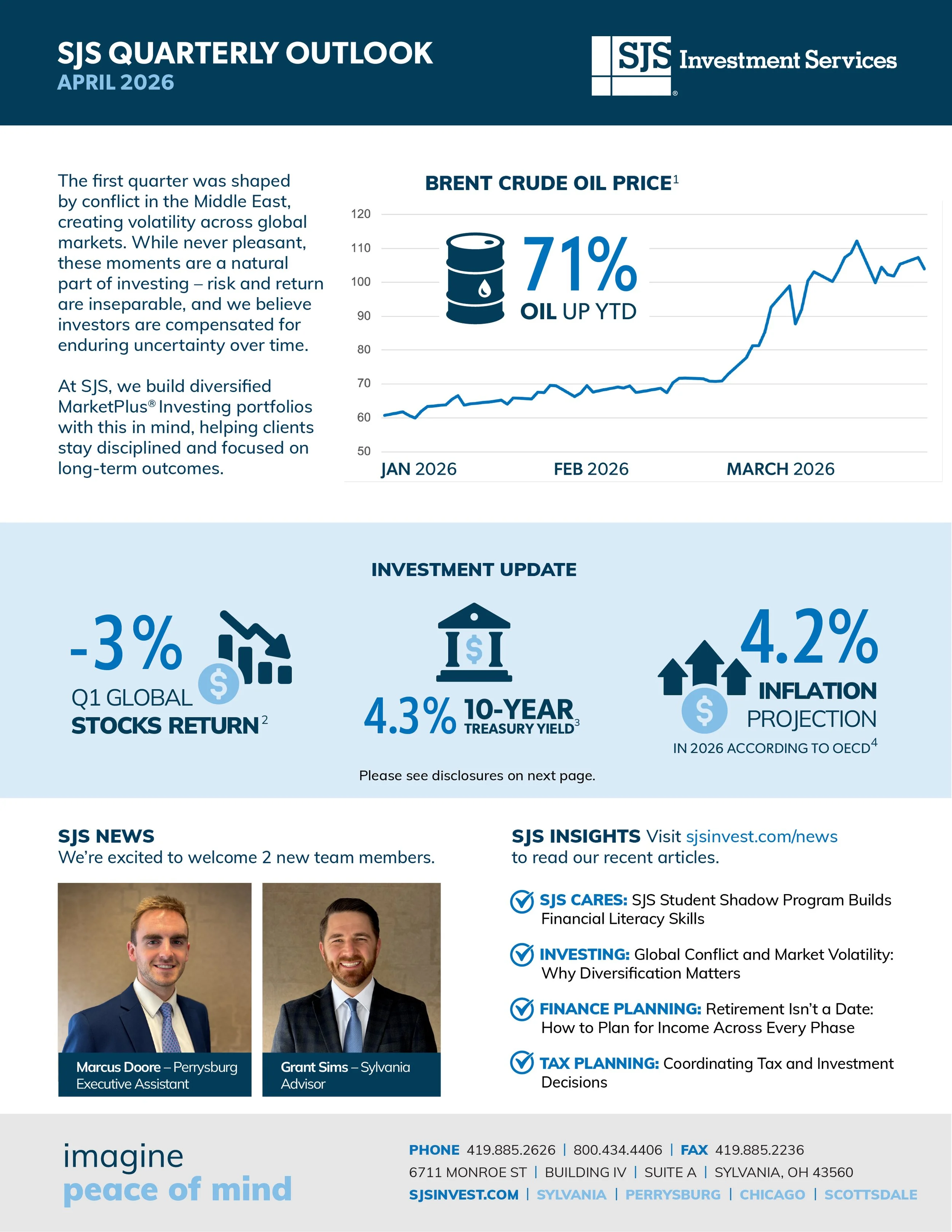
The SJS Q4 2023 Outlook includes our insights on small town values, MarketPlus® Investing, and planning financially for the new year. We also highlight new SJS Team members and look forward to Q1 2024.


Suggested Reading


Read More