
Stay On Target
By Chief Investment Officer Tom Kelly, CFA
Every January, Wall Street releases its newest flurry of S&P 500 year‑end predictions. And inevitably, we’re asked where we think the market is headed. At SJS, we certainly have opinions, but we don’t publish short-term market forecasts or build client portfolios around them. Because, quite simply, no one knows where markets will land. Not us, not the loudest voices on TV, and not even the banks that publish those targets with great confidence.
Last year offered a perfect reminder of this. Across various sources from surveys by Bloomberg reporters, market strategists on average began the year expecting the S&P 500 Index to finish at 6,614. By May, after tariff volatility and markets already fell, they slashed their estimates 11.5% from the start - a little late. As the market rose, conveniently so did their year-end price targets, looking more like followers than forecasters. The S&P 500 ended up 17% higher than the low prediction point, which you would have missed if you were a lemming.[1]
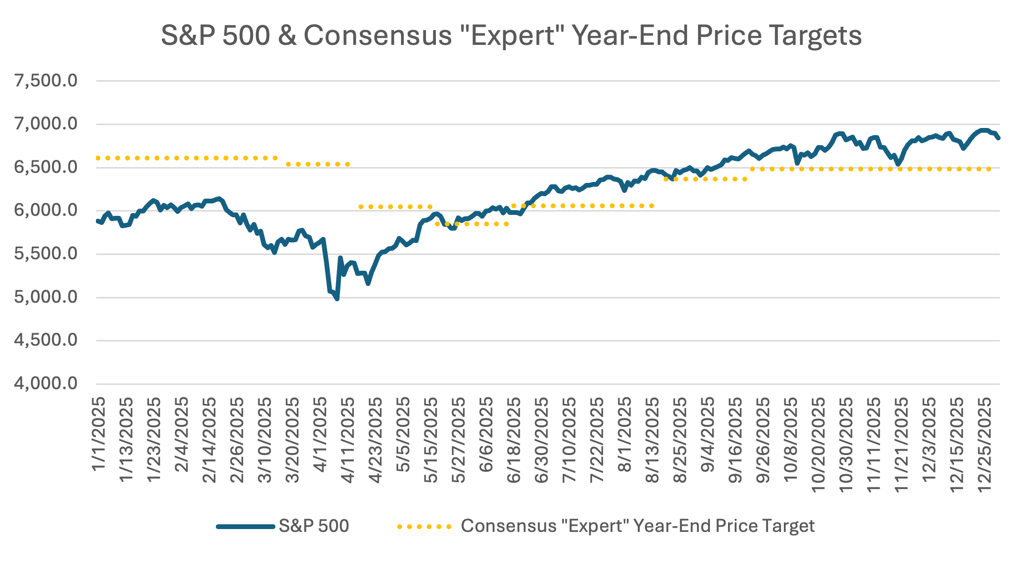
Source: SJS Investment Services, Morningstar, Bloomberg.[1] The S&P 500 Index is a free float-adjusted market-capitalization-weighted index of 500 of the largest publicly traded companies in the United States. The index performance figures assume the reinvestment of all income, including dividends and capital gains. The average year-end price target for the S&P 500 Index is compiled from a survey of Wall Street strategists by Bloomberg reporters. Forecasts contained herein are for illustrative purposes only, may be based upon proprietary research and are developed through analysis of historical public data. Past performance is no guarantee of future results. See Important Disclosure Information.
This pattern is familiar. When conditions get tough, predictions often move after the fact. Not a single major investment bank we’ve seen currently expects the market to finish 2026 lower, even though historically, US stock markets decline in about a quarter of all calendar years.[2] However, we think they’ll adjust their forecasts down the time the going gets tough.
This is why, at SJS, our attention stays firmly on what actually matters: your goals, your plan, and the elements of wealth management you can truly control. That’s the heart of our MarketPlus® Investing approach, relying on science and structure rather than speculation.
So as the headlines debate targets and pundits adjust their outlooks, we’ll continue focusing on what brings you peace of mind: clear planning, purposeful investing, and a partner who walks with you through the ups and downs. Now that’s a target worth hitting.
Important Disclosure Information & Sources:
[1] Year-end price targets for the S&P 500 Index are sourced from the following Bloomberg news articles. The average year-end price target for the S&P 500 Index is compiled from a survey of Wall Street strategists by Bloomberg reporters. Forecasts contained herein are for illustrative purposes only, may be based upon proprietary research and are developed through analysis of historical public data.
“Wall Street Starts to Rethink Lofty S&P 500 Forecasts for 2025”. Alexandra Semenova, 10-Mar-2025, bloomberg.com.
“Stock Strategists Slash S&P Targets at Faster Pace Than in Pandemic”. Jess Menton & Farah Elbahrawy, 17-Apr-2025, bloomberg.com.
“Wall Street’s Biggest Bull Isn’t Budging on S&P 7,000 This Year”. Alexandra Semenova, 05-May-2025, bloomberg.com.
“Stock Pros See Forecasts as ‘Necessary Evil’ in Era of Policy Chaos”. Sagarika Jaisinghani & Alexandra Semenova, 15-Jul-2025, bloomberg.com.
“Wall Street Pros Race to Lift S&P 500 Targets After Record Rally”. Sagarika Jaisinghani, 10-Sep-2025, bloomberg.com.
[2] Source: Morningstar, as measured by the S&P 500 Index.
The S&P 500 Index is a free float-adjusted market-capitalization-weighted index of 500 of the largest publicly traded companies in the United States. The index performance figures assume the reinvestment of all income, including dividends and capital gains.
Past performance does not guarantee future results. Diversification neither assures a profit nor guarantees against a loss in a declining market. There is no guarantee investment strategies will be successful.
Indices are not available for direct investment. Index performance does not reflect the expenses associated with management of an actual portfolio. Index performance is measured in US dollars.
MarketPlus® Investing models consist of registered investment companies. Investment values will fluctuate, and shares, when redeemed, may be worth more or less than original cost.
Statements contained in this article that are not statements of historical fact are intended to be and are forward looking statements. Forward looking statements include expressed expectations of future events and the assumptions on which the expressed expectations are based. All forward looking statements are inherently uncertain as they are based on various expectations and assumptions concerning future events and they are subject to numerous known and unknown risks and uncertainties which could cause actual events or results to differ materially from those projected.