
SJS Book Club: Why Small Habits Matter for Investing, Retirement, and Life
By Katie Cristofoli, Molly LaClair and Jennifer Smiljanich
At SJS, we often talk about what it means to build a better life. While investing and financial planning play an important role, we know the foundation of a better life is much broader than simply making sound financial decisions. Living a more meaningful life often starts with small, consistent habits.
Recently, our SJS Book Club read Atomic Habits: An Easy & Proven Way to Build Good Habits and Break Bad Ones by James Clear. As we talked through the book together, something stood out: much of what the book emphasizes mirrors the advice we give clients every day. James Clear puts it simply: “Habits are the compound interest of self-improvement.” Small actions may feel insignificant in the moment, but over time, they can add up in powerful ways. We found ourselves reflecting not only on how we guide clients in financial planning and investing, but on how we apply these ideas in our own lives.
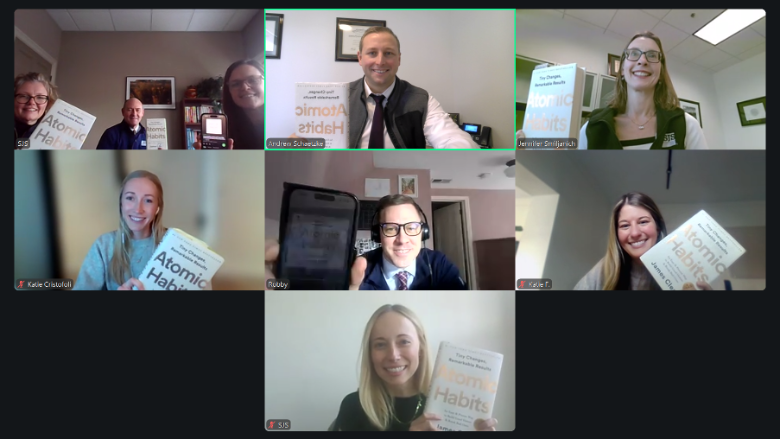
Here are a few of our takeaways:
The Power of Getting 1% Better
One of the book’s central ideas is the concept of getting just 1% better each day. If we need to make a monumental change in our life, we might think that we need to take a monumental leap to make it happen. However, this mindset can underestimate the value of steady, incremental improvement over time. And time has a way of building small changes into an impactful result.
As a team that works in investment management, we strongly relate to this idea. We know, and have seen firsthand, that long-term success rarely comes from making dramatic moves. More often, success comes from consistency and patience, over time.
Designing the Right Environment
Another key takeaway from Atomic Habits is that lasting change depends more on our environment than on motivation alone. When good behaviors are built into our surroundings, they’re more sustainable over the long term.
Small changes to our daily environment can have considerable impact. Preparing in advance and setting up systems can make good decisions easier. Whether it’s laying out your clothes the night before for a morning workout or keeping healthy foods easily accessible, small changes help remove friction and unnecessary obstacles to good habits.
Another way to reinforce positive behaviors (and to avoid negative ones) is through technology. Automating positive behaviors, such as scheduling monthly savings, helps create consistency without requiring effort. Conversely, setting limits on phone apps or notifications can make it easier to stay focused on what is most important. By shaping the right environment, we create conditions where good habits can compound over time.
The Connection Between Habits & Identity
Possibly one of the most powerful concepts from Atomic Habits is that habits are deeply connected to identity. How we see ourselves often shapes our actions more than we realize.
This idea is important during periods of transition, such as retirement, when a previous identity no longer fits, and new identities can be formed. As the book emphasizes, a shift in perspective can turn what feels limiting into opportunity, opening the door to new habits. For example, by reframing retirement as an opportunity to explore new passions or to focus on family, you can begin building habits that support this new identity.
Whether in your personal, professional, or financial life, lasting change often starts with how we define ourselves.
One of the most reassuring takeaways from Atomic Habits is that progress doesn’t require perfection; it just requires consistency and a commitment to start small. Good habits often feel inconvenient in the moment, while bad habits rarely do. But as James Clear reminds us, “The cost of your good habits are in the present. The cost of your bad habits are in the future.” Over time, those small choices shape outcomes in ways we can’t always see right away.
Whether it’s automating your savings, simplifying your routines, or designing your environment to support better choices, the goal isn’t to do everything at once. It’s to do something and then repeat it. When small habits compound, they don’t just help build better portfolios - they help build better lives.
Important Disclosure Information & Sources:
“Atomic Habits: An Easy & Proven Way to Build Good Habits & Break Bad Ones”. James Clear, 2018, Avery.
There is no guarantee investment strategies will be successful. Past performance is no guarantee of future results. Diversification neither assures a profit nor guarantees against a loss in a declining market.
Statements contained in this article that are not statements of historical fact are intended to be and are forward looking statements. Forward looking statements include expressed expectations of future events and the assumptions on which the expressed expectations are based. All forward looking statements are inherently uncertain as they are based on various expectations and assumptions concerning future events and they are subject to numerous known and unknown risks and uncertainties which could cause actual events or results to differ materially from those projected.
Advisory services are provided by SJS Investment Services, a registered investment advisor (RIA) with the SEC. Registration does not imply a certain level of skill or training. SJS Investment Services does not provide legal or tax advice. Please consult your legal or tax professionals for specific advice.