
530A Account (Trump Account): A New Tax-Advantaged Savings Option For Children
One of our most common discussion topics with people is: how can my family save and invest in a tax-smart way?
There are many tax-advantaged investment accounts currently, including Roth IRAs, 401(k) & 403(b) workplace retirement plans, health savings accounts (HSAs), and 529 plans for education expenses. As tax laws evolve over time, the rules can change for these accounts, and some options may be added or removed.
On July 4, 2026, a new tax-advantaged investment account was officially launched by the US government: 530A accounts, also known as Trump accounts.[1]
We dive into the details of these new accounts, who can contribute to them, available investment options, other investment accounts available for children, and whether to open a 530A account.
What Is A 530A Account?
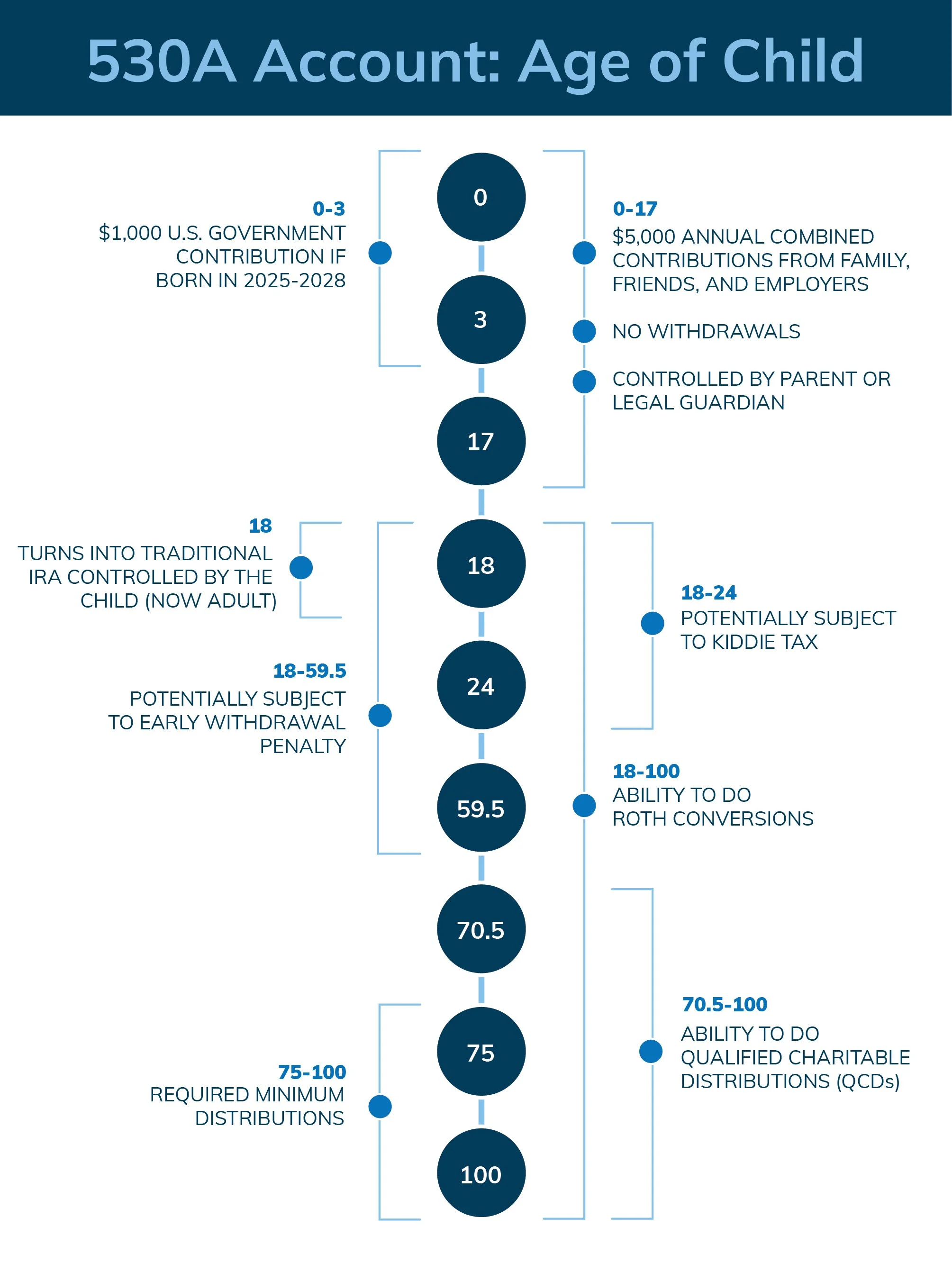
A 530A account is a retirement account for children under 18 years old. Family, friends, and employers (up to $2,500) can contribute up to $5,000 annually combined (adjusted for inflation) to the child’s 530A account, until the calendar year that the child turns age 18. The 530A account is automatically invested in a low-cost diversified U.S. stock investment, with withdrawals not allowed. While the money is in the account, no taxes are owed on investment gains.[1][2]
On January 1st of the year that the child turns age 18, the 530A account turns into a Traditional IRA, which is a tax-deferred retirement investment account that the child controls. Traditional IRAs are still designed to be invested until at least age 59.5, though they offer more investment and withdrawal flexibility.[3]
Who Can Contribute To A 530A Account?
The $5,000 annual inflation-adjusted contribution limit applies to family, friends, and employers combined. Cash contributions by an individual are subject to the aggregate gift tax annual exclusion ($19,000 in 2026), meaning contributions solely to the 530A account with no other gifts will not trigger gift tax consequences for the contributor.[4]
The U.S. government and other philanthropic donors are also able to contribute to 530A accounts in addition to the $5,000 limit. For example, for any child born in the U.S. between 2025-2028 with a valid Social Security number, the U.S. government will contribute $1,000 to the 530A account.[1] Additionally, private donors are already planning to contribute to a broader group of children.[5]
Who Controls The 530A Account?
A parent or legal guardian must create and manage the 530A account for the child by submitting Form 4547, which can be completed on the IRS website or when filing your income taxes. The parent is responsible for the account until January 1st of the year in which the child turns age 18; from then on, the account is converted to a Traditional IRA in the child’s name which the child controls.[1][2]
Are There Tax Benefits For Contributing To A 530A Account?
Individuals do not receive any income tax benefits for contributing to a 530A account. Employers can receive a tax benefit for contributions. Subject to specific rules (particularly relating to the amount of recipients), philanthropists may receive a tax deduction for contributions.[5]
Are There Any Other Tax Benefits?
While the money is in the 530A account and resulting Traditional IRA, the money grows tax-free. Income taxes are only relevant when money is withdrawn from these accounts.
Contributions by individuals (including family and friends) are considered after-tax. Based on current tax rules, when the child withdraws from the Traditional IRA, income taxes would not be applied to these after-tax contribution amounts; only the gains as well as contributions from the government and private philanthropists would be subject to income taxes. The pro-rata rule applies to withdrawals, meaning the child cannot first just withdraw the after-tax contribution amounts.[6]
When the child is age 18+, they may be able to convert some / all of the resulting Traditional IRA to a Roth IRA at a lower tax bracket. However, children under age 24 need to be aware of the kiddie tax, through which any Roth conversions or withdrawals would be subject to parents' tax rates if the child doesn’t have enough earned (work) income.[7] Roth conversions may be particularly helpful in lower income years. For any taxes owed for Roth conversions prior to age 59.5, it usually makes sense to pay these taxes using cash (out of pocket) outside of the Traditional IRA; taxes paid directly from the Traditional IRA are considered a withdrawal likely subject to income taxes and 10% early withdrawal penalty.
When Can I Withdraw From A 530A Account?
Withdrawals are not allowed from the 530A account.
Once the 530A account becomes a Traditional IRA in the year that the child turns age 18, the child may withdraw from the Traditional IRA, subject to income tax and potentially the kiddie tax if under age 24.[7] A 10% early withdrawal penalty prior to age 59.5 may also apply, with certain exceptions such as first-time homeowner, birth of a child, and disaster recovery expenses.[3]
What Are The Investment Options?
530A accounts are designed to be invested in low-cost, diversified U.S. stock investments. Currently, the default and only investment option is the State Street SPDR Portfolio S&P 500 ETF (SPYM). Four additional investment options will be available in the coming months.[8]
Once the 530A account becomes a Traditional IRA, the child can move the Traditional IRA to a custodian of their choice, which allows for a much broader investment selection.
Where Is The 530A Account Held At?
The U.S. government has hired multiple large custodians (including BNY Mellon) to securely hold the investments for 530A accounts. To make it easier, the government has created a website and app - trumpaccounts.gov - to securely access the account and make any profile & investment changes.[1]
When the 530A account becomes a Traditional IRA in the year the child turns age 18, the Traditional IRA will be held at the default custodian (currently BNY Mellon). If the child wants, they will have the ability to transfer the Traditional IRA tax-free to an eligible custodian of their choice.[1]
Are There Other Accounts I Should Consider Contributing To Instead?
530A accounts are meant to be retirement accounts that will benefit the child in the future. Family and friends may have other priorities to help the child beyond retirement, which can feel very far off in an uncertain future.
Depending on the purpose for the money, other investment accounts to consider include:[7][10][11]
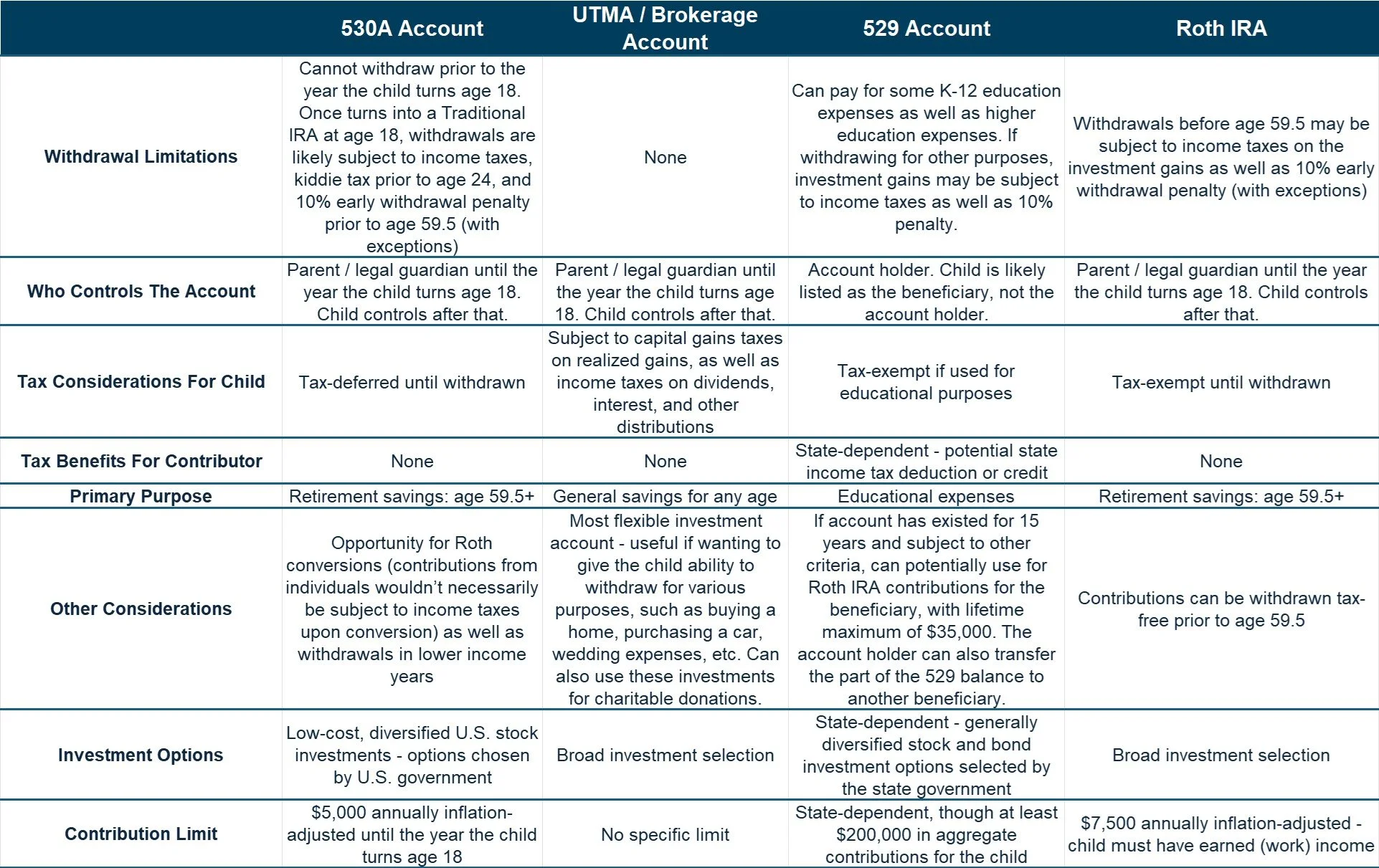
Generally, any contributions to investment accounts are subject to gift tax limits, meaning someone could only give up to $19,000 per child in 2026 across all contributions / gifts combined before being subject to the gift tax.
Should I Contribute To A 530A Account?
530A accounts are one of many options for tax-advantaged investment accounts for a child. With the ability to start a 530A account when a child is born, the primary benefit is tax-deferred expected investment growth over decades.
For illustration, consider a child born in 2026 who receives the $1,000 government contribution as well as $5,000 annual inflation-adjusted contributions from family & friends until age 18. Assuming 7% annualized investment growth and 2% annualized inflation, the 530A account and resulting Traditional IRA would grow to millions of dollars by the time the child (now adult) is age 59.5, all tax-deferred. Even accounting for after-inflation (real) returns, the account would still have $1 million+ value.
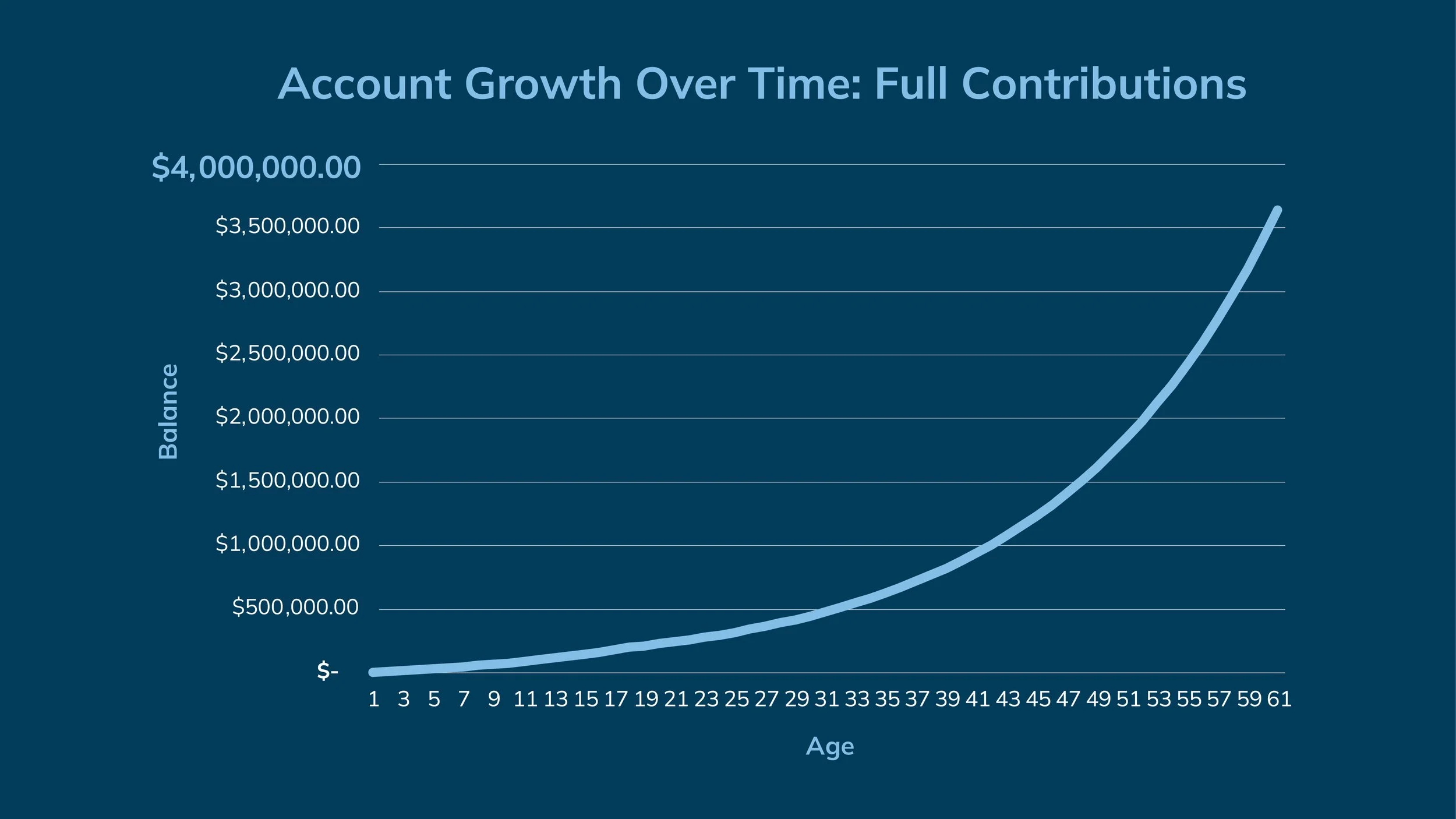
While this illustration does not consider the variability of investment returns as well as future taxes (both of which are very important considerations), it does demonstrate the power of compounding by investing early.
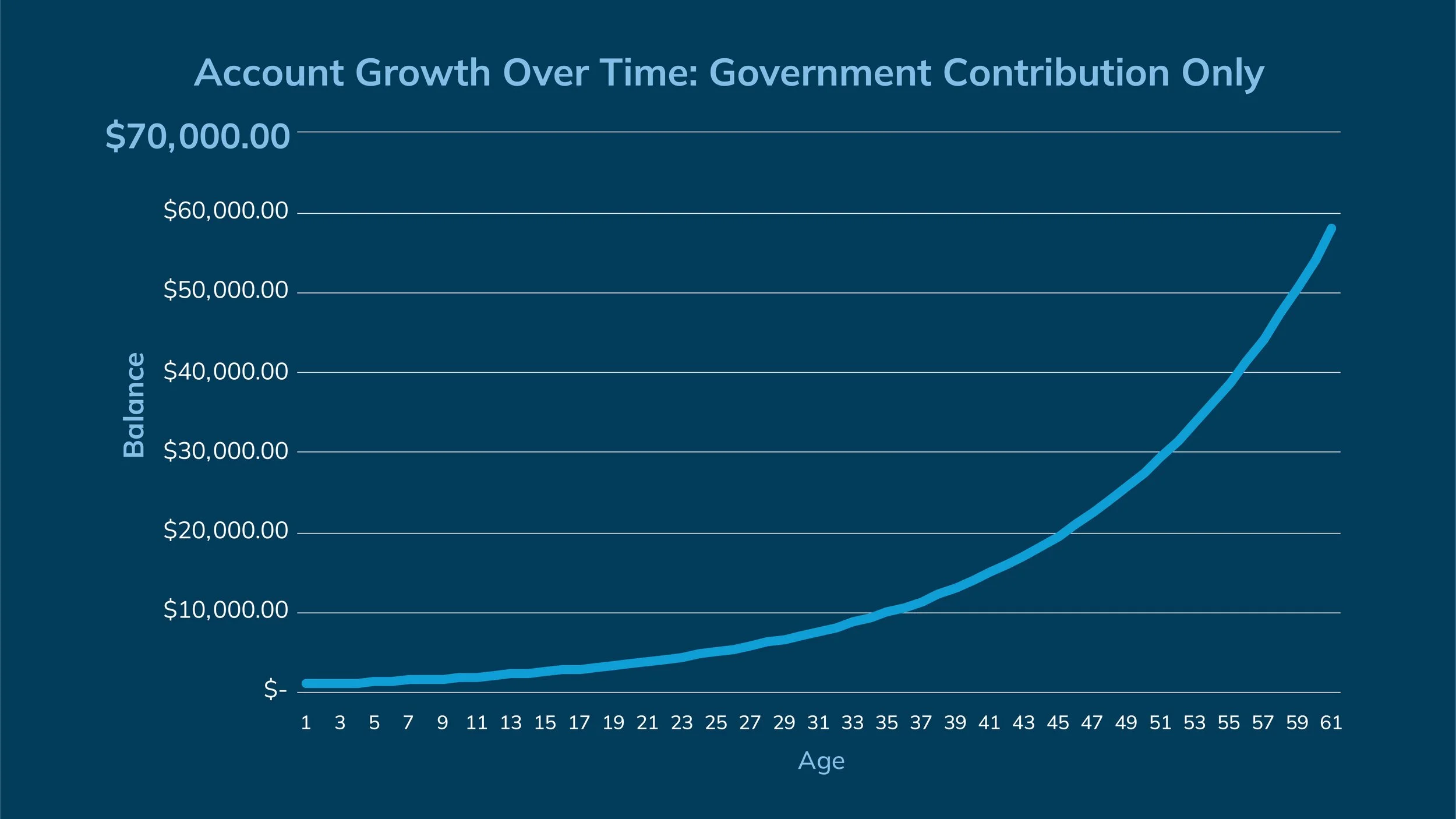
Even if a parent or legal guardian is not planning / able to to contribute to the 530A account, it may still make sense to open the account anyways in order for the child to receive any contributions from other individuals, philanthropists, or U.S. / state / local governments.
For example, for the same child born in 2026 who just receives the $1,000 government contribution with the same return and inflation assumptions, the account would grow to $50,000+ by age 59.5 ($18,000+ in inflation-adjusted value).
For a child in your life, as you are planning for various childhood expenses as well as helping to prepare for the child’s financial future, a 530A account is a new account worth keeping in mind. As always, we are here to help you think through your different priorities and create a plan to put your children in a good position now and in the future - please feel free to reach out to our team.
Important Disclosure Information & Sources:
[1] “Trump Accounts”. United States Government, July 2026, trumpaccounts.gov.
[2] “Trump Accounts”. IRS, 29-May-2026, irs.gov.
[3] “Retirement topics - Exceptions to tax on early distributions”. IRS, 11-Dec-2025, irs.gov.
[4] “Treasury, IRS provide safe harbor for certain contributions to Trump Accounts under the Working Families Tax Cuts”. IRS, 29-Jun-2026, irs.gov.
[5] “Invest America”. Invest America Charitable Foundation, July 2026, investamerica.org.
[6] “Rollovers of after-tax contributions in retirement plans”. IRS, 26-Feb-2026, irs.gov.
[7] “Topic no. 553, Tax on a child's investment and other unearned income (kiddie tax)”. IRS, 10-Jun-2026, irs.gov.
[8] “Treasury Announces Investment Lineup for Trump Accounts”. U.S. Department of the Treasury, 01-Jul-2026, treasury.gov.
[9] “What to know about the new Trump accounts for kids”. Joel Dickson, 05-Jan-2026, vanguard.com.
[10] “529 Plans: Questions and answers”. IRS, 30-Jan-2026, irs.gov.
[11] “Roth IRAs”. IRS, 30-Jan-2026, irs.gov.
There is no guarantee investment strategies will be successful. Past performance is no guarantee of future results. Diversification neither assures a profit nor guarantees against a loss in a declining market.
Advisory services are provided by SJS Investment Services, a registered investment advisor (RIA) with the SEC. Registration does not imply a certain level of skill or training. SJS Investment Services does not provide legal or tax advice. Please consult your legal or tax professionals for specific advice.
Statements contained in this report that are not statements of historical fact are intended to be and are forward looking statements. Forward looking statements include expressed expectations of future events and the assumptions on which the expressed expectations are based. All forward looking statements are inherently uncertain as they are based on various expectations and assumptions concerning future events and they are subject to numerous known and unknown risks and uncertainties which could cause actual events or results to differ materially from those projected.
There are inherent risks in the presentation of hypothetical performance data because the data may not reflect the impact of material economic and market factors. The results presented reflect the effect that recent material market and economic conditions, such as equity market losses and overall market volatility, had on the actual performance of the underlying mutual funds but does not reflect the impact that these factors might have had on other decision-making.