

This Too Shall Pass
As advisors and professional investors, we hold vivid memories of the times when markets are volatile and bear markets ensue.
By Scott Savage, CEO & Kevin Kelly, CFA, President.
Past as Prologue?
As advisors and professional investors, we hold vivid memories of the times when markets are volatile and bear markets ensue. So far, 2022 is going to be a year we won’t soon forget, joining 1987, 2000 through 2002, 2008 & 2009, and 2020, among others.
The primary culprit this year for lower bond and stock prices is an unexpected increase in short-term interest rates, reaching levels not seen in over fifteen years. The Federal Reserve that is responsible for the level of short-term rates has acted decisively, raising short term rates by 3.0% between March and September, attempting to halt and reverse the inflation rate from its current annual pace of 8%+. The Fed’s rate hikes flow directly to higher lending rates which tend to slow economic activity, thus increasing the risk of a recession.
All of this has been a significant headwind for stock and bond prices, giving the calendar year of 2022 its bear-market distinction.

Good Decisions vs. Good Predictions
Despite our opinions, we have never held ourselves out as predictors or market timers. However, we believe you rely on us to help make good decisions in a thoughtful and disciplined manner, in good markets and bad; decisions that involve re-balancing and making sure your long-term asset allocation targets are maintained. For your taxable accounts, we harvest losses where appropriate with the intention of deferring future taxes.
Last year at this time we made the decision to add a new alternative manager to our stable of asset managers. This decision has proved to be helpful thus far in 2022, adding some stability to the portfolio with our diversified alternatives fund (symbol: SRDAX) experiencing a nominal decline of 4% through September 30th, compared to much sharper drops of 25% for the MSCI ACWI and 15% for the Bloomberg U.S. Aggregate Bond Index. We continue to look for new managers and strategies that strive to improve the risk/reward profile of your portfolio.
The hard-to-find silver lining in such a difficult time is that going forward, the long-term expected rates of return on our capital market assumptions are higher than they were at the start of the year, due to more attractive price valuations as of September 30, 2022. Does this mean we are close to a bottom? That is never knowable in advance. But if history repeats, we want to make sure that your investments are well-positioned to benefit from rising asset prices, if and whenever that may come.
We remind ourselves, knowing that past performance is not indicative of future returns, that periods following past bear markets have offered very meaningful market returns, the historical “reward” in the risk reward trade-off:

Source: Russell Indexes, Jan 1979 – Sep 2022.
We can only speculate on the short-term vagaries of the markets, and in the meantime, we will keep making what we believe are the best decisions for you!
Important Disclosure Information:
There is no guarantee investment strategies will be successful. Past performance is no guarantee of future results. Diversification neither assures a profit nor guarantees against a loss in a declining market.
Statements contained in this report that are not statements of historical fact are intended to be and are forward looking statements. All forward looking statements are inherently uncertain as they are based on various expectations and assumptions concerning future events and they are subject to numerous known and unknown risks and uncertainties which could cause actual events or results to differ materially from those projected.
Indices are not available for direct investment. Index performance does not reflect the expenses associated with management of an actual portfolio. Index performance is measured in US dollars. The index performance figures assume the reinvestment of all income, including dividends and capital gains. The performance of the indices was obtained from published sources believed to be reliable.
Advisory services are provided by SJS Investment Services, a registered investment advisor (RIA) with the SEC. Registration does not imply a certain level of skill or training. SJS Investment Services does not provide legal or tax advice. Please consult your legal or tax professionals for specific advice.

What Should You Do About A Recession?
We explore what is a recession, how the US stock market has performed before and after a recession, and how an investor can prepare for recessions.
By Investment Associate Bobby Adusumilli, CFA.
One common discussion topic with our clients recently is whether the US is in a recession. While it is commonly believed that a recession is a period of two or more consecutive quarters of negative economic (GDP) growth, that is not exactly how recessions are officially defined within the US. As of August 2022, the National Bureau of Economic Research (NBER) has not declared a recession in the US during any part of 2022.[1]
In an effort to better understand recessions, we explore how a recession is defined, what have been the recessions throughout US history, which indicators go in to determining a recession, how the US stock market has performed before and after a recession, and how an investor can prepare for recessions.
What Is A Recession?
The NBER's traditional definition of a recession is a significant decline in economic activity that is spread across the economy and that lasts more than a few months. The NBER believes that while each of the three criteria - depth, diffusion, and duration - needs to be met individually to some degree, extreme conditions revealed by one indicator may partially offset weaker indications from another.[2]
It is important to note that the start date for a recession is often declared in retrospect, meaning it is possible to be in a recession for a few months before it is officially declared.
Since 1928, there have been 15 recessions in the US lasting on average 12.5 months, according to the NBER.[1]

Source: “US Business Cycle Expansions and Contractions“. NBER, nber.org.
What Indicators Go In To Determining A Recession?
Data for all indicators can be found and downloaded from the Federal Reserve Bank of St. Louis FRED website. Indicators include:[2]
How Has The US Stock Market Performed Before A Recession?
Over the last 15 recessions, the S&P 500 has had an average annualized return of 15.80% during the two years before the start of a recession.[3] None of these two-year periods had a negative return. This is not a huge surprise, as the period before the start of a recession usually coincides with a peak in the business cycle.[1]

Sources: Dimensional Returns Web, NBER, Morningstar. Recession start dates are based on the US Business Cycle Expansions and Contractions data from the National Bureau of Economic Research. The S&P 500 total return index assumes reinvestment of all distributions. See Important Disclosure Information.
How Has The US Stock Market Performed After The Start Of A Recession?
Over the last 15 recessions, the S&P 500 has had an average annualized return of 5.97% during the two years following the start of recession.[3] While the average return is positive, the S&P 500 had a negative return in 5 of the 15 two-year periods. In some cases, the S&P 500 fell significantly (such as at the start of the Great Depression), fell but then rebounded quickly (such as during the start of the COVID-19 pandemic), or just didn’t really experience any outsized volatility (such as after World War II).[1]

Sources: Dimensional Returns Web, NBER, Morningstar. Recession start dates are based on the US Business Cycle Expansions and Contractions data from the National Bureau of Economic Research. The S&P 500 total return index assumes reinvestment of all distributions. See Important Disclosure Information.
Taking a longer-term view, the S&P 500 has eventually recovered and grown after all recessions over the past century, though in some recessions it has taken many years for this to happen.[3] The US stock market has been able to withstand the short-term volatility caused by recessions, growing significantly over time.

Sources: Dimensional Returns Web, NBER, Morningstar. Gray shaded areas represent periods of recession. Recession start and end dates are based on the US Business Cycle Expansions and Contractions data from the National Bureau of Economic Research. The S&P 500 total return index assumes reinvestment of all distributions. See Important Disclosure Information.
How Can You Prepare For A Recession?
Build Up Your Emergency Fund
An emergency fund can give you the ability and confidence to stick with your investment plan through a recession. The amount that you should save in your emergency fund partially depends on what would help you sleep comfortably at night if your investment portfolio begins to decline in value. Some people feel comfortable with an emergency fund with 6 months' worth of living expenses, while others prefer 1-2 years' worth of living expenses.
The idea behind an emergency fund as a way to make it through a recession is not new. Detailing his experiences living through the Great Depression, Benjamin Roth wrote in The Great Depression: A Diary, “This depression has indelibly impressed on my mind one thing - and that is the value of having on hand sufficient capital to cover emergencies. In the investment field it means the difference between success or failure to have enough capital to buy bargains when they are available or to hold on to investments thru thick and thin and not be forced to sell at a loss.“[4]
Diversify Across Stocks, Bonds, & Alternatives
Periods of negative US stock market performance are inevitable. By diversifying across global stocks, high-quality bonds, and alternative investments with low correlations to US stocks, you can help to limit the impact of a period of negative US stock market performance on your portfolio.
Review Your Asset Allocation Ahead Of Time
Your asset allocation refers to the amount of stocks, bonds, and alternatives that you hold in your investment portfolio. While it may be difficult to imagine how you may react to declines in your investment portfolio, we believe it is critical to choose a level of riskiness that you will be able to stick with during good investment times and bad.
Important Disclosure Information & Sources:
[1] “US Business Cycle Expansions and Contractions“. NBER, nber.org.
[2] “Business Cycle Dating Procedure: Frequently Asked Questions“. NBER, nber.org.
[3] The S&P 500 Index is a free float-adjusted market-capitalization-weighted index of 500 of the largest publicly traded companies in the United States.
[4] The Great Depression: A Diary. Benjamin Roth, 2010, Publicaffairs.
Indices are not available for direct investment. Index performance does not reflect the expenses associated with management of an actual portfolio. Index performance is measured in US dollars. The index performance figures assume the reinvestment of all income, including dividends and capital gains. The performance of the indices was obtained from published sources believed to be reliable but which are not warranted as to accuracy or completeness.
There is no guarantee investment strategies will be successful. Past performance is no guarantee of future results. Diversification neither assures a profit nor guarantees against a loss in a declining market.
Statements contained in this article that are not statements of historical fact are intended to be and are forward looking statements. All forward looking statements are inherently uncertain as they are based on various expectations and assumptions concerning future events and they are subject to numerous known and unknown risks and uncertainties which could cause actual events or results to differ materially from those projected.
Advisory services are provided by SJS Investment Services, a registered investment advisor (RIA) with the SEC. Registration does not imply a certain level of skill or training. SJS Investment Services does not provide legal or tax advice. Please consult your legal or tax professionals for specific advice.
Hyperlinks to third-party information are provided as a convenience and we disclaim any responsibility for information, services or products found on websites or other information linked hereto.

Inflation Protection Through Series I Savings Bonds
Series I Saving Bonds provide many of the benefits of TIPS, but may be even more beneficial during times of heightened inflation.
By Investment Associate Bobby Adusumilli, CFA.
In the book In Pursuit of the Perfect Portfolio, MIT Professor Andrew Lo interviews pioneering individuals in the investment industry - including Vanguard Founder John Bogle as well as Nobel Prize winners such as Eugene Fama and Robert Shiller - in order to answer a question that has captivated investors for generations: what is the perfect portfolio? While each interviewee gives hints as to what they consider the perfect portfolio, Andrew Lo ultimately concludes that there is no such thing as an everlasting perfect portfolio, writing, “Our Perfect Portfolio today is really just a snapshot of what’s best for you at the moment and in the current environment. Expected returns are ever evolving…. The pursuit of the Perfect Portfolio is all about adapting to our current income, our spending habits, our financial goals, the environment, and expected returns.“[1]
Nevertheless, the interviewees do provide some investments to consider. Andrew Lo writes, “If there is one specific asset that a majority of our authorities recommended for your Personal Portfolio, it’s TIPS (Treasury Inflation-Protected Securities). Inflation in recent years has been stable and low, but there is always the risk of macroeconomic change.“[1] TIPS are U.S. government-issued securities that generally increase in value with inflation and decrease in value with deflation, as measured by the nonseasonally adjusted Consumer Price Index for all Urban Consumers (CPI-U) for all items.[2][3]

Source: FRED, as of July 31, 2022. See Important Disclosure Information.
Since the book came out in August 2021, U.S. inflation has risen significantly. As a result of this rise in inflation, TIPS (as measured by the Bloomberg U.S. TIPS Index 0-5 Years) have performed relatively well over the past year, outperforming the U.S. stock market (as measured by the Russell 3000) and the U.S. bond market (as measured by the Bloomberg U.S. Aggregate Bond Index), as shown in the below graph. However, because TIPS are subject to market demand as well as other structural features, TIPS have underperformed inflation (as measured by nonseasonally adjusted CPI-U) over the past year.

Sources: Dimensional Returns Web, U.S. Bureau of Labor Statistics. See Important Disclosure Information.
This lends the question: are there any investments that can provide more inflation protection than TIPS? Luckily, there may be.
Series I Saving Bonds provide many of the benefits of TIPS, but may be even more beneficial during times of heightened inflation.[4][5] Offered directly by the U.S Department of the Treasury through the treasurydirect.gov website, Series I Savings Bonds are 30-year government bonds designed to pay interest that matches (or even exceeds) inflation, as measured by the nonseasonally adjusted Consumer Price Index for all Urban Consumers (CPI-U) for all items.[4]
The interest on Series I Savings Bonds is composed of two parts: a fixed rate that lasts for the entire time that you hold the bond, and the inflation interest rate that resets every six months. The rates are set on May 1 and November 1, and you are guaranteed the stated inflation interest rate for the first six months that you hold the bond, and then you are guaranteed the next set inflation interest rate for the following six months, and so on. The interest rate on Series I Savings Bond cannot go negative (though a negative inflation rate can decrease your fixed rate for that six-month period to a minimum of 0%), which is beneficial considering that the specific CPI index includes the volatile food and energy sectors.[3][6]
You can choose to defer paying taxes on the monthly interest that you receive until you redeem the bond. The interest on Series I Savings Bonds is only subject to federal income taxes, not state or local income taxes. You can redeem Series I Savings Bonds directly with the U.S. government via the treasurydirect.gov website after one year, subject to some limitations listed below.[4]

While Series I Savings Bonds have many benefits, there are some drawbacks:[4]
Each eligible person and entity can only purchase up to $10,000 in Series I Savings Bonds per year, thus limiting usefulness for higher net worth people and entities.
Except in rare circumstances, you cannot redeem your Series I Savings Bond within the first year.
If you redeem your Series I Savings Bond within five years of purchase, you lose the most recent three months' worth of interest.
If you decide not to pay taxes on the annual interest while you hold the bond, then the year you redeem a Series I Savings Bond, you may add a significant amount to your federal taxable income, thus increasing your federal taxes in that year.
You must buy Series I Savings Bonds through the treasurydirect.gov website; you cannot buy through another custodian, and your financial advisor cannot buy these bonds on your behalf.
You can only specify one beneficiary (via the Registration List section on your treasurydirect.gov account) per Series I Savings Bond.
If inflation falls back to low levels, Series I Savings Bonds may pay little interest.
Prominent financial journalists including Jason Zweig, Christine Benz, and John Rekenthaler have written about Series I Savings Bonds in recent weeks, and it’s easy to see why given the current inflation interest rate of 4.81% for the first six months if you purchase prior to November 1, 2022.[4][7][8][9] We believe that Series I Savings Bonds can provide value for investors over the near-term as well as the long-term. Whether using for an emergency fund, saving for a big purchase such as a home, or wanting to add diversification to your overall investment portfolio, Series I Savings Bonds can provide a safe and stable way to save money while minimizing loss of U.S. dollar purchasing power. And if inflation ends up rising again in future years, then by accumulating Series I Savings Bonds over time, you can provide some stability and growth for your portfolio at a time when other investments may suffer.
Important Disclosure Information & Sources:
[1] In Pursuit of the Perfect Portfolio. Andrew Lo & Stephen R. Foerster, 2021, Princeton University Press.
[2] “Treasury Inflation-Protected Securities (TIPS)“. U.S. Department of the Treasury, Bureau of the Fiscal Service, treasurydirect.gov.
[3] “Consumer Price Index for All Urban Consumers: All Items in U.S. City Average“. Federal Reserve Bank of St. Louis, fred.stlouisfed.org.
[4] “Series I Savings Bonds“. U.S. Department of the Treasury, Bureau of the Fiscal Service, treasurydirect.gov.
[5] “Comparison of TIPS and Series I Savings Bonds“. U.S. Department of the Treasury, Bureau of the Fiscal Service, treasurydirect.gov.
[6] “Series I Savings Bonds Rates & Terms: Calculating Interest Rates“. U.S. Department of the Treasury, Bureau of the Fiscal Service, treasurydirect.gov.
[7] “Fight Runaway Inflation With I Bonds“. Jason Zweig, 29-Jul-2022, wsj.com.
[8] “Is It Too Late to Add Inflation Protection to Your Portfolio?“ Christine Benz, 22-Jul-2022, morningstar.com.
[9] “Run, Don’t Walk, for I Bonds“. John Rekenthaler, 10-Aug-2022, morningstar.com.
The Consumer Price Index for All Urban Consumers: All Items (CPIAUCSL) is a measure of the average monthly change in the price for goods and services paid by urban consumers between any two time periods. It can also represent the buying habits of urban consumers.
Russell 3000 TR USD Index is a market-capitalization-weighted index that measures the performance of the largest 3000 US companies representing approximately 98% of the investable US equity market.
Bloomberg US Aggregate Bond TR USD Index measures the performance of investment grade, U.S. dollar-denominated, fixed-rate taxable bond market, including Treasuries, government-related and corporate securities, MBS (agency fixed-rate and hybrid ARM passthroughs), ABS, and CMBS.
Bloomberg U.S. Treasury Inflation-Protected Securities (TIPS) 0–5 Year Index is a market-weighted index measures the performance of inflation-protected public obligations of the U.S. Treasury that have a remaining maturity of less than five years
There is no guarantee investment strategies will be successful. Past performance is no guarantee of future results. Diversification neither assures a profit nor guarantees against a loss in a declining market.
Statements contained in this report that are not statements of historical fact are intended to be and are forward looking statements. All forward looking statements are inherently uncertain as they are based on various expectations and assumptions concerning future events and they are subject to numerous known and unknown risks and uncertainties which could cause actual events or results to differ materially from those projected.
Indices are not available for direct investment. Index performance does not reflect the expenses associated with management of an actual portfolio. Index performance is measured in US dollars. The index performance figures assume the reinvestment of all income, including dividends and capital gains. The performance of the indices was obtained from published sources believed to be reliable but which are not warranted as to accuracy or completeness.
Hyperlinks to third-party information are provided as a convenience and we disclaim any responsibility for information, services or products found on websites or other information linked hereto.

What Is Driving Inflation, And What Can You Do About It?
Global stock and bond markets have been tested by inflation many times in the past, and these markets have historically demonstrated their resilience in providing returns higher than inflation over time.
By Investment Associate Bobby Adusumilli, CFA.
It’s hard not to notice inflation these days - we see it in higher gas prices, higher grocery bills, and higher housing costs, among other areas. This is true beyond the U.S.: inflation rates in countries around the world are higher compared to recent history.[1]
For the one-year period ending May 31, 2022, the U.S. inflation rate (as measured by the CPI for All Urban Consumers Unadjusted Index) is 8.6%.[2] While most of the U.S. economy is experiencing some inflation, energy - which includes gasoline, oil, electricity, and other commodities - has experienced an outsized amount of inflation, approaching 35%.[2]

Source: “Consumer Price Index Summary“. U.S. Bureau of Labor Services, 10-Jun-2022, bls.gov. The Consumer Price Index (CPI) is a measure of the average change over time in the prices paid by urban consumers for a market basket of consumer goods and services. See Important Disclosure Information.
While these higher prices are difficult to handle right now, we believe there are some reasons for optimism regarding inflation. Energy prices spiked largely in response to effects from the COVID-19 pandemic as well as the war in Ukraine.[3] While we may experience elevated prices in the short-term, companies and markets tend to respond when there is high demand for a product, creating more competition and thus more supply, which should help constrain energy prices over time. Additionally, the Federal Reserve has been aggressively raising interest rates to combat inflation.[4] While this has hurt stock and bond prices recently, we believe this will help decrease inflation over time.[4]
Global bond markets are also expressing optimism that the U.S. inflation rate will fall back to more normal levels. For example, the 10-year breakeven inflation rate - which is a measure of what bond investors expect U.S. inflation to be over the next 10 years on average - is 2.33% as of June 30th, 2022.[5] While this is higher than the Federal Reserve’s goal of 2.00% inflation, bond markets do not expect medium- to long-term inflation to be anywhere close to the recent inflation rate.[5][6]

Source: FRED, as of June 30, 2022. The breakeven inflation rate represents a measure of expected inflation derived from 10-Year Treasury Constant Maturity Securities and 10-Year Treasury Inflation-Indexed Constant Maturity Securities. The latest value implies what market participants expect inflation to be in the next 10 years, on average. See Important Disclosure Information.
Given all of this information, we have designed MarketPlus Investing portfolios to have some built-in inflation protection. For example, MarketPlus Investing model portfolios with fixed income allocations have exposure to U.S. Treasury Inflation-Protected Securities (TIPS) as well as short-duration (<5 years) bonds, which tend to provide some protection from inflation. And while global stocks can underperform inflation over the short-term (< 5 years), research has demonstrated that global stocks tend to provide inflation protection over the intermediate- (5-10 years) and long-term (10+ years).[7]
Investors looking for additional inflation protection can also consider purchasing Series I Savings Bonds, which are 30-year savings bonds offered by the U.S. government designed to match the Consumer Price Index for All Urban Consumers inflation rate. Each individual can buy up to $10,000 worth of these bonds per year, and you can sell after one year, subject to some conditions.[8] While SJS cannot buy these bonds for you directly, we are supportive of Series I Savings Bonds as potential investments for inflation protection. You can find additional information on the treasurydirect.gov website.
Global stock and bond markets have been tested by inflation many times in the past, and these markets have historically demonstrated their resilience in providing returns higher than inflation over time.[7] While it may be difficult in the short-term, we believe that staying invested is the key to getting through this market volatility and inflation.
Important Disclosure Information & Sources:
[1] “Inflation Rate - By Country“. Trading Economics, June 2022, tradingeconomics.com.
[2] “Consumer Price Index Summary“. U.S. Bureau of Labor Services, 10-Jun-2022, bls.gov.
[3] “How High Is Inflation and What Causes It? What to Know“. Gabriel T. Rubin & David Harrison, 10-Jun-2022, wsj.com.
[4] “Fed Raises Rates by 0.75 Percentage Point, Largest Increase Since 1994“. Nick Timiraos, 15-Jun-2022, wsj.com.
[5] “10-Year Breakeven Inflation Rate“. Federal Reserve Bank of St. Louis, 30-Jun-2022, fred.stlouisfed.org.
[6] “Why does the Federal Reserve aim for inflation of 2 percent over the longer run?“ Board of Governors of the Federal Reserve System, 27-Aug-2020, federalreserve.gov.
[7] Stocks for the Long Run. Jeremy Siegel, 2014, McGraw Hill.
[8] “Series I Savings Bonds”. U.S. Department of the Treasury, June 2022, treasurydirect.gov.
There is no guarantee investment strategies will be successful. Past performance is no guarantee of future results. Diversification neither assures a profit nor guarantees against a loss in a declining market.
Statements contained in this report that are not statements of historical fact are intended to be and are forward looking statements. All forward looking statements are inherently uncertain as they are based on various expectations and assumptions concerning future events and they are subject to numerous known and unknown risks and uncertainties which could cause actual events or results to differ materially from those projected.
MarketPlus Investing® models consist of institutional quality registered investment companies. Investment values will fluctuate, and shares, when redeemed, may be worth more or less than original cost.
Hyperlinks to third-party information are provided as a convenience and we disclaim any responsibility for information, services or products found on websites or other information linked hereto.

History Is Merely A Lot Of Surprises
I would suggest that hoping things get back to “normal” would be inconsistent with history, and that moving optimistically forward in spite of fear, uncertainty, and doubt has been rewarded in the past.
“History is merely a lot of surprises. It can only prepare us to be surprised yet again.”
If nothing else, the last three years have painfully reinforced what Kurt Vonnegut, a counter-cultural idol of the 1960’s and 70’s, wrote.[1]
Just as the COVID-19 pandemic appeared to be evolving into an endemic disease, the surprise invasion by Russia into Ukraine continues to upend the lives of people in the war-torn country with negative implications for millions of people around the world. Add in the shock of higher inflation that is driving global interest rates higher and the value of financial assets lower, and Vonnegut’s words ring true.[2]
I would suggest that hoping things get back to “normal” would be inconsistent with history, and that moving optimistically forward in spite of fear, uncertainty, and doubt has been rewarded in the past.[3]
While this isn’t a Pollyannish prediction, as we all know that uncertainty and volatility in markets can increase, we take comfort in our fundamental beliefs that haven’t wavered since I started SJS:
We behave as if markets are efficient and are priced to reflect all known information, including the surprises we have experienced.
Trying to predict the short-term direction of markets is futile.
In the past, disciplined risk-taking has been rewarded over long periods of time, and we believe will be rewarded in the future.[3]
Unique portfolio design implemented in a disciplined manner is the value we bring to each and every client relationship.
The Team we have assembled - employees and partners alike - are giving their best every day, enabling us to act in your best interests.
My hope is that this is no surprise to you!
Important Disclosure Information & Sources:
[1] Slapstick or Lonesome No More! Kurt Vonnegut, 1999, Dial Press Trade Paperback.
[2] “Market perspectives June 2022“. Vanguard, 31-May-2022, vanguard.com.
[3] “Historical Returns on Stocks, Bonds and Bills: 1928-2021“. Aswath Damodaran, January 2022, pages.stern.nyu.edu.
There is no guarantee investment strategies will be successful. Past performance is no guarantee of future results. Diversification neither assures a profit nor guarantees against a loss in a declining market.
MarketPlus Investing® models consist of institutional quality registered investment companies. Investment values will fluctuate, and shares, when redeemed, may be worth more or less than original cost.
Advisory services are provided by SJS Investment Services, a registered investment advisor (RIA) with the SEC. Registration does not imply a certain level of skill or training. SJS Investment Services does not provide legal or tax advice. Please consult your legal or tax professionals for specific advice.
Statements contained in this report that are not statements of historical fact are intended to be and are forward looking statements. All forward looking statements are inherently uncertain as they are based on various expectations and assumptions concerning future events and they are subject to numerous known and unknown risks and uncertainties which could cause actual events or results to differ materially from those projected.
Hyperlinks to third-party information are provided as a convenience and we disclaim any responsibility for information, services or products found on websites or other information linked hereto.
Suggested Reading

What Makes A Great Investor?
In my opinion, investing is arguably the most competitive field in the world. So what differentiates a great investor from the rest?
By Investment Associate Bobby Adusumilli, CFA.
In my opinion, investing is arguably the most competitive field in the world. With financial and technological innovations in recent decades, almost anyone in most developed countries with a sum of money can buy and sell public stocks, bonds, mutual funds, ETFs, and other financial instruments. Additionally, regardless of their occupations, many people invest through 401(k)s, 403(b)s, 457 plans, IRAs, taxable accounts, and / or a number of other financial accounts. Even if their primary occupations take up most of their time, these people are also investors.
With billions (or even trillions) of dollars in potential gains at stake, investing has become increasingly competitive as time has gone on. Thousands of investment firms across the country employ smart people and cutting-edge technology, all in the pursuit of achieving higher returns. As a result, investment market prices are constantly adjusting from the buy and sell orders of sophisticated parties, making it very difficult for someone to outperform the market.[1][2]
So what differentiates a great investor from the rest?
Over a series of recent newsletters and articles, financial journalist Jason Zweig (author of Your Money and Your Brain, as well helped Nobel Prize-winning psychologist Daniel Kahneman write the bestselling book Thinking, Fast and Slow) details what he believes are the seven virtues of great investors.[3] We share these virtues below, providing our own experiences with each.

Discipline
Discipline is about creating a well-thought-out investment process appropriate for you, and then following your rules.[4] Discipline also helps you get out of your own way, particularly in the tough times. In our experience, the more disciplined an investor is, the better their investment returns tend to be. As John Bogle writes in his book Bogle On Mutual Funds: New Perspectives For The Intelligent Investor, “Successful investing involves doing just a few things right and avoiding serious mistakes.“[5]
Curiosity
Curiosity is driven by wanting to understand the world, wanting to get closer to what is true.[6] By being curious enough to understand what investment strategies work and why, you can potentially help yourself become a better investor.
Skepticism
Skepticism requires focusing on your foundational principles, and questioning arguments that differ from these principles.[7] For example, research demonstrates that most stock market investors underperform total stock market index funds, particularly over the long-term.[1] If someone tries to pitch you an investment that they say will outperform the stock market, and there is not enough good theory and evidence to back up their claim, then we would strongly caution you against purchasing that investment.
However, skepticism is not the same as pessimism. Skepticism also calls for open-mindedness when theory and evidence support a particular argument. As Howard Marks writes in his book The Most Important Thing, “Skepticism calls for pessimism when optimism is excessive. But it also calls for optimism when pessimism is excessive.“[8]
Independence
Independence means doing the right thing.[9] If others are doing the right thing, then independence doesn’t mean that you have to be alone. But if others around you are doing something that doesn’t align with your principles and investment strategy, then being independent means having the courage to stick with your investment plan, even if that means going against the crowd.
Humility
Humility means understanding the reality of your situation, not deceiving yourself.[10] Humility recognizes that you don’t control and know everything. As an investor, there will be times when you underperform others around you, and there will be times when you outperform. In our experience, performance is always subject to some degree of luck. Humility also means that there will be someone more successful at investing than you, and recognizing that that is okay as long as you have a sound investment strategy in place and you are making progress towards your goals.
Patience
The longer you invest, the more time you are giving your investments to potentially grow, as the graph at the bottom of this article demonstrates.[11] While each investor has different circumstances and goals, in our experience, many of the best investors give themselves as much time as possible to grow their money; they have the patience to have the longest view in the room.
Courage
It is hard to be a great or even good investor. It is hard to continue investing when the market is going down, and it is hard to be disciplined enough to stick with your investment strategy when other strategies are booming.[3] If you create a well-thought-out investment plan backed by theory and evidence, then in our experience, having the courage to stick to your investment plan in both good times and bad tends to work out for people in the long run.
So What Can You Do To Become A Great Investor?
Research shows that the vast majority of stock market investors underperform the stock market, with greater underperformance as the period of time studied is lengthened.[1] While there are some people who outperform for a period of time, it is very hard to know who these people are in advance. Even if you know who they are, as the period of time increases, some of these great investors no longer achieve the same level of outperformance.
So what can you do to become a great investor? One strategy is to aim to be an above-average investor each year for a very long period of time. For example, research shows that just owning the stock market through an index fund will help you outperform most investors in most years as well as over time.[1] For example, if you had been able to own the global stock market as measured by the MSCI ACWI Index from 1988 (the index inception) through April 2022 (assuming reinvestment of all distributions; no other expenses or taxes considered), an initial investment of $100,000 would have grown to over $1,400,000. While the definition of a great investor is ambiguous, this performance seems like a great outcome to me.
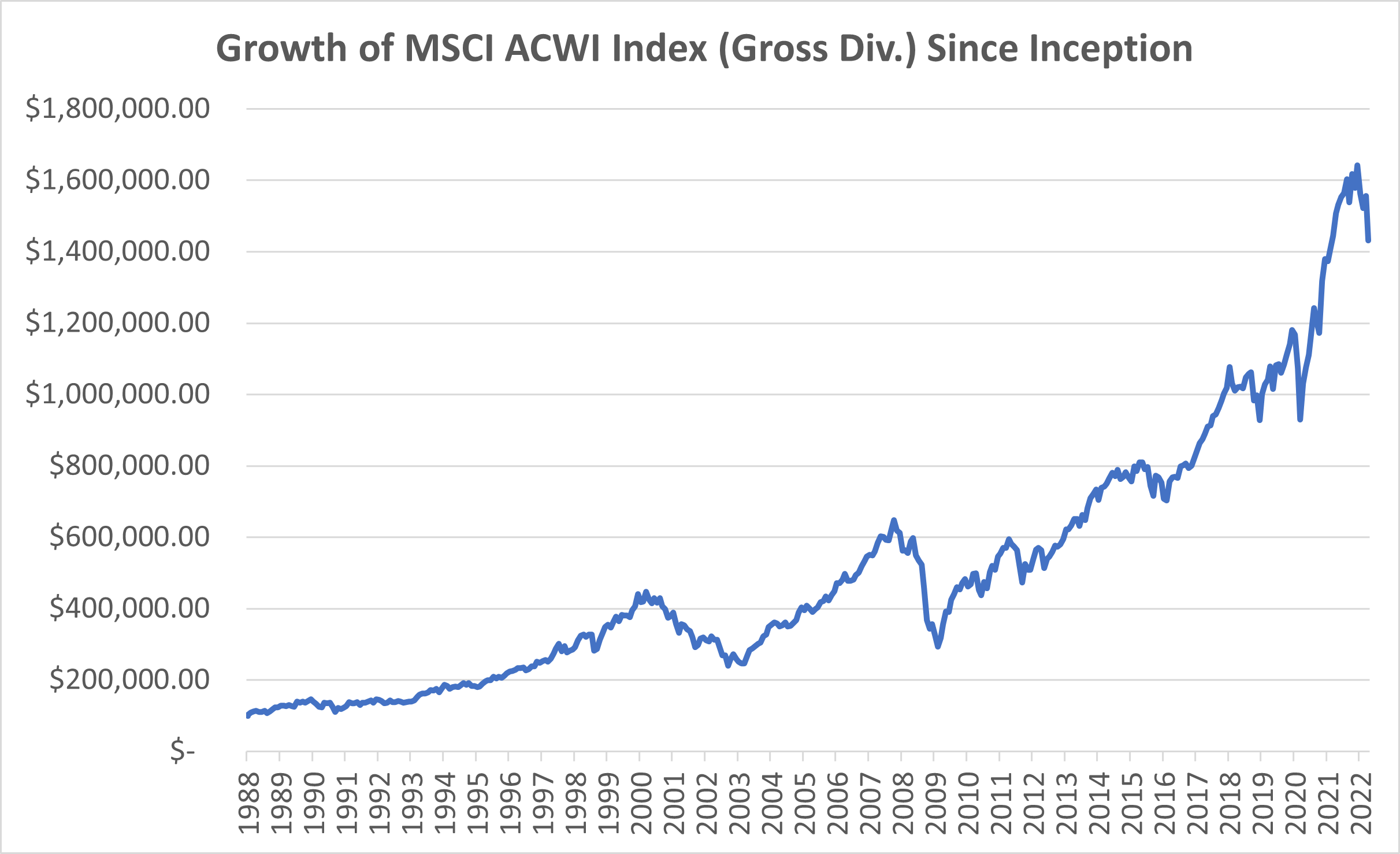
Source: Dimensional Returns Web. See Important Disclosure Information.[12]
While future performance will differ from past performance, and while it was more difficult to invest in global investment strategies in the past, investors today have the ability to nearly match many global stock and bond indices even after considering fees.[13] Therefore, we believe that investing in low-cost, low-turnover, broadly-diversified global mutual funds and ETFs is a sound investment strategy that can potentially help a lot of people over the long-term.[14] And if you stick with a sound investment strategy long enough, you may become a great investor yourself.
Important Disclosure Information & Sources:
[1] “2022 Quantitative Analysis of Investment Behavior Report”. DALBAR, 2022, dalbar.com.
[2] “Why Do Investors Underperform?“ Bobby Adusumilli, 24-Jun-2021, sjsinvest.com.
[3] “The Secret to Braving a Wild Market“. Jason Zweig, 02-Mar-2022, wsj.com.
[4] “2020: The Sequel?“ Jason Zweig, 12-Jan-2022, The Intelligent Investor Newsletter - wsj.com.
[5] “Bogle On Mutual Funds: New Perspectives For The Intelligent Investor“. John Bogle, 2015, Wiley Investment Classics.
[6] “'The First Great Investing Virtue“. Jason Zweig, 19-Jan-2022, The Intelligent Investor Newsletter - wsj.com.
[7] “A New Month, A New Market?“ Jason Zweig, 08-Feb-2022, The Intelligent Investor Newsletter - wsj.com.
[8] “The Most Important Thing: Uncommon Sense for the Thoughtful Investor“. Howard Marks, 2011, Columbia Business School Publishing.
[9] “Stepping Away from the Herd“. Jason Zweig, 15-Feb-2022, The Intelligent Investor Newsletter - wsj.com.
[10] “On Humility and Independence“. Jason Zweig, 22-Feb-2022, The Intelligent Investor Newsletter - wsj.com.
[11] “Patience Amid Turbulence“. Jason Zweig, 02-Mar-2022, The Intelligent Investor Newsletter - wsj.com.
[12] The MSCI ACWI Index is a free float-adjusted market capitalization weighted index designed to measure the equity market performance of developed and emerging markets, consisting of 47 country indices comprising 23 developed and 24 emerging market country indices. Indices are not available for direct investment. Index performance does not reflect the expenses associated with management of an actual portfolio. Index performance is measured in US dollars. The index performance figures assume the reinvestment of all income, including dividends and capital gains. The performance of the indices was obtained from published sources believed to be reliable but which are not warranted as to accuracy or completeness.
[13] “Index funds“. Vanguard, vanguard.com.
[14] “MarketPlus Investing“. SJS Investment Services, sjsinvest.com.
There is no guarantee investment strategies will be successful. Past performance is no guarantee of future results. Diversification neither assures a profit nor guarantees against a loss in a declining market.
Statements contained in this article that are not statements of historical fact are intended to be and are forward looking statements. All forward looking statements are inherently uncertain as they are based on various expectations and assumptions concerning future events and they are subject to numerous known and unknown risks and uncertainties which could cause actual events or results to differ materially from those projected.
Advisory services are provided by SJS Investment Services, a registered investment advisor (RIA) with the SEC. Registration does not imply a certain level of skill or training. SJS Investment Services does not provide legal or tax advice. Please consult your legal or tax professionals for specific advice.
Hyperlinks to third-party information are provided as a convenience and we disclaim any responsibility for information, services or products found on websites or other information linked hereto.

Bitcoin & Cryptocurrencies: Do They Have A Place In Your Portfolio?
To help you better understand cryptocurrencies, we provide a short history, potential benefits, concerns, and how your portfolio can potentially benefit from cryptocurrencies.
By Founder & CEO Scott Savage.
Increasingly, this is a question that is posed to the SJS Team: Should I buy bitcoin?
While bitcoin and other cryptocurrencies have risen dramatically in price over the past ten years, most of the ideas underlying cryptocurrencies are not all that new, and cryptocurrencies are not as complicated as they may appear to be.[1] To help you better understand cryptocurrencies, we provide a short history, potential benefits, concerns, and how your portfolio can possibly benefit from cryptocurrencies.
History Of Cryptocurrencies
The idea behind a digital currency is not new. Starting around the 1980s, many individuals have attempted to create a digital currency, with each breakthrough building on top of past breakthroughs.[2] For example, in its early years, PayPal (which also now owns Venmo) was driven by the “idea of creating a new digital currency to replace the U.S. dollar.”[3] Technology and the internet have allowed for transactions to become faster, more secure, and lower cost. Many people in the US today don’t even use paper cash today, meaning the U.S. dollar already feels like a digital currency for them.
In 2008, another breakthrough occurred: an unknown person or team named Satoshi Nakamoto outlined a new cryptocurrency called bitcoin in a white paper, calling bitcoin, “A purely peer-to-peer version of electronic cash would allow online payments to be sent directly from one party to another without going through a financial institution.“[4] Simply put, bitcoin is digital money that securely allows people to transact over the internet, without needing a bank or traditional financial intermediary involved.
Bitcoin’s single biggest innovation is the blockchain, which is the technology underlying bitcoin that allows for all historical transactions to be recorded for anyone around the world to access at any time. The blockchain also allows for transactions to happen almost instantaneously, securely, in a relatively low-cost manner, and be verified by anyone around the world.
21 million bitcoin is the maximum number of bitcoin that will ever be created.[4] Today, there are roughly 19 million bitcoin outstanding, and the remaining 2 million will be “mined” over the next 100+ years to compensate people for ensuring the accuracy of the blockchain.[4][5] You can own fractional interest of one bitcoin. In 2011, the price of one bitcoin exceeded $1 US dollar; by April 2022, the price of bitcoin is around $40,000 US dollars, meaning the total value of all bitcoin in existence today is roughly $750 billion.[5]
As with any lucrative technology, bitcoin and the blockchain have given risen to thousands of other cryptocurrencies and related digital assets. While we believe the vast majority of these digital assets won’t have value over the long-term, another cryptocurrency called Ethereum has made significant innovations building off of bitcoin, which is why it has become the second most valuable cryptocurrency behind bitcoin.[6]
If you would like more information on the history of bitcoin and cryptocurrencies, we recommend the book Digital Gold: Bitcoin and the Inside Story of the Misfits and Millionaires Trying to Reinvent Money by Nathaniel Popper.
Potential Benefits Of Cryptocurrencies

Transparency: Bitcoin is designed to be transparent, in efforts to limit the ability for a group of people or institutions to manipulate both bitcoin and the blockchain.
Limited amount of currency: Bitcoin and some other cryptocurrencies limit the amount of currency that will exist in the future. Many supporters believe this will help these cryptocurrencies serve as a store of value (this is why bitcoin is sometimes referred to as “digital gold”) as well as protection from inflation.[6] This is a major positive factor for people who are worried about governments printing money to pay off debts, which would devalue those currencies.[6]
Ability to hold around the world: Particularly for people who live in countries with volatile currencies or who move around the world, owning cryptocurrencies can be significantly more stable and secure for them compared to holding the local currencies.
Lower transaction costs: Cryptocurrencies may be able to help lower financial transaction fees over time. For example, many individuals in developing countries have to pay significant transaction fees in order to wire money to the US. Bitcoin can potentially reduce these transaction fees. Additionally, many people hope that the blockchain will help to lower (or even eliminate) credit card fees over time.
Privacy: Each bitcoin has a public key and a private key. Someone needs to use their private key (a long string of numbers and letters) in order to initiate a transaction. During a transaction, the public key is used by others on the blockchain to verify transactions. Both public and private keys are not associated with a person’s name, so as long as people don’t know that you own the private key and public key, then this can help to limit the chances that they will learn that you own that bitcoin.
Increasing adoption: Both individuals as well as institutions have been increasingly adopting the two largest cryptocurrencies (bitcoin and Ethereum) over the last few years.[7]
Concerns Of Cryptocurrencies
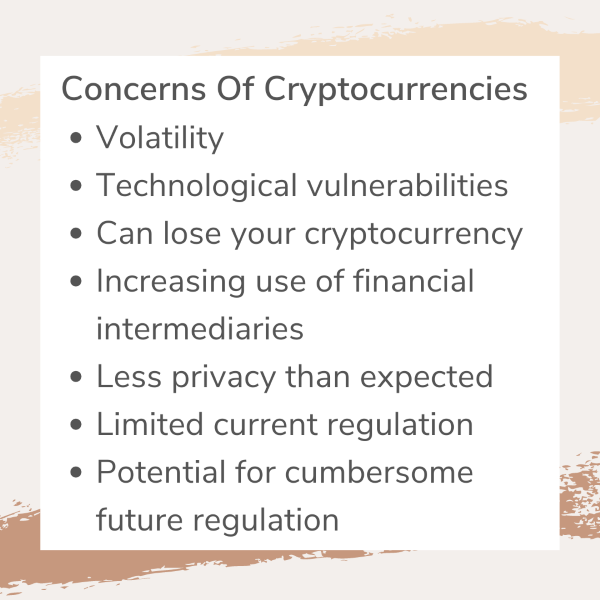
Volatility: Historically, even the largest cryptocurrencies have been highly volatile in price.[5] While this volatility is expected to decrease with increasing adoption, the volatility limits usefulness as an actual day-to-day currency.
Technological vulnerabilities: Cryptocurrencies and exchanges are subject to security risks, operational shutdowns, and hackers. For example, the Wall Street Journal estimates that approximately $3.2 billion worth of cryptocurrency was stolen in 2021.[8] However, the largest risks often impact newer and less-adopted cryptocurrencies and exchanges. In the coming years, the technology and infrastructure for the largest cryptocurrencies such as Bitcoin and Ethereum will become more robust, and hackings may become less common as a result.
Can lose your cryptocurrency: If you have a private wallet not affiliated with a major exchange, then if you lose your private key, you may potentially lose your cryptocurrency forever. For example, the New York Times recently estimated that nearly 20% of the total Bitcoin outstanding has been lost or is in stranded wallets.[9]
Increasing use of financial intermediaries: People and institutions are increasingly using financial intermediaries to store their cryptocurrencies.[7] This trend is in contrast to the initial vision for bitcoin.[4]
Less privacy than expected: Some people and institutions may not be able to achieve the level of privacy that they are hoping for with cryptocurrencies. For example, due to Russia’s war with Ukraine in 2022, Coinbase announced that it would block nearly 25,000 Russian-linked accounts (addresses) believed to be engaging in illicit activity, and governments around the world are also trying to seize Russian-linked cryptoassets.[10][11]
Limited current regulation, and potential for cumbersome regulation in the future: So far, regulation in countries around the world has lagged the growth of cryptocurrencies. However, governments are increasingly prioritizing regulation for cryptocurrencies, which could lead to uncertain effects. For example, China (which is expected to become the largest economy in the world by around 2030) has banned citizens from transacting in cryptocurrencies.[12] Additionally, the United States has not allowed for cryptocurrencies to be held directly in mutual funds and ETFs.[13] How will future regulation impact the value of cryptocurrencies?
How Can Your Portfolio Potentially Benefit From Bitcoin?

Market prices are driven by supply and demand. There is large and increasing demand for cryptocurrencies, and therefore we believe that cryptocurrencies are here to stay.
However, we don’t know what the aggregate market capitalization of cryptocurrencies will be, nor do we know how quickly cryptocurrencies will grow or decline, nor which ones will flourish and which ones will cease to exist. Bitcoin doesn’t have any earnings and doesn’t pay dividends, so we can’t value it like stocks.
What we do know is that cryptocurrencies have been quite volatile, and many clients are not comfortable investing in them. Additionally, for people who don’t do their homework, we view their buying of bitcoin as speculation, not investing.
Therefore, we do not invest client assets directly into cryptocurrencies. However, there are other ways to benefit from potential growth in cryptocurrencies. For example, there is an expansive options market for bitcoin where people and institutions do everything from speculating to hedging to achieving indirect exposure. In alignment with our view that cryptocurrencies are here to stay, we believe there are positive expected returns available in providing capital to the bitcoin options market. It is very complicated; we rely on an investment manager who has extensive experience with this market as part of a diversified alternatives mutual fund.[14] Additionally, due to their exposures to cryptocurrencies, some of the underlying stocks in the mutual funds and ETFs that we recommend may benefit from potential growth in cryptocurrencies.
The Ancient Chinese proverb famously says, “The best time to plant a tree was 20 years ago. The second best time is now.” When it comes to speculating in bitcoin, I would urge caution when applying this proverb to anything other than trees!
Important Disclosure Information & Sources:
[1] “Total Cryptocurrency Market Cap“. CoinMarketCap, 22-Apr-2022, coinmarketcap.com.
[2] “Cryptocurrency“. Wikipedia, wikipedia.org.
[3] Zero to One: Notes on Startups, or How to Build the Future. Peter Thiel & Blake Masters, 2014, Currency.
[4] “Bitcoin: A Peer-to-Peer Electronic Cash System“. Satoshi Nakamoto, 2008, bitcoin.org/en.
[5] “Total Circulating Bitcoin“. Blockchain, 22-Apr-2022, blockchain.com.
[6] Digital Gold: Bitcoin and the Inside Story of the Misfits and Millionaires Trying to Reinvent Money. Nathaniel Popper, 2016, Harper Paperbacks.
[7] “Our Thoughts on Bitcoin“. Ray Dalio & Rebecca Patterson, 28-Jan-2021, bridgewater.com.
[8] “Cryptocurrency-Based Crime Hit a Record $14 Billion in 2021“. Mengqi Sun & David Smagalla, 06-Jan-2022, wsj.com.
[9] “Lost Passwords Lock Millionaires Out of Their Bitcoin Fortunes”. Nathaniel Popper, 14-Jan-2021, nytimes.com.
[10] “Using Crypto Tech to Promote Sanctions Compliance“. Paul Grewal, 06-Mar-2022, coinbase.com.
[11] “The hunt for Russian crypto is on“. Benjamin Pimentel, 08-Mar-2022, protocol.com.
[12] “What's behind China’s cryptocurrency ban?“ Francis Shin, 31-Jan-2022, weforum.org.
[13] “SEC Delays Decision on Bitcoin ETFs Again“. Chitra Somayaji, 23-Jun-2021, wsj.com.
[14] “Stone Ridge 2020 Shareholder Letter“. Ross Stevens, 2020, stoneridgefunds.com/?tab=srdax.
Other resources that influenced this blog post.
“Cryptoassets: The Guide to Bitcoin, Blockchain, and Cryptocurrency for Investment Professionals“. Matt Hougan & David Lawant, 07-Jan-2021, cfainstitute.org/en.
“Why Bitcoin Matters“. Marc Andreesen, 11-Jan-2014, nytimes.com.
There is no guarantee investment strategies will be successful. Past performance is no guarantee of future results. Diversification neither assures a profit nor guarantees against a loss in a declining market.
MarketPlus Investing® models consist of institutional quality registered investment companies. Investment values will fluctuate, and shares, when redeemed, may be worth more or less than original cost.
Statements contained in this article that are not statements of historical fact are intended to be and are forward looking statements. All forward looking statements are inherently uncertain as they are based on various expectations and assumptions concerning future events and they are subject to numerous known and unknown risks and uncertainties which could cause actual events or results to differ materially from those projected.
Advisory services are provided by SJS Investment Services, a registered investment advisor (RIA) with the SEC. Registration does not imply a certain level of skill or training. SJS Investment Services does not provide legal or tax advice. Please consult your legal or tax professionals for specific advice. This material has been prepared for informational purposes only.
Hyperlinks to third-party information are provided as a convenience and we disclaim any responsibility for information, services or products found on websites or other information linked hereto.

Structured Notes - Caveat Emptor! Buyer Beware!
We summarize structured notes as well as detail concerns we believe investors should understand before investing one penny.
By Founder & CEO Scott Savage.
We want to warn you about an investment product called structured notes. These derivative instruments typically purport to provide investors with a coupon payment higher than available in the bond market, as well as downside protection from the underlying reference asset, which is often a stock-based investment like the S&P 500 Index.[1] Sounds great, right? What could go wrong? A lot!
Below, we summarize structured notes as well as detail concerns we believe investors should understand before investing one penny. While risk management is the responsibility of each advisor who touts these investments, we want you to be aware of the risks in case someone recommends structured notes to you.

Summary
A structured note is a derivative instrument designed to typically provide both a regular coupon payment as well as some degree of principal protection compared to an underlying (usually stock) reference asset. Typically, the investor purchases an initial issue of the note from the sponsor (usually an investment bank) in exchange for coupon payments over the length of the note (often 1 to 5 years).
Generally, if the underlying reference asset only declines a little over the length of the note, the investor has a pre-specified level of principal protection and still receives the coupon payments. If the reference asset value falls below the predetermined knock-in level (the minimum value specified in the contract to receive coupon and principal payments), you may not receive all of the coupon payments and your principal amount would decline. When the reference asset increases over the note length, the investor usually receives the coupon payments and some principal upside based on the participation rate.[1]

Source: “Spotlight on… top issuers in the US“. Structured Retail Products, 07-Jan-2022, structuredretailproducts.com.[2]
Advantages
An investor can receive a coupon rate that is higher than yields available in the bond markets, while receiving some downside principal protection if the underlying reference asset declines.
Some structured note platforms are creating more competition among sponsors, which can help to create more investor-friendly structured notes.
Many banks offer structured notes for a wide variety of underlying stocks, indices, and other financial assets.
Concerns
Most structured notes are relatively complicated, often with dozens of pages of details such as protection (specified knock-in levels), maturity, coupon rates, and underlying reference assets.
Most structured notes are subject to multiple layers of fees, and the fees are often difficult to understand.
In terms of issuers, structured notes are primarily issued by large, predominantly Wall Street banks.[2]
Structured notes tend to have maturities of 1 to 5 years, meaning upon maturity you will have to review newer structured notes if you want to continue investing in structured notes.
Many structured notes can be redeemed (called) by the issuer, either automatically triggered based on the underlying reference investment or whenever the issuer has the right to call.
Typically, there are no federal or state insurance guarantees on the principal invested in structured notes. Additionally, structured notes tend to be senior, unsecured notes by the sponsor. If the sponsor is unable to make interest and / or principal payments, the investor may not receive the full note value.
Many structured notes do not provide full downside protection in case the reference asset falls below the knock-in level. The downside market protection may not fully cover your investment in more volatile market periods.[4]
Most notes have a relatively illiquid secondary market. Some notes allow the investor to sell back the notes to the sponsor, often at a discount to the current value.
Interest (excluding principal) from the notes can be complicated, and often considered taxable income if held within a taxable account.
Sponsors typically measure reference assets without dividends and other distributions.
Structured notes are over-the-counter investment products, which have less regulatory supervision compared to mutual funds and ETFs.
The total market for structured notes is not as competitive (particularly on costs and product features) as other investment products such as mutual funds and ETFs.[1]
Structured notes are not standardized across issuers.
In recent years, the U.S. Securities & Exchange Commission (SEC) has issued Investor Alerts & Bulletins detailing the risks of structured notes. In particular, the SEC encourages you to answer the following questions before purchasing a structured note:[5][6]


Conclusion
As we contemplate our duty to our clients as fiduciaries, SJS does not recommend structured notes to clients. They tend to be complex, primarily offered by Wall Street banks, have multiple layers of fees, and require a lot of work to fully understand each structured note.[1][2][4][5] Finally, we are not aware of any well-regarded institution or endowment fund that invests in structured notes. We wonder why?
Important Disclosure Information & Sources:
[1] “Why Structured Notes Might Not Be Right for You“. Jason Whitby, 11-Dec-2021, investopedia.com.
[2] “Spotlight on… top issuers in the US“. Structured Retail Products, 07-Jan-2022, structuredretailproducts.com.
[3] “Barclays to Book $591 Million Loss Due to Debt-Sale Snafu“. Anna Hirtenstein, 28-Mar-2022, wsj.com.
[4] “Structured Notes: The Risks of Insuring Against Risks“. Jason Zweig, 17-Oct-2014, wsj.com.
[5] “Structured Notes with Principal Protection: Note the Terms of Your Investment.” United States Securities and Exchange Commission, 01-Jun-2011, sec.gov.
[6] “Investor Bulletin: Structured Notes.” United States Securities and Exchange Commission, 12-Jan-2015, sec.gov.
There is no guarantee investment strategies will be successful. Past performance is no guarantee of future results. Diversification neither assures a profit nor guarantees against a loss in a declining market.
MarketPlus Investing® models consist of institutional quality registered investment companies. Investment values will fluctuate, and shares, when redeemed, may be worth more or less than original cost.
Statements contained in this report that are not statements of historical fact are intended to be and are forward looking statements. All forward looking statements are inherently uncertain as they are based on various expectations and assumptions concerning future events and they are subject to numerous known and unknown risks and uncertainties which could cause actual events or results to differ materially from those projected.
Advisory services are provided by SJS Investment Services, a registered investment advisor (RIA) with the SEC. Registration does not imply a certain level of skill or training. SJS Investment Services does not provide legal or tax advice. Please consult your legal or tax professionals for specific advice. This material has been prepared for informational purposes only.
Hyperlinks to third-party information are provided as a convenience and we disclaim any responsibility for information, services or products found on websites or other information linked hereto.

Market Corrections & Market Highs
We believe that trying to time when to get in and out, or what to buy and sell, represents little more than gambling.
By Chief Investment Officer Tom Kelly, CFA.
In 2021, the global stock market (as measured by the MSCI ACWI Index) continued to reach new high after new high, but this year is off to a different start.[1][2] After the slow and steady rise in 2021, the rather opposite slow and steady fall occurred throughout the first quarter of 2022.[1] Though some recovery happened in the last three weeks, market headlines continue to point out all the things to worry about such as war, inflation, and recession.[1] Challenging times may be ahead, especially with the continued conflict between Russia and Ukraine.
While not diminishing those challenges and the people affected, it may be an opportune time to take a step back for a wider perspective. When looked at as a whole, the stock market can sometimes seem tame and uninteresting during times of lesser volatility, and all fraught with despair during periods of higher volatility and drawdowns. However, the drawdown of 13% so far this year for the global stock market is not uncommon at all, and we often see intra-year drawdowns well into the double digits even when the end-of-year returns end up positive.[2] Over the last 20 years in the global stock market, intra-year drawdowns averaged 16%, yet calendar year returns were positive in 15 out of 20 of those years.[2] A gentle reminder to stay the course.

Source: Morningstar. See Important Disclosure Information.[2]
It is interesting to note that the “market” as a whole often masks the ups and downs of its individual stock components. Within the MSCI All Country World Index, 94% of the nearly 3,000 companies experienced a drawdown of at least -10% during 2021, and about half drew down 25% or more.[2] This in a year when there was lower volatility, limited geopolitical events, and the global stock market as a whole up 19%![2] This suggests the value of broad diversification.
When evaluating the underlying returns, there is often plenty to worry about and temptation to tinker. We believe that trying to time when to get in and out, or what to buy and sell, represents little more than gambling. MarketPlus Investing on the other hand is a disciplined process, centered around research and evidence, with diversification at the core.
Important Disclosure Information & Sources:
[1] “SJS Weekly Market Update”. SJS Investment Services, 2021-2022, sjsinvest.com.
[2] Morningstar. The global stock market is represented by the MSCI ACWI Index, which is a free float-adjusted market capitalization weighted index designed to measure the equity market performance of developed and emerging markets. The MSCI ACWI Index consists of 47 country indices comprising 23 developed and 24 emerging market country indices.
There is no guarantee investment strategies will be successful. Past performance is no guarantee of future results. Diversification neither assures a profit nor guarantees against a loss in a declining market.
Statements contained in this article that are not statements of historical fact are intended to be and are forward looking statements. All forward looking statements are inherently uncertain as they are based on various expectations and assumptions concerning future events and they are subject to numerous known and unknown risks and uncertainties which could cause actual events or results to differ materially from those projected.
Indices are not available for direct investment. Index performance does not reflect the expenses associated with management of an actual portfolio. Index performance is measured in US dollars. The index performance figures assume the reinvestment of all income, including dividends and capital gains. The performance of the indices was obtained from published sources believed to be reliable but which are not warranted as to accuracy or completeness.
Hyperlinks to third-party information are provided as a convenience and we disclaim any responsibility for information, services or products found on websites or other information linked hereto.

The Fed Poked The Bear
Rising interest rates are not always a bad thing. As interest rates move higher, the drop in value can be concerning, but in the longer-term, higher rates mean higher expected returns for investors, as bonds begin to produce more income.
By Senior Advisor Kirk Ludwig, CFIP, AIF®.
March 20th was the celebration of the Vernal Equinox and the Earth’s axis has once again shifted us into a new season. From the green pop of tulips sprouting to the warmth of the sunshine spilling through the windows, the United States began celebrating one of their most beloved seasons: The NCAA March Madness Basketball Tournament, or as many of us like to call it… Spring! Along with spring comes the chirping of migrating birds and the waking of hungry bears. This spring the Fed gave the “bond bear” a bit of a poke to get the season rolling.
After a two-year hibernation of zero percent interest rates, the Fed has embarked on the challenging mission of hiking interest rates to combat elevated inflation levels while not inducing a recession at the same time.[1] By increasing short-term interest rates and reducing the size of their balance sheet, the Fed will attempt to orchestrate a soft economic landing.[1] So how many times will they need to raise interest rates to accomplish their goal?
Now for the bad news “bear”… The Fed indicated their intent to continue raising rates into the near future.[1] As of the end of March, the market is expecting the Fed to raise rates eight to nine more times in 2022.[2] This number has changed multiple times in the past few weeks and will likely continue to adjust in the coming months.[2] As new information is presented to the market, bond yields will quickly reflect the possible changes which may occur as a result.
Why are rising rates viewed negatively by the market? Let’s revisit how bond values can change based on the change of market interest rates. Like a teeter-totter, when rates rise, bond values fall and vice versa. Additionally, the sensitivity of the price change is primarily impacted by the term length (maturity) of the bond. The longer the maturity, the more sensitive the price of the bond will likely be. With this recent move higher in yields, the S&P U.S. Aggregate Bond Market Index dropped 5.57% in the first three months of 2022.[3] One of the worst starts of the year on record.[3]
However, rising rates are not always a bad thing. As interest rates move higher, the drop in value can be concerning, but in the longer-term, higher rates mean higher expected returns for investors, as bonds begin to produce more income. The chart below shows the change in yields for three different time periods; 1.) 09/30/21 - before the Fed indicated their plan on raising rates, 2.) 12/31/21 – early stage of the Fed’s plan, and 3.) 03/31/22 – the market’s interpretation of future rates as of the end of the quarter:[2]

Source: “Daily Treasury Par Yield Curve Rates“. U.S. Department of the Treasury, treasury.gov.
As illustrated in the graph, current interest rates have moved markedly higher since the start of the year. Short-term rates - inside three years - have had the most dramatic move as the market prepares for future rate hikes. The longer maturities, which often provide more information about future growth and inflation expectations, have experienced a parallel shift higher. The shape of the yield curve prices in the future expected events, i.e. rate hikes, inflation, economic growth to name a few.
With all the uncertainties surrounding today’s markets, the day-to-day news can be distracting to investors. If you’re worried about how many more times the Fed is going raise rates, know that the market has already priced in that risk. Future inflation? Same answer. Possibility of future recessions… same! Therefore, trying to make long-term decisions on short-term news can often lead investors down the wrong path.
‘Ok, so what should we do now?’ SJS does not react to the short-term noise, but we do evaluate the longer-term expected risk and return characteristics of each segment of the portfolio and manage to those risks. Some of the adjustments that we have made on behalf of our clients:
Maintaining a shorter duration than the total bond market: We believe this reduces interest rate risk relative to the total broader US bond market, while still maintaining broad diversification.
Investing in shorter-term inflation-protected securities: We believe this hedges the portfolio against sharp increases in inflation, while still maintaining a relatively short duration.
Adding diversified alternative investments: We believe investing in diversified alternatives with low correlation to US stocks and bonds can help to redistribute expected risk, broaden diversification, and increase expected returns compared to US fixed income over the long-term.
While you are enjoying the shift into this new season, be comforted in knowing that SJS is continuously monitoring the market and keeping your best interests top of mind. As markets experience higher levels of uncertainty, the best course of action is to maintain a strong discipline with broad diversification. Yes, the hungry bear may seem scary, and you will likely want to run, but the market will eventually find its balance so we can all get back to monitoring our college basketball brackets.
Important Disclosure Information & Sources:
[1] “Fed Raises Interest Rates for First Time Since 2018“. Nick Timiraos, 17-Mar-2022, wsj.com.
[2] “Daily Treasury Par Yield Curve Rates“. U.S. Department of the Treasury, treasury.gov.
[3] “S&P U.S. Aggregate Bond Index“. S&P Dow Jones Indices, spglobal.com/spdji/en. The S&P U.S. Aggregate Bond Index is designed to measure the performance of publicly issued U.S. dollar denominated investment-grade debt.
There is no guarantee investment strategies will be successful. Past performance is no guarantee of future results. Diversification neither assures a profit nor guarantees against a loss in a declining market.
MarketPlus Investing® portfolios consist of institutional quality registered investment companies. Investment values will fluctuate, and shares, when redeemed, may be worth more or less than original cost.
Advisory services are provided by SJS Investment Services, a registered investment advisor (RIA) with the SEC. Registration does not imply a certain level of skill or training. SJS Investment Services does not provide legal or tax advice. Please consult your legal or tax professionals for specific advice. This material has been prepared for informational purposes only.
Statements contained in this article that are not statements of historical fact are intended to be and are forward looking statements. All forward looking statements are inherently uncertain as they are based on various expectations and assumptions concerning future events and they are subject to numerous known and unknown risks and uncertainties which could cause actual events or results to differ materially from those projected.
Indices are not available for direct investment. Index performance does not reflect the expenses associated with management of an actual portfolio. Index performance is measured in US dollars. The index performance figures assume the reinvestment of all income, including dividends and capital gains. The performance of the indices was obtained from published sources believed to be reliable but which are not warranted as to accuracy or completeness.
Hyperlinks to third-party information are provided as a convenience and we disclaim any responsibility for information, services or products found on websites or other information linked hereto.

The Certainty of Uncertainty - Your Investments During Geopolitical Events
On the conflict in Ukraine, how that may impact investment markets, and what you can control within your investment portfolio.
By Chief Investment Officer Tom Kelly, CFA.
With conflict between Russia and Ukraine escalating in recent days - unfortunately leading to an invasion and war between the nations - we are reminded of the never-ending risks in the world.[1] Just as the light at the end of the tunnel of the pandemic begins to appear, the next global challenge presents itself. The only thing predictable is the unpredictability of the world.
From an investment perspective, global ramifications of war are certainly hard to determine. Military events - just like economic disruptions, natural disasters, and social turmoil - affect the stock market in many unpredictable ways. The tendency for investors is to try to predict and adjust based on events, but we believe markets are continually pricing in expectations and likelihoods of further developments, whether positive or negative.
One of the hardest things to do as an investor is to stay invested and committed to your investment plan, particularly during periods of great uncertainty. However as this graph demonstrates, markets have rewarded investors over long periods of time.[2] In our experience, the discipline to stick to their investment plan through the periods of greatest uncertainty often differentiates great investors from the rest.

Source: Morningstar Direct, S&P data © 2022 S&P Dow Jones Indices LLC, a division of S&P Global. All rights reserved. See Important Disclosure Information.[2]
Unfortunately, there have been many major armed conflicts over the last century to look to and see how markets might behave. As this table demonstrates, both US stock and bond markets still achieved positive returns during the years associated with major wars of the past.

Sources: “What Happens to the Market if America Goes to War?“ Mark Armbruster, cfainstitute.org. Dimensional Returns Web. The indices used for each asset class are as follows: the S&P 500 Index for large-Cap stocks; CRSP Deciles 6-10 for small-cap stocks; long-term US government bonds for long-term bonds; five-year US Treasury notes for five-year notes; long-term US corporate bonds for long-term credit; one-month Treasury bills for cash; and the Consumer Price Index for inflation. All index returns are total returns for that index. Returns for a war-time period are calculated as the returns of the index four months before the war and during the entire war itself. Returns for “All Wars” are the annualized geometric return of the index over all “war-time periods.” Volatility is the annualized standard deviation of the index over the given period. Past performance is not indicative of future results. See Important Disclosure Information.
For investors historically, wars have not been detrimental to long-term investment performance. We do not believe the current situation will be detrimental to long-term investors going forward. While no two conflicts are the same - and each more unfortunate than the last regarding the continued loss of human life and havoc on nations - humanity (and the markets) remain resilient. Industry and innovation continue. We hope and pray this time is the same.
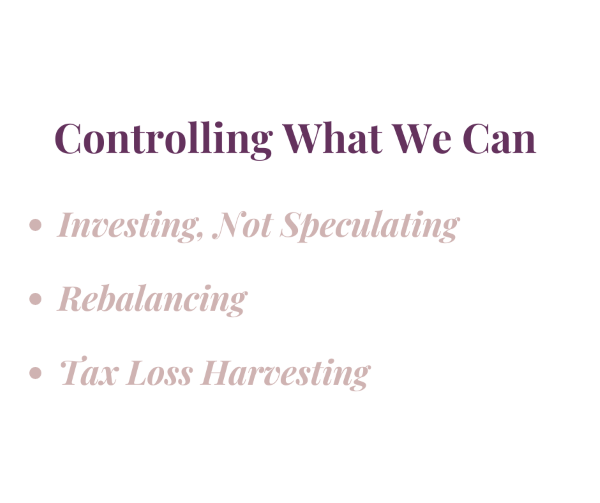
For those who have a sound, diversified, personalized investment plan in place, we do not believe that now is the time to make any major changes. Instead of focusing on how external forces that you do not control may impact your investments, we recommend that you focus on what you can control. For our clients, we are doing the following on your behalf:
Investing, Not Speculating
As anyone who invested through the COVID-19 pandemic knows, investment markets can be highly volatile, and regularly move in ways that we don’t expect.[3] Instead of making it up as we go along, we think that creating an investment plan ahead of time and sticking to it during down markets is most likely to benefit most investors over the long-term. We believe in long-term investing, not short-term speculating.
Rebalancing
During most volatile market periods, stocks tend to be more negatively impacted in the short-term compared to bonds. Therefore, you can potentially rebalance back to your target allocations by selling some bonds and buying some stocks. This can allow you to buy stocks when they are at lower valuations as well as rebalance your total portfolio to its target risk allocation, which may potentially help improve your risk-adjusted expected returns over the long-term.[4]
Tax Loss Harvesting
Volatile investment periods tend to provide more tax-loss harvesting opportunities within taxable accounts. You can potentially sell an investment now at a capital loss and buy a similar (though not a “substantially identical” investment per the Wash Sale Rule) investment.[5] Then in the future, you can realize capital gains in your taxable accounts and use the past capital losses to lower your tax burden, which can potentially increase long-term after-tax expected returns.
We don’t know what will happen, but we will control what we can in efforts to help your investment portfolio. As always, if you have specific questions or concerns related to your portfolio, please call us. We’re always here to listen and assist.
Important Disclosure Information & Sources:
[1] “Russia Invades Ukraine, Aims to Oust Leadership“. By Yaroslav Trofimov, Alan Cullison, Brett Forrest, & Ann M. Simmons, 24-Feb-2022, wsj.com.
[2] The S&P 500 Index is a free float-adjusted market-capitalization-weighted index of 500 of the largest publicly traded companies in the United States.
[3] “Started From the Bottom”. Nick Maggiulli, 23-Mar-2021, ofdollarsanddata.com.
[4] “Opportunistic Rebalancing: A New Paradigm for Wealth Managers.” Gobind Daryanani, fpanet.org.
[5] “Wash-Sale Rule“. Jason Fernando, 17-Feb-2022, investopedia.com.
There is no guarantee investment strategies will be successful. Past performance is no guarantee of future results. Diversification neither assures a profit nor guarantees against a loss in a declining market.
Advisory services are provided by SJS Investment Services, a registered investment advisor (RIA) with the SEC. Registration does not imply a certain level of skill or training. SJS Investment Services does not provide legal or tax advice. Please consult your legal or tax professionals for specific advice. This material has been prepared for informational purposes only.
Statements contained in this report that are not statements of historical fact are intended to be and are forward looking statements. All forward looking statements are inherently uncertain as they are based on various expectations and assumptions concerning future events and they are subject to numerous known and unknown risks and uncertainties which could cause actual events or results to differ materially from those projected.
Indices are not available for direct investment. Index performance does not reflect the expenses associated with management of an actual portfolio. Index performance is measured in US dollars. The index performance figures assume the reinvestment of all income, including dividends and capital gains. The performance of the indices was obtained from published sources believed to be reliable but which are not warranted as to accuracy or completeness.
Hyperlinks to third-party information are provided as a convenience and we disclaim any responsibility for information, services or products found on websites or other information linked hereto.

The Growth of Real Estate
As anyone who was looking to purchase or sell a home in 2021 knows, the US real estate market grew a lot in value in 2021. Will this continue?
By Investment Associate Bobby Adusumilli, CFA.
As anyone who was looking to purchase or sell a home in 2021 knows, the US real estate market grew a lot in value in 2021. For example, the US publicly-traded real estate market, as measured by the Dow Jones US Select REIT Index, returned nearly 46% in 2021, the best year since the index began in 1987.[1]
One driver of REIT performance is property and housing values. Heavily driven by the decline in interest rates resulting from the COVID-19 pandemic, Americans spending more time working remotely, as well as record amounts invested from investment firms, home purchases have been driven by a surge in demand combined with a relatively steady supply.[2][3]

Source: S&P Dow Jones Indices LLC, S&P/Case-Shiller U.S. National Home Price Index [CSUSHPISA], Federal Reserve Bank of St. Louis, 16-Feb-2022, fred.stlouisfed.org.
In the second edition of his famous book Irrational Exuberance that was released in 2006, Nobel Prize-winning economist Robert Shiller wrote, “It is true that for the United States as a whole real home prices were 66% higher in 2004 than in 1890, but all of that increase occurred in two brief periods: the time right after World War II (with the first increases occurring in the early 1940s, just before the war ended) and a period that appears to reflect a lagged response to the 1990s stock market boom (or a response to its boom and crash), with the first signs of increase occurring in 1998. Other than those two periods, real home prices overall have been mostly flat or declining.“[4]
The above data suggests that this past decade - particularly in 2020 and 2021 - are a third such period of a rise in real home prices in the United States.
However, we believe that some of the factors driving this rise are unsustainable. According to the Wall Street Journal as of late 2021, the median time a home stays on the market in the US is around one week, which is a record low.[5] Many purchasers today are no longer taking advantage of low interest rates, often paying all-cash at a price above listing in order to beat out other purchasers.[5] In a sign of exuberance, many homebuyers are not even inspecting these homes as a contractor would recommend.[5]
With short-term interest rates expected to increase significantly throughout 2022, as well as an already growing home supply projected over the next few years, we do not expect this current housing boom to sustain its pace.[6][7] As a result of this and other evidence, we believe that publicly-traded REIT investments will have lower expected returns over the medium-term compared to the last ten years, though we still expect returns to remain positive over the medium- to long-term.
Important Disclosure Information & Sources:
[1] Source: Dimensional Returns Web. The Dow Jones U.S. Select REIT Index tracks the performance of publicly traded REITs and REIT-like securities and is designed to serve as a proxy for direct real estate investment, in part by excluding companies whose performance may be driven by factors other than the value of real estate.
[2] “U.S. Existing-Home Sales Reached a 15-Year High of 6.1 Million Last Year“. Nicole Friedman, 20-Jan-2022, wsj.com.
[3] “Building and Renting Single-Family Homes Is Top-Performing Investment“. Will Parker, 09-Nov-2021, wsj.com.
[4] Irrational Exuberance. Robert Shiller, 2006, Crown Business.
[5] “Homes Now Typically Sell in a Week, Forcing Buyers to Take Risks“. Nicole Friedman, 11-Nov-2021, wsj.com.
[6] “Fed Signals Rate Increase in March, Citing Inflation and Strong Job Market“. Jeanna Smialek, 26-Jan-2022, nytimes.com.
[7] “New Privately-Owned Housing Units Started: Total Units“. Federal Reserve Bank of St. Louis, 31-Dec-2021, fred.stlouisfed.org.
There is no guarantee investment strategies will be successful. Past performance is no guarantee of future results. Diversification neither assures a profit nor guarantees against a loss in a declining market.
Indices are not available for direct investment. Index performance does not reflect the expenses associated with management of an actual portfolio. Index performance is measured in US dollars. The performance of the indices was obtained from published sources believed to be reliable but which are not warranted as to accuracy or completeness.
Statements contained in this report that are not statements of historical fact are intended to be and are forward looking statements. All forward looking statements are inherently uncertain as they are based on various expectations and assumptions concerning future events and they are subject to numerous known and unknown risks and uncertainties which could cause actual events or results to differ materially from those projected.
Advisory services are provided by SJS Investment Services, a registered investment advisor (RIA) with the SEC. Registration does not imply a certain level of skill or training. SJS Investment Services does not provide legal or tax advice. Please consult your legal or tax professionals for specific advice. This material has been prepared for informational purposes only.
Hyperlinks to third-party information are provided as a convenience and we disclaim any responsibility for information, services or products found on websites or other information linked hereto.

What's Happening With The Chinese Stock Markets?
China has been growing rapidly from an economic perspective. So what’s happening with the Chinese stock markets?
By Investment Associate Bobby Adusumilli, CFA.
2021 was a turbulent year for Chinese stocks. Partially due to concerns about government involvement in businesses, human rights, and the repercussions of the COVID-19 pandemic, the MSCI China Index declined nearly 22% in 2021, compared to a 10% gain for the MSCI Emerging Markets ex China Index.[1][2][3] To demonstrate the significance of China to emerging markets stock performance, the MSCI Emerging Markets Index fell roughly 2.5% in 2021, of which Chinese stocks make up approximately 29%.[4]

Source: MSCI, as of December 31, 2021. Please see Important Disclosure Information.
As the above illustrates, Chinese stocks and emerging markets stocks more generally have had rough performance relative to the United States over the past ten years.[5] However, that does not mean that investors should abandon emerging markets stocks. As the above fundamentals demonstrate, emerging markets (including China) stocks are significantly cheaper than US stocks. Additionally, even with the poor performance in 2021, Chinese stocks have outperformed other emerging markets stocks over the past ten years while also having similar forward-looking valuation metrics, suggesting Chinese stocks can help emerging markets investments.
Demographic trends seem to indicate there will be more economic growth in emerging markets like China compared to more developed markets such as the US.[6] To illustrate this trend, the below graph shows the gross domestic product (GDP) - a measure of the goods and services produced in a country during a period of time - of China and the US. In 1980, China’s GDP was 11% of the United States' GDP; by 2021, China’s GDP had grown to 86% of the United States' GDP.[7]

Source: “GDP, current prices“. International Monetary Fund, imf.org/en/Home. Please see Important Disclosure Information.
Many of the world’s top investors are also investing heavily in China. For example, according to the Wall Street Journal, venture-capital investors invested $129 billion into more than 5,300 startups in China in 2021.[8] These investments made up roughly 20% of the approximately $643 billion in global venture capital investments in 2021.[8][9] For comparison, Chinese stocks currently only make up 4% of global stock market capitalization as measured by the MSCI All Country World Index (ACWI).[10] This venture capital activity suggests that the aggregate market capitalization of Chinese stocks will grow considerably in the years to come.
While the various investor concerns about China are legitimate, it is important to note that among companies on stock exchanges in developed markets (including the US), nearly 20% of their revenues come from emerging markets, with China being the single-biggest revenue source.[11] Given the global nature of business today, it is very difficult to invest in stocks without having direct or indirect exposure to China. Investors worried about certain practices in Chinese companies can invest in ESG (Environment, Social, & Governance)-focused emerging markets mutual funds and ETFs, which can help people decrease exposure to companies that don’t match their values. Or investors can invest in emerging markets mutual funds and ETFs that exclude Chinese stocks.
China has been growing rapidly from an economic perspective, with the amount of people in the middle class rising significantly, as well as innovative companies starting in China at a number only rivaled by the United States.[12][7] Given all of the above, we believe Chinese stocks are positioned to have positive expected returns over the intermediate- and long-term.
Important Disclosure Information & Sources:
[1] “Chinese Companies Listed at Home Surge While Crackdowns Clobber Those Abroad“. Rebecca Feng, 03-Jan-2022, wsj.com.
[2] “MSCI China Index (USD)“. MSCI, 31-Dec-2021, msci.com. The MSCI China Index captures large and mid cap representation across China A shares, H shares, B shares, Red chips, P chips and foreign listings (e.g. ADRs). The index covers about 85% of this China equity universe. Currently, the index includes Large Cap A and Mid Cap A shares represented at 20% of their free float adjusted market capitalization.
[3] “MSCI Emerging Markets ex China Index (USD)“. MSCI, 31-Dec-2021, msci.com. The MSCI Emerging Markets ex China Index captures large and mid cap representation across 24 of the 25 Emerging Markets (EM) countries excluding China. The index covers approximately 85% of the free float-adjusted market capitalization in each country.
[4] “MSCI Emerging Markets Index (USD)”. MSCI, 31-Dec-2021, msci.com. The MSCI Emerging Markets Index captures large and mid cap representation across 25 Emerging Markets (EM) countries. The index covers approximately 85% of the free float-adjusted market capitalization in each country.
[5] “MSCI USA Index”. MSCI, 31-Dec-2021, msci.com. The MSCI USA Index is designed to measure the performance of the large and mid cap segments of the US market. The index covers approximately 85% of the free float-adjusted market capitalization in the US.
[6] “Real GDP growth“. International Monetary Fund, imf.org/en/Home.
[7] “GDP, current prices“. International Monetary Fund, imf.org/en/Home.
[8] “China’s Startups Are Awash With Money as Beijing Shifts Focus to ‘Hard Tech’“. Liza Lin, Jing Yang, & Keith Zhai, 13-Jan-2022, wsj.com.
[9] “Global Venture Funding And Unicorn Creation In 2021 Shattered All Records“. Gene Teare, 05-Jan-2022, crunchbase.com.
[10] “MSCI ACWI Index (USD)“. MSCI, 31-Dec-2021, msci.com. The MSCI ACWI captures large and mid cap representation across 23 Developed Markets (DM) and 25 Emerging Markets (EM) countries. The index covers approximately 85% of the global investable equity opportunity set.
[11] “The Ever Given, Suez Canal and Impact of One Stuck Ship on the Global Economy“. Avantis Investors, March 2021, avantisinvestors.com.
[12] “China’s Influence on the Global Middle Class“. Homi Kharas & Meagan Dooley, October 2020, brookings.edu.
There is no guarantee investment strategies will be successful. Past performance is no guarantee of future results. Diversification neither assures a profit nor guarantees against a loss in a declining market.
Statements contained in this article that are not statements of historical fact are intended to be and are forward looking statements. All forward looking statements are inherently uncertain as they are based on various expectations and assumptions concerning future events and they are subject to numerous known and unknown risks and uncertainties which could cause actual events or results to differ materially from those projected.
Indices are not available for direct investment. Index performance does not reflect the expenses associated with management of an actual portfolio. Index performance is measured in US dollars. The index performance figures assume the reinvestment of all income, including dividends and capital gains. The performance of the indices was obtained from published sources believed to be reliable but which are not warranted as to accuracy or completeness.
Advisory services are provided by SJS Investment Services, a registered investment advisor (RIA) with the SEC. Registration does not imply a certain level of skill or training. This material has been prepared for informational purposes only.
Hyperlinks to third-party information are provided as a convenience and we disclaim any responsibility for information, services or products found on websites or other information linked hereto.

There's Always Something To Worry About
There will always be something to worry about, but with the right portfolio design and disciplined approach, you can whether almost any storm.
By SJS Investment Services Senior Advisor Kirk Ludwig CFIP, AIF®.
When it comes to the financial markets, there’s always something to worry about. In today’s “uncertain” market, people are worried about the COVID resurgence, stock market valuations, long-term trend of inflation, the Fed’s plans on monetary and fiscal policy, potential tax law changes, and debt ceiling negotiations. Many investors become so worried about risks and uncertainty that they sell out of the market.
Yet risk is the nature of markets, and that’s a good thing! Can you imagine a stock market with nothing to worry about? It would essentially mean there would be no perceived risk for investors. What’s the expected return for investments with little or no risk?
The One-Month Treasury Bill is considered one of the lowest risk investments available in the public markets and carries an annual yield of 0.03% as of October 12, 2021.[1] In this case, the expected return for little or no perceived risk is near 0%. There’s a simple rule in investing – risk and return are related! If you want return, there must be a level of risk you’re willing to accept.

Source: Avantis Investors, Bloomberg, as of 30-Sep-2021. The US Treasury yield curve compares the yields of maturities from short-term Treasury bills (<1 year) to long-term Treasury notes and bonds (>10 years).
People dislike risk because they are worried about the uncertainty of the future. Yet from a broadly-diversified investing perspective, the greater the uncertainty, the higher the risk. Investors expect to be appropriately compensated for accepting risk. An investor who owns a One-Month Treasury Bill understands there’s very little to worry about when it comes to volatility, and agrees to give up expected return for the comfort of safety. We want stock market investors to understand that while the value of their investments can drop rapidly at times, investors tend to benefit significantly from this risk in stocks over the long-run.
For example, when COVID-19 first started spreading in the US, the S&P 500 fell roughly 34% from February 19, 2020 through March 23, 2020.[2] Even before the US reached its highest spike in COVID cases, the market started rebounding, and this year has continued to set new record highs.[2][3] As of October 12, 2021, the S&P 500 is up roughly 95% since the lows set on March 23, 2020.
Even with their knowledge of financial history, some investors are currently worried that the US stock market is overvalued. The Price / Earnings (P/E) ratio of the S&P 500 is around 25, which places this time period in the top 5 percentile of historical market valuations since 1930.[4] However, not all sectors of the US economy have equally high valuations. For example, the mega-cap growth space, driven by the FAAMG stocks, has a P/E around 39.[5] Conversely, the small value space, which is heavily weighted with financials and energy companies, has a P/E around 14.[6] As this accompanying graph demonstrates, the valuation spreads between growth and value stocks are near record highs around the world.[7]
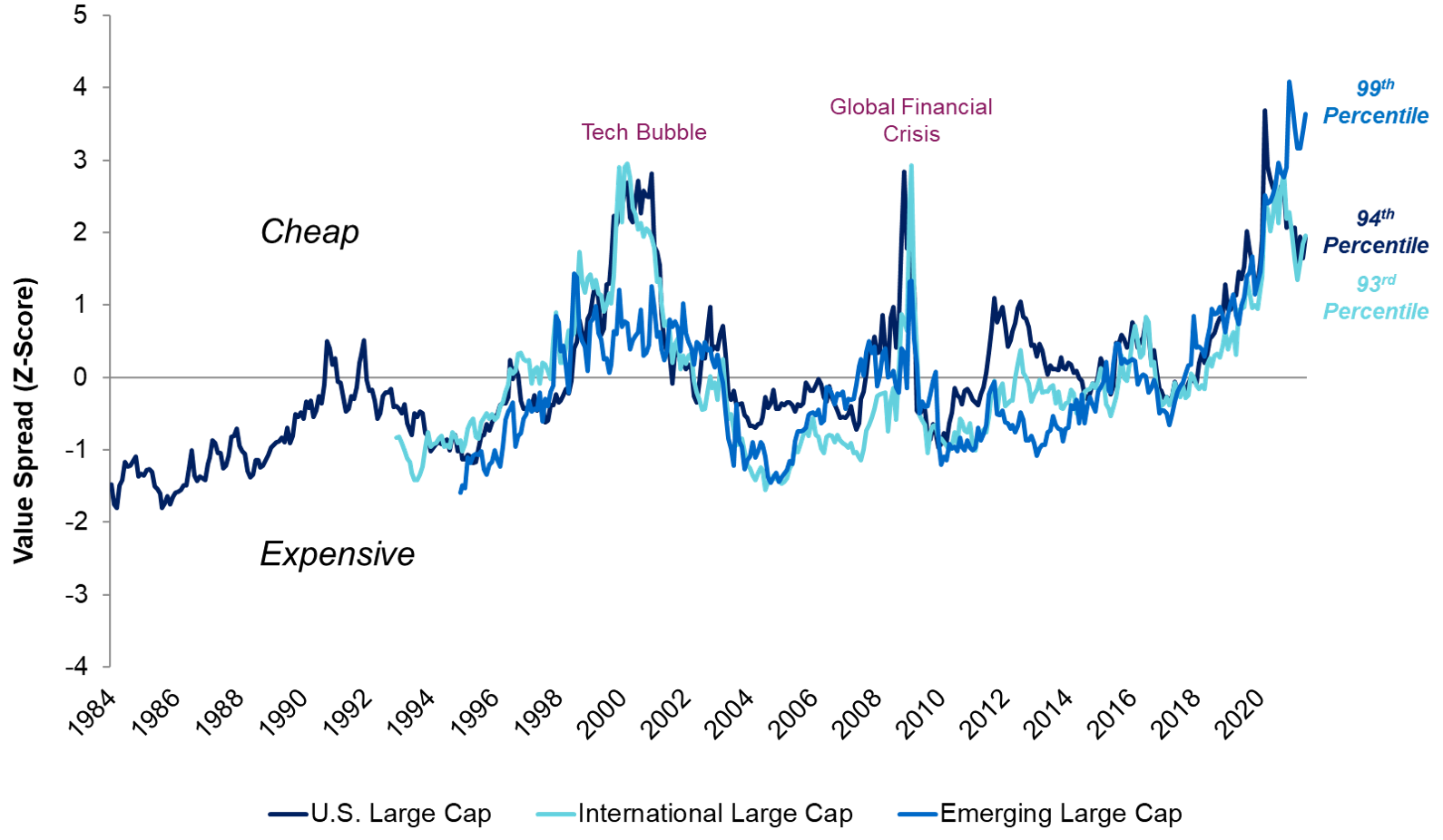
Source: “Are Value Stocks Cheap for a Fundamental Reason?”. AQR Capital Management, 30-Aug-2021, aqr.com. Spreads are constructed using the Hypothetical AQR U.S. Large Cap, International, and Emerging Valuation Theme Models, and are adjusted to be dollar-neutral, but not necessarily beta-neutral through time. For illustrative purposes only and not representative of an actual portfolio AQR currently manages.
General market commentary doesn’t always capture the full picture of the markets. When you dig further into the details, you’ll often find a different story.
Given all of this information, we do not anticipate a major stock market correction in the short-term. But markets are unpredictable, and it’s possible a stock market correction may occur. If so, we don’t think that you should be alarmed, because stock market corrections are relatively common.[8] Since 1946, the S&P 500 has experienced a 5% drawdown every 7 months on average.[8] Similarly, 10% corrections have occurred every 22 months, and 20% corrections every 76 months (6.33 years) on average.[8] Despite all of these corrections, the S&P 500 has continued to march onward, returning 11% annually since 1946.[4]
In summary, there’s always something to worry about, but it’s rare that a well-known issue causes a major stock market correction. Most issues are well-known and analyzed by markets participants at every moment. Typically, it’s a surprise event that serves as the catalyst for a market selloff. Despite all of the surprise events of the past, global stock markets have remained resilient and have rewarded investors over the long-run.[9]
We believe that the best course of action for managing unexpected events is through controlling what you can, such as broad diversification with the appropriate balance of growth and stability in your portfolio. You can use market volatility as an opportunity to rebalance to your target asset allocation. As certain asset classes increase in value, you can look to reduce exposure, and as asset classes decline in value, you can look to add; the simple notion of selling high and buying low. There might also be an opportunity for tax loss harvesting.
By focusing on the long-term goals of your portfolio, you can reduce the temptation of making major changes based on short-term news events. There will always be something to worry about, but with the right portfolio design and disciplined approach, you can whether almost any storm.
Important Disclosure Information & Sources:
[1] “Daily Treasury Yield Curve Rates“. U.S. Department of the Treasury, 12-Oct-2021, treasury.gov.
[2] “S&P 500 (^GSPC)“. Yahoo Finance, 12-Oct-2021, finance.yahoo.com.
[3] “COVID-19 Projections”. Institute for Health Metrics and Evaluation, healthdata.org.
[4] “S&P 500”. Morningstar Direct, January 1930 - September 2021.
[5] “CRSP US Mega Cap Growth Index“. Morningstar Direct, 30-Sep-2021. The CRSP US Mega Cap Growth Index includes the largest U.S. companies, with a target of including the top 70% of investable market capitalization, ranked by various metrics to consider valuations.
[6] “CRSP US Small Cap Value Index“. Morningstar Direct, 30-Sep-2021. The CRSP US Small Cap Value Index focuses on the bottom 2% - 15% of US stocks by market capitalization, ranked by various metrics to consider valuations.
[7] “Are Value Stocks Cheap for a Fundamental Reason?“. AQR Capital Management, 30-Aug-2021, aqr.com.
[8] “Putting Pullbacks in Perspective“. Guggenheim Investments, August 2021, guggenheiminvestments.com.
[9] “Stocks for the Long Run”. Jeremy Siegel, 2014, Wharton School Press.
There is no guarantee investment strategies will be successful. Past performance is no guarantee of future results. Diversification neither assures a profit nor guarantees against a loss in a declining market.
Statements contained in this article that are not statements of historical fact are intended to be and are forward looking statements. All forward looking statements are inherently uncertain as they are based on various expectations and assumptions concerning future events and they are subject to numerous known and unknown risks and uncertainties which could cause actual events or results to differ materially from those projected.
Indices are not available for direct investment. Index performance does not reflect the expenses associated with management of an actual portfolio. Index performance is measured in US dollars. The index performance figures assume the reinvestment of all income, including dividends and capital gains. The performance of the indices was obtained from published sources believed to be reliable but which are not warranted as to accuracy or completeness.
Hyperlinks to third-party information are provided as a convenience and we disclaim any responsibility for information, services or products found on websites or other information linked hereto.
Suggested Reading

The Topic That Keeps Rising To The Top: Inflation
Before worrying too much about runaway prices and the inability to pay the rising costs, we believe it’s important to look at a few underlying factors.
By SJS Investment Services Chief Investment Officer Tom Kelly, CFA.
As the summer vacations and barbeques kick back into full swing, one conversation topic continues to rise to the top – inflation. Thankfully for many of us, gone are the days of masks, social-distancing, and awkward elbow bumps. The new “fear” is now, “Are things in the economy too good?” What a difference a year makes!
In last quarter’s SJS Outlook, our headline piece asked, “Inflation: Necessity or Risk? And What Should We Do?” Since then, inflation has continued to rise, as we’ve seen year-over-year inflation rates come in at 4.9% in May 2021 and 5.3% in June 2021, leading to continued questions and worries of “hyperinflation.”[1] However, before worrying too much about runaway prices and the inability to pay the rising costs, we believe it’s important to look at a few underlying factors.
As I mentioned earlier, what a difference a year makes. If you think back to all the uncertainty, and therefore lack of spending, that existed in Spring 2020, you would not be surprised to know that inflation was falling and near zero at this point last year. The year-over-year inflation numbers, which make the headlines, look a bit magnified because of where we were last year. When looking at prices compared to “pre-pandemic” levels, by observing annualized inflation over the last two years, inflation was only 3.0% in June 2021.[1]

“Consumer Price Index for All Urban Consumers: All Items in U.S. City Average”. U.S. Bureau of Labor Statistics, June 2021, fred.stlouisfed.org.
Additionally, when breaking down some of the components of inflation, indications point to some of the main causes of the recent rise as more transitory vs. pervasive. As of June 2021, areas such as airline fares (up 25% from a year ago) and used cars & trucks (up 45% from a year ago, due largely to a chip shortage) suggest that pent-up demand and temporary supply chain bottlenecks will lead to the dramatic rises being short-lived rather than enduring.[2][3]
We welcome the continued growth of the economy and potential of increased inflation as opposed to the alternate reality of stagnation and weak economy. Could inflation become a major problem? Certainly. Do we think inflation is a major problem right now? Probably not. Should you make drastic moves to ward it off? Not prudent in our opinion.
As Mark Twain purportedly said, “It ain’t what you don’t know that gets you into trouble. It’s what you know for sure that just ain’t so.” We continue to be humble about what we don’t know – the direction of inflation and corresponding market movements included – and focus on what we can control: designing portfolios to help you achieve your financial goals and putting you first. All the time. Every time.
Important Disclosure Information & Sources:
[1] “Consumer Price Index for All Urban Consumers: All Items in U.S. City Average”. U.S. Bureau of Labor Statistics, June 2021, fred.stlouisfed.org. US Bureau of Labor Statistics Consumer Price Index All Urban Seasonally Adjusted is a measure of the average monthly change in the price for goods and services paid by urban consumers between any two time periods. It can also represent the buying habits of urban consumers. This particular index includes roughly 88 percent of the total population, accounting for wage earners, clerical workers, technical workers, self-employed, short-term workers, unemployed, retirees, and those not in the labor force.
[2] “Consumer Price Index for All Urban Consumers: Airline Fares in U.S. City Average“. U.S. Bureau of Labor Statistics, June 2021, fred.stlouisfed.org.
[3] “Consumer Price Index for All Urban Consumers: Used Cars and Trucks in U.S. City Average“. U.S. Bureau of Labor Statistics, June 2021, fred.stlouisfed.org.
There is no guarantee investment strategies will be successful. Past performance is no guarantee of future results. Diversification neither assures a profit nor guarantees against a loss in a declining market.
Statements contained in this report that are not statements of historical fact are intended to be and are forward looking statements. All forward looking statements are inherently uncertain as they are based on various expectations and assumptions concerning future events and they are subject to numerous known and unknown risks and uncertainties which could cause actual events or results to differ materially from those projected.
Hyperlinks to third-party information are provided as a convenience and we disclaim any responsibility for information, services or products found on websites or other information linked hereto.
Suggested Reading

Why Do Investors Underperform?
We want to emphasize six aspects of investor psychology - also known as cognitive biases - that tend to hurt investor performance, and what investors can do to address these biases.
By SJS Investment Services Investment Associate Bobby Adusumilli, CFA.
Over the past 40 years, advances in investment offerings and technology have provided investors with far more opportunities to invest in stocks and bonds compared to the past. From their laptops, people can now invest in markets all around the world. Mutual fund and ETF expense ratios have been decreasing, with many index mutual funds and ETFs approaching a 0.00% expense ratio.[1] Congress has created tax-advantaged accounts such as IRAs, 401(k)s, 529 plans, and HSAs to encourage people to invest while saving on taxes over time.[2] And more recently, many brokerage firms no longer charge trading commissions on stock and bond trades.[3]
Given all of these advances, you would think that investors have gotten better at earning their fair share of investment returns. However, you may be surprised to learn that most stock and bond investors in the US still significantly underperform the market averages.
For example, as of 31-Dec-2019, DALBAR found that the average equity mutual fund investor underperformed the S&P 500 (a benchmark for the US stock market) by nearly 5% annually over a 30-year span.[8] For a $100,000 initial investment, that’s a 30-year ending portfolio balance of $437,161 for the average equity mutual fund investor compared to $1,726,004 for the S&P 500.[4]
What explains this underperformance? We think that part of the explanation is that many investors trade too much, as well as pay too much in transaction fees (including bid-ask spreads), high expense ratios, and unnecessary taxes. However, we think a bigger part of the explanation relates to investor psychology. In particular, we want to emphasize six aspects of investor psychology - also known as cognitive biases - that tend to hurt investor performance, and what investors can do to address these biases.[5]
Overconfidence
Overestimating our skills or circumstances, which interferes with our ability to make good decisions. For example, when evaluating a particular investment, an investor may feel really confident that they have a much better analysis than the general market.
Loss Aversion
The tendency to be driven more strongly to avoid losses than to achieve gains. For example, even when presented with better investment opportunities, an investor may decide to keep holding a stock that has declined in value until it can be sold at a gain.
Confirmation Bias
The tendency to seek out and interpret information that confirms or strengthens our existing beliefs. For example, after making an investment in a particular stock, an investor may actively search for news and analyses that support the decision to invest, as opposed to considering other news or alternative analyses.
Recency Bias
Believing that recent events are more likely to occur than they actually are. For example, a year after a major stock market downturn, many investors still avoid investing because they believe that another major downturn is likely to happen in the short-term.
Endowment Effect
The tendency to place more value on an investment that you own compared to the price it can be purchased / sold at on the open market. For example, particularly for an inherited stock or stock in the family business, an investor may value their shares more than the current market price.
Optimism Bias
The belief that our chances of experiencing negative events are lower and our chances of experiencing positive events are higher than the averages. For example, many investors believe that if they just have good returns over the short-term, they will be much happier and better off in the future.
What Can You Do About Your Cognitive Biases?
Cognitive biases are easy to write about, but hard to actually prevent from negatively impacting our investment returns. Based on our years working with clients, we find that the below actions tend to help investors achieve better investment returns:
Define Your Circle Of Competence, And Don’t Stray Beyond That
There are many different investment styles that have helped people become wealthy over time. However, because there are so many investors competing to find the best investments, many top investors only focus on one particular style of investing that they understand really well, and don’t even consider other potential investments. This frees them to focus on what they do best, and ignore everything else.
Create Strategies And Systems That Do The Work For You
Instead of making a new decision each time you have money to invest (which is often stressful and time-consuming), you can instead create a strategy and system that automatically makes the decision for you. For example, many of our clients benefit from the below investment process:
Invest in broadly-diversified, low-cost, tax-efficient global mutual funds and ETFs.
Maximize contributions to tax-advantaged accounts, such as IRAs, 401(k)s, and HSAs.
Dollar-cost average: every time you have money to invest, immediately invest according to your pre-specified asset allocation.
Have a pre-specified and largely automated rebalancing strategy.
Cap Your Downside Risks
As investor Warren Buffett says about investing: “Rule Number 1: Never lose money. Rule Number 2: Don’t forget Rule Number 1.“ When deviating from a well-crafted and implemented investment strategy, much more can go wrong than can go right. We generally advise for investors to limit all of their niche investments to less than 10% of their overall portfolio. Additionally, we encourage investors to have an emergency fund with six months' worth of expenses, as well as all appropriate insurance coverage, in order to protect themselves in case something happens to them or their investments.
Respect The Averages, And Only Deviate From Your Plan If You Actually Have An Advantage
Many studies have found that investors who buy and hold broadly-diversified, low-cost, global index mutual funds and ETFs outperform the vast majority of investors over the long-term.[6] Investing in stocks and bonds is extremely competitive. As a result, if you don’t have a particular competitive advantage, or if you are not able to spend the necessary hours to do thorough research on a regular basis, then you probably won’t benefit from attempting to time the market or investing in niche investments.
More Money Probably Won’t Make You Much Happier
Through his research, Nobel-Prize-winning psychologist Daniel Kahneman has found that while being poor makes people miserable, for most people with a basic level of wealth, more wealth does not significantly increase day-to-day well-being.[7] Once an investor has a good investment strategy in place and reviews this strategy periodically, spending more time analyzing investments is unlikely to significantly improve investment returns or make someone happier over time.[4][6][7]
Summary
As the data shows for the majority of people, investing well over the long-term is tough.[4][6] By understanding ourselves better and creating well-thought-out & systematic investment processes, we think that investors are more likely to earn their fair share of investment returns over time.
Important Disclosure Information & Sources:
[1] “Pay Attention to Your Fund’s Expense Ratio“. Jean Folger, 27-Oct-2020, investopedia.com.
[2] “The Basics of a 401(k) Retirement Plan“. Mark Cussen, 29-Mar-2021, investopedia.com.
[3] “In the race to zero-fee broker commissions, here’s who the big winner is“. James Royal, 04-Oct-2019, bankrate.com.
[4] “2020 QAIB Report”. DALBAR, 2020, wealthwatchadvisors.com.
[5] How to Decide. Annie Duke, 2020, Portfolio / Penguin.
[6] Unconventional Success: A Fundamental Approach to Personal Investment. David Swensen, 2005, Free Press.
[7] Thinking, Fast and Slow. Daniel Kahneman, 2013, Farrar, Straus and Giroux.
There is no guarantee investment strategies will be successful. Past performance is no guarantee of future results. Diversification neither assures a profit nor guarantees against a loss in a declining market.
Statements contained in this post that are not statements of historical fact are intended to be and are forward looking statements. Forward looking statements include expressed expectations of future events and the assumptions on which the expressed expectations are based. All forward looking statements are inherently uncertain as they are based on various expectations and assumptions concerning future events and they are subject to numerous known and unknown risks and uncertainties which could cause actual events or results to differ materially from those projected.
MarketPlus Investing® models consist of institutional quality registered investment companies. Investment values will fluctuate, and shares, when redeemed, may be worth more or less than original cost.
Advisory services are provided by SJS Investment Services, a registered investment advisor with the SEC. Registration does not imply a certain level of skill or training. SJS Investment Services does not provide legal or tax advice. Please consult your legal or tax professionals for specific advice. This material has been prepared for informational purposes only.
Certain advisors of SJS may recommend the purchase of insurance-related products. Certain advisors of SJS are licensed insurance agents with various insurance companies and may receive additional compensation for such transactions.
Indices are not available for direct investment. Their performance does not reflect the expenses associated with management of an actual portfolio.
The S&P 500 Index is a free float-adjusted market-capitalization-weighted index of 500 of the largest publicly traded companies in the United States.
Bloomberg Barclays US Aggregate Bond TR USD Index measures the performance of investment grade, U.S. dollar-denominated, fixed-rate taxable bond market, including Treasuries, government-related and corporate securities, MBS (agency fixed-rate and hybrid ARM passthroughs), ABS, and CMBS.
Inflation represented by the US Bureau of Labor Statistics Consumer Price Index All Urban Seasonally Adjusted, which is a measure of the average monthly change in the price for goods and services paid by urban consumers between any two time periods. It can also represent the buying habits of urban consumers. This particular index includes roughly 88 percent of the total population, accounting for wage earners, clerical workers, technical workers, self-employed, short-term workers, unemployed, retirees, and those not in the labor force.
Hyperlinks to third-party information are provided as a convenience and we disclaim any responsibility for information, services or products found on websites or other information linked hereto.
Suggested Reading

What You Need to Know Before You Invest Your Money
Smart investors do their homework, find people they can trust and use strategies that work for them. Here are three things investors must know about themselves.
MarketPlus Investing® Helps Investors Choose What’s Right for Them
By SJS Investment Services President Kevin Kelly, CFA.
With countless investment options available to you, with so much written about the state of the markets, the state of the economy, and the state of the world, deciding how to invest your money - whether it be your own or an organization’s - keeps getting more complicated. Smart investors do their homework, seek out people they can trust, and find investment strategies that work for them. In words, that sounds easy. In practice it isn’t very easy at all.
SJS Investment Services has spent decades helping people choose what’s right for them when it comes to investments through our proprietary investment process called MarketPlus Investing. And through it all, we have discovered the three most important things investors need to know about themselves before they invest.

WHO ARE THE PEOPLE YOU CARE ABOUT AND HOW DO YOU WANT TO TAKE CARE OF THEM?
In the course of conversation, SJS Investment Services gets to the core of what’s important. It might be a person or a cause, but until we know who you care about and how you want to take care of them, we don’t know enough about you to fully guide you.
WHAT IS YOUR TIME WINDOW? (OR, HOW LONG IS YOUR RUNWAY?)
How long before you or the people you care about need your money? This makes a big difference when determining an appropriate investment vehicle for you or your organization. Some individuals have a time window of twenty years or more. Others, including organizations, want investments that cover their expenses next month or next year. Between the extremes are an infinite number of scenarios, and each imply a different investment strategy.
HOW RISK AVERSE ARE YOU?
When asked this question, investors are often quick to say that they are comfortable with risk. But the reality is that many investors are more risk averse than they think. That’s why SJS Investment Services digs deeper than just this question to find out the real answer. And more importantly, we ask about necessary or desired return on an investment*, so we can help design an investment portfolio appropriate for you.
At SJS Investment Services, these three questions are just a part of getting to know you. The more we know about you, the better we can design a MarketPlus Investing portfolio for you. Because MarketPlus Investing is our proprietary science-based process of structuring investment portfolios to help people achieve their specific financial goals, there are countless options. And the more we know, the better we can apply the academic models, the market trend analysis and consider ever changing key indicators on your behalf. SJS Investment Services through MarketPlus Investing seeks to develop the right portfolio design to meet your needs.
Important Disclosure Information:
*There is no guarantee investment strategies will be successful. Past performance is no guarantee of future results. Diversification neither assures a profit nor guarantees against a loss in a declining market.
Advisory services are provided by SJS Investment Services, a registered investment advisor (RIA) with the SEC. Registration does not imply a certain level of skill or training. This material has been prepared for informational purposes only.
Hyperlinks to third-party information are provided as a convenience and we disclaim any responsibility for information, services or products found on websites or other information linked hereto.
Suggested Reading

Are Stocks Riskier Than Bonds?
You have probably heard the saying, “Stocks are riskier than bonds.” While the logic makes sense, are stocks actually riskier than bonds?
By SJS Investment Services Investment Associate Bobby Adusumilli, CFA.
You have probably heard the saying, “Stocks are riskier than bonds.” The idea is that if investors take greater risk, they should get rewarded with a higher return over time; therefore, since stocks are riskier than bonds, then stocks should have higher returns over time. While the logic seems to make sense, we wanted to look at the historical data to answer the question: are stocks actually riskier than bonds?
The answer is: it depends on how you define risk. If you define risk as portfolio fluctuations over the short-term, then stocks have generally been riskier than bonds. However, if you define risk as loss of wealth over the long-term, or as lost opportunity to grow wealth over the long-term, then you may be surprised to learn that stocks may not actually be much riskier than bonds.
We want to illustrate these points via graphs. We use the S&P 500 Index as representative of the U.S. stock market, and the Bloomberg Barclays U.S. Aggregate Bond Index as representative of the U.S. bond market.[1][2] We want to focus on increases in purchasing power, so we use the U.S. Consumer Price Index (CPI) to calculate real (inflation-adjusted) returns.[3] Additionally, in order to use as much reliable historical data as we can, we chose the S&P 500 Index that has available data since 1926, while the Bloomberg Barclays U.S. Aggregate Bond Index has data since 1976.
It’s important to emphasize that indices are not directly investable. Before the last few decades, it was difficult for an individual to invest similar to a broadly-diversified index in a low-cost, tax-efficient, trading-efficient way. Therefore, it is unreasonable to expect that any investor could have matched the index returns below. However, with the increasing popularity of index funds over the past 25 years, an individual investor has a much greater ability to achieve returns similar to a well-known index in a low-cost, tax-efficient, trading-efficient way going forward.[4]
Risk: Portfolio Fluctuations Over The Short-Term
The U.S. stock market tends to fluctuate a lot from year-to-year. Since 1926 using end-of-year data, yearly real returns have ranged from -38% to +58%, rarely staying flat.
![Source: Dimensional Returns Web. See “Important Disclosure Information” below.[1]](https://images.squarespace-cdn.com/content/v1/5ee8ee8eb4fb337e3b806c1e/1620415191588-HMRZRCBNT9WB2VWZR882/2021.05.14+One-Year+Real+Returns+-+S%26P+500+Index.png)
Source: Dimensional Returns Web. See “Important Disclosure Information” below.[1]
Comparatively, the U.S. fixed income market has been much more steady. Since 1976, yearly real returns have ranged from -10% to 27%, with most returns within the range of -7% to 7%.
![Source: Dimensional Returns Web. See “Important Disclosure Information” below.[2]](https://images.squarespace-cdn.com/content/v1/5ee8ee8eb4fb337e3b806c1e/1620415588202-8XV9W7OOGHZUL4L3AOR5/2021.05.14+One-Year+Real+Returns+-+Bloomberg+Barclays+U.S.+Aggregate+Bond+Index.png)
Source: Dimensional Returns Web. See “Important Disclosure Information” below.[2]
These graphs above support the argument that stocks are riskier than bonds, if you define risk as fluctuations in value over the short-term.
Risk: Loss Of Wealth Over The Long-Term
Since 1945 based on end-of-year data, the U.S. stock market has not had a negative 20-year real return. The annualized 20-year real returns have ranged from 1% to 15%.
![Source: Dimensional Returns Web. See “Important Disclosure Information” below.[1]](https://images.squarespace-cdn.com/content/v1/5ee8ee8eb4fb337e3b806c1e/1620415659708-E17JQW7W4UU8USDJY8RF/2021.05.14+Rolling+20-Year+Real+Annualized+Returns+-+S%26P+500+Index.png)
Source: Dimensional Returns Web. See “Important Disclosure Information” below.[1]
Similarly since 1995, the U.S. bond market 20-year real return has never been negative. The annualized 20-year real returns have ranged from 3% to 7%, and have generally been steadier than the U.S. stock market.
![Source: Dimensional Returns Web. See “Important Disclosure Information” below.[2]](https://images.squarespace-cdn.com/content/v1/5ee8ee8eb4fb337e3b806c1e/1620415710802-QJP1FYOGKXTQ4N5A9763/2021.05.14+Rolling+20-Year+Real+Annualized+Returns+-+Bloomberg+Barclays+U.S.+Aggregate+Bond+Index.png)
Source: Dimensional Returns Web. See “Important Disclosure Information” below.[2]
It’s surprising, but if you define risk as loss of wealth over the long-term, then U.S. stocks have not actually been much riskier than U.S. bonds over longer-term periods.
Why This Matters
You may be wondering why the definition of risk matters. To demonstrate, this graph below shows the real growth of $100 for both the U.S. stock market and U.S bond market since 1976. Although U.S. stocks had significantly greater short-term fluctuations than U.S. bonds, $100 grew to $3,184 for the U.S. stock market, compared to $510 for the U.S bond market. A big difference.
![Source: Dimensional Returns Web. See “Important Disclosure Information” below.[1][2]](https://images.squarespace-cdn.com/content/v1/5ee8ee8eb4fb337e3b806c1e/1620415766061-MAZSITG7UIK5VMBBF5JD/2021.05.14+Real+Growth+of+100+Dollars+-+S%26P+500+Index+and+Bloomberg+Barclays+U.S.+Aggregate+Bond+Index.JPG)
Source: Dimensional Returns Web. See “Important Disclosure Information” below.[1][2]
If you define risk as short-term fluctuations in value, then you may be tempted to invest more in bonds than in stocks. Conversely, if you define risk as long-term loss of wealth or lost opportunity to grow wealth, then you may be able to better withstand the yearly fluctuations in favor of more stocks. As Jeremy Siegel wrote in his best-selling book, you may be able to commit yourself to “stocks for the long run”.[5]
Considerations
Because of evolving needs, many investors use different definitions of risk at different periods of time as well as for different accounts. There are many legitimate reasons to focus on short-term portfolio fluctuations - and thus potentially invest more in bonds - including:
Cash flow needs in the short-term and / or intermediate-term
Potential expected return benefits through diversification and rebalancing
Belief that the stock market will not continue to provide positive returns in the future
Ability to psychologically withstand large market fluctuations
Focusing more on current self compared to future self
If you have varying goals and time horizons for your wealth, then you can consider the following:
For shorter-term (<5 years) cash flow needs, you can define risk as short-term portfolio fluctuations, and focus more on bonds.
For longer-term (10+ years) investing (e.g., 401(k), IRA, savings for future children / grandchildren), you can define risk as long-term loss of wealth, and focus more on stocks.
For intermediate-term (5-10 years) cash flow needs, you can combine the definitions of risk, and use a balanced portfolio of stocks and bonds.
Conclusion
Many investors have greatly benefitted from investment markets historically (particularly stocks), and we expect investors to continue to benefit going forward.[6] Defining how you think about risk can significantly impact your future returns. If you have any questions or want to talk about your situation, please feel free to reach out to us.
Important Disclosure Information & Sources:
[1] The S&P 500 Index is a free float-adjusted market-capitalization-weighted index of 500 of the largest publicly traded companies in the United States.
[2] The Bloomberg Barclays US Aggregate Bond TR USD Index measures the performance of investment grade, U.S. dollar-denominated, fixed-rate taxable bond market, including Treasuries, government-related and corporate securities, MBS (agency fixed-rate and hybrid ARM passthroughs), ABS, and CMBS.
[3] The US Bureau of Labor Statistics Consumer Price Index (CPI) All Urban Seasonally Adjusted is a measure of the average monthly change in the price for goods and services paid by urban consumers between any two time periods. It can also represent the buying habits of urban consumers. This particular index includes roughly 88 percent of the total population, accounting for wage earners, clerical workers, technical workers, self-employed, short-term workers, unemployed, retirees, and those not in the labor force.
[4] “Index Funds Are the New Kings of Wall Street“. Dawn Lim, 28-Sep-2019, wsj.com.
[5] “Stocks for the Long Run 5/E: The Definitive Guide to Financial Market Returns & Long-Term Investment Strategies“. Jeremy Siegel, 2014, McGraw-Hill Education.
[6] “SJS 2021 Capital Markets Expectations: Making Sense Of The Future“. SJS Investment Services, 04-Feb-2021, sjsinvest.com/blog.
There is no guarantee investment strategies will be successful. Past performance is no guarantee of future results. Diversification neither assures a profit nor guarantees against a loss in a declining market.
Indices are not available for direct investment. Index performance does not reflect the expenses associated with management of an actual portfolio. Index performance is measured in US dollars. The index performance figures assume the reinvestment of all income, including dividends and capital gains. The performance of the indices was obtained from published sources believed to be reliable but which are not warranted as to accuracy or completeness.
Statements contained in this report that are not statements of historical fact are intended to be and are forward looking statements. Forward looking statements include expressed expectations of future events and the assumptions on which the expressed expectations are based. All forward looking statements are inherently uncertain as they are based on various expectations and assumptions concerning future events and they are subject to numerous known and unknown risks and uncertainties which could cause actual events or results to differ materially from those projected.
Hyperlinks to third-party information are provided as a convenience and we disclaim any responsibility for information, services or products found on websites or other information linked hereto.
Suggested Reading

The Case For International Diversification
While history has shown that US stock markets have handily outperformed international developed markets in nine of the last eleven calendar years, we may be due for a sea change.
By SJS Investment Services Managing Director & Senior Advisor Jennifer Smiljanich, CFP®.
We believe that diversification is one of the foundational principles of investing. While many of us might have a favorite stock or two, it is not ideal for most of us to invest in just a few names or in particular parts of the market, such as sectors, countries, or regions. While concentrating portfolios may certainly be a way to create wealth, it also concentrates risk.
Rather, if your concern is to protect your investments, reducing risk by investing across a broad spectrum of asset types may be the better strategy. American film producer Jerry Bruckheimer may have said it best:[1]
I mean if you put all of your eggs in one basket, boy, and that thing blows up you've got a real problem.
Film-making aside, as investors, we know that it is difficult to be able to predict the best part of the market to invest in over any length of time. Case in point, who would have predicted the strong US stock market performance of 2020, especially if we go back to March of last year?[2] While history has shown that US stock markets (as represented by the S&P 500 Index) have handily outperformed international developed markets (as represented by the MSCI EAFE Index) in nine of the last eleven calendar years, we may be due for a sea change. From 2002-2009, it was international stock markets that outpaced US stock markets.[2]
![Source: Morningstar, as of 31-Dec-2020. See Important Disclosure Information.[2]](https://images.squarespace-cdn.com/content/v1/5ee8ee8eb4fb337e3b806c1e/1618255474909-GOWAEJMDJW2GEKK4BV51/2021.04.13+Returns+-+S%26P+500+and+MSCI+EAFE+Index.JPG)
Source: Morningstar, as of 31-Dec-2020. See Important Disclosure Information.[2]
Another potential benefit of global diversification is exposure to different currencies. Diversified currency exposure can protect your portfolio from unexpected risks, such as inflation. Given the start of a weakening dollar, international markets might again take the lead in the performance race. When the US dollar weakens, international stocks are worth more in US dollar terms. This was generally true from 2001-2010, when the international markets last experienced their stretch of outperformance.[3]
![Source: “U.S. Dollar Index (DXY)”. Wall Street Journal, 30-Mar-2021, wsj.com. See Important Disclosure Information.[3]](https://images.squarespace-cdn.com/content/v1/5ee8ee8eb4fb337e3b806c1e/1618255547651-3O2T0CX5NQL5EHOQCTKM/2021.04.13+US+Dollar+Index.JPG)
Source: “U.S. Dollar Index (DXY)”. Wall Street Journal, 30-Mar-2021, wsj.com. See Important Disclosure Information.[3]
As we enter the modified “Awards Season,” cinema buffs may recall the 2020 Oscar for Best Picture went to the foreign film Parasite, which became the first non-English language film to win the Academy Award for Best Picture.[4] Could this be a coincidental foreshadowing of what’s to come in the markets? We’ll have to wait and see what the envelope holds! But know that you can sit back, relax, and enjoy the show, knowing that your MarketPlus Portfolio is well diversified and strives to be positioned for whatever the future brings.
Important Disclosure Information & Sources:
[1] “Jerry Bruckheimer Quotes”. quote.org.
[2] Morningstar, as of 31-Dec-2020. The S&P 500 Index is a free float-adjusted market-capitalization-weighted index of 500 of the largest publicly traded companies in the United States. The MSCI EAFE GR USD Index is a free float-adjusted market-capitalization-weighted index that measures the performance of the large and mid cap segments of developed markets, excluding the US & Canada equity securities.
[3] “U.S. Dollar Index (DXY)”. Wall Street Journal, 30-Mar-2021, wsj.com. The U.S. Dollar Index (USDX, DXY, DX) is an index (or measure) of the value of the United States dollar relative to a basket of foreign currencies, often referred to as a basket of U.S. trade partners' currencies.
[4] “Parasite (2019 film)”. Wikipedia, en.wikipedia.org.
There is no guarantee investment strategies will be successful. Past performance is no guarantee of future results. Diversification neither assures a profit nor guarantees against a loss in a declining market.
Indices are not available for direct investment. Their performance does not reflect the expenses associated with management of an actual portfolio.
MarketPlus Investing® models consist of institutional quality registered investment companies. Investment values will fluctuate, and shares, when redeemed, may be worth more or less than original cost.
Hyperlinks to third-party information are provided as a convenience and we disclaim any responsibility for information, services or products found on websites or other information linked hereto.
Suggested Reading
Inflation: Necessity or Risk? And What Should We Do?
We believe economic inflation is a real risk - the other edge of the sword in contrast to the risk of stock-market volatility that is so often referenced in investment-risk discussions.
By SJS Investment Services President Kevin Kelly, CFA.
Have you ever had a flat? Re-inflating the tire is a good thing!
Ever over-inflated a tire? Or a balloon? Not so good!
Coming off the severe economic disruption from the early months of the COVID pandemic, you could justifiably argue that daily commerce had a flat tire - or four!
Never fear! Our duly elected leaders in Washington of BOTH parties were ready to help - a few trillion dollars in stimulus payments ought to do the trick!
A classic characterization of economic inflation, or its cause, is “too many dollars chasing too few goods.”
Of course, it is never quite that simple.
While “Money Supply” has increased measurably from this time one year ago, significant slack remains in our U.S. economy such that the “Velocity of Money,” or how frequently a dollar changes hands, has plummeted from the pre-pandemic rate. Both have an influence on inflation.[1][2]

Source: “Inflation, consumer prices for the United States“. Federal Reserve Bank of St. Louis, 03-Mar-2021, research.stlouisfed.org.
Anecdotally, we can point to price increases in housing, automobiles, some groceries, and fill-in-the-blank here based on your personal experience. Asset prices have increased as reflected by the stock market.[3] Producer Price Indices have surged, but this may not sustain as supply chains recover and stabilize.[4] The value of a dollar is on a downward trend compared to many foreign currencies.[5] The “breakeven inflation rate” indicated by the U.S. Treasury bond market suggests a 10-year rate of inflation approaching 2.4%, the highest this indicator has been in about eight years.[6]
But “what to do” quickly becomes the punchline, whether you anticipate inflation or not. SJS professionals believe economic inflation is a real risk - the other edge of the sword in contrast to the risk of stock-market volatility that is so often referenced in investment-risk discussions.
A primary motivation for taking investment risk to begin with is to maintain and grow the purchasing power of your assets. With cash deposits receiving close to a zero-percent rate of return, a general inflation rate of 2.4% will erode your purchasing power in a meaningful way over a period of years unless you invest beyond cash.
We recently “benchmarked” our model portfolios against the Consumer Price Index (CPI) to demonstrate
this inflation-beating characteristic of our investment strategies.

Benchmark: “Consumer Price Index for All Urban Consumers: All Items in U.S. City Average (CPIAUCSL)”. Federal Reserve Bank of St. Louis, 31-Mar-2021, research.stlouisfed.org. See Important Disclosure Information.
Your MarketPlus Investing® design has allocations to inflation-adjusted bonds and inflation-hedging stocks for environments such as our current one. No hedge or adjustment is perfect, and inflation can put stress on your household budget no matter what. But as “professional worriers,” planners, and managers, your team at SJS has anticipated inflation and works daily on your behalf to align your investments with current valuations, our outlook on the markets, and your best interests.
We can all agree that a flat tire or a stalled economy is not a desirable state of affairs. Let’s hope the government stimulus spending, a resurgent economy, and inflationary dynamics find the right balance and keep us on a steady road of progress in the quarters and years ahead!
Important Disclosure Information And Sources:
[1] “M2 Money Stock (M2SL)“. Federal Reserve Bank of St. Louis, 25-Mar-2021, research.stlouisfed.org.
[2] “Velocity of M2 Money Stock (M2V)“. Federal Reserve Bank of St. Louis, 25-Mar-2021, research.stlouisfed.org.
[3] “MSCI ACWI IMI Index (USD)“. MSCI, 31-Mar-2021, msci.com.
[4] “Producer Price Indexes (PPI)“. Federal Reserve Bank of St. Louis, 25-Mar-2021, research.stlouisfed.org.
[5] “Foreign Exchange Rates - H.10“. Board of Governors of the Federal Reserve System, 05-Apr-2021, federalreserve.gov.
[6] “10-Year Breakeven Inflation Rate (T10YIE)“. Federal Reserve Bank of St. Louis, 31-Mar-2021, research.stlouisfed.org.
Past performance does not guarantee future results.
SJS Investment Services (SJS) has created hypothetical performance returns for each of its MarketPlus® Asset Allocation Models. The hypothetical performance was calculated by applying the actual performance of a mutual fund to the asset class percentage within a MarketPlus® Asset Allocation Model. The Model Portfolio Historic Returns do not reflect actual trading or the performance of actual accounts. Actual client results may be materially different than the hypothetical returns. All returns presented include reinvestment of dividends and other earnings. The hypothetical results presented reflect the deduction of a 1.10% annual SJS advisory fee, the maximum fee charged. Advisory fee may be less than illustrated. Performance may be reduced by other fees charged by your custodian. The effect of fees and expenses on performance will vary with the relative size of the fee and account performance. Please refer to Part 2A of SJS’ Form ADV for additional information on SJS’ advisory fees.
There are inherent risks in the presentation of hypothetical performance data because the data may no t reflect the impact of material economic and market factors. The results presented reflect the effect that material market and economic conditions had on the actual performance of the underlying mutual funds but does not reflect the impact that these factors might have had on decision-making.
Hyperlinks to third-party information are provided as a convenience and we disclaim any responsibility for information, services or products found on websites or other information linked hereto.