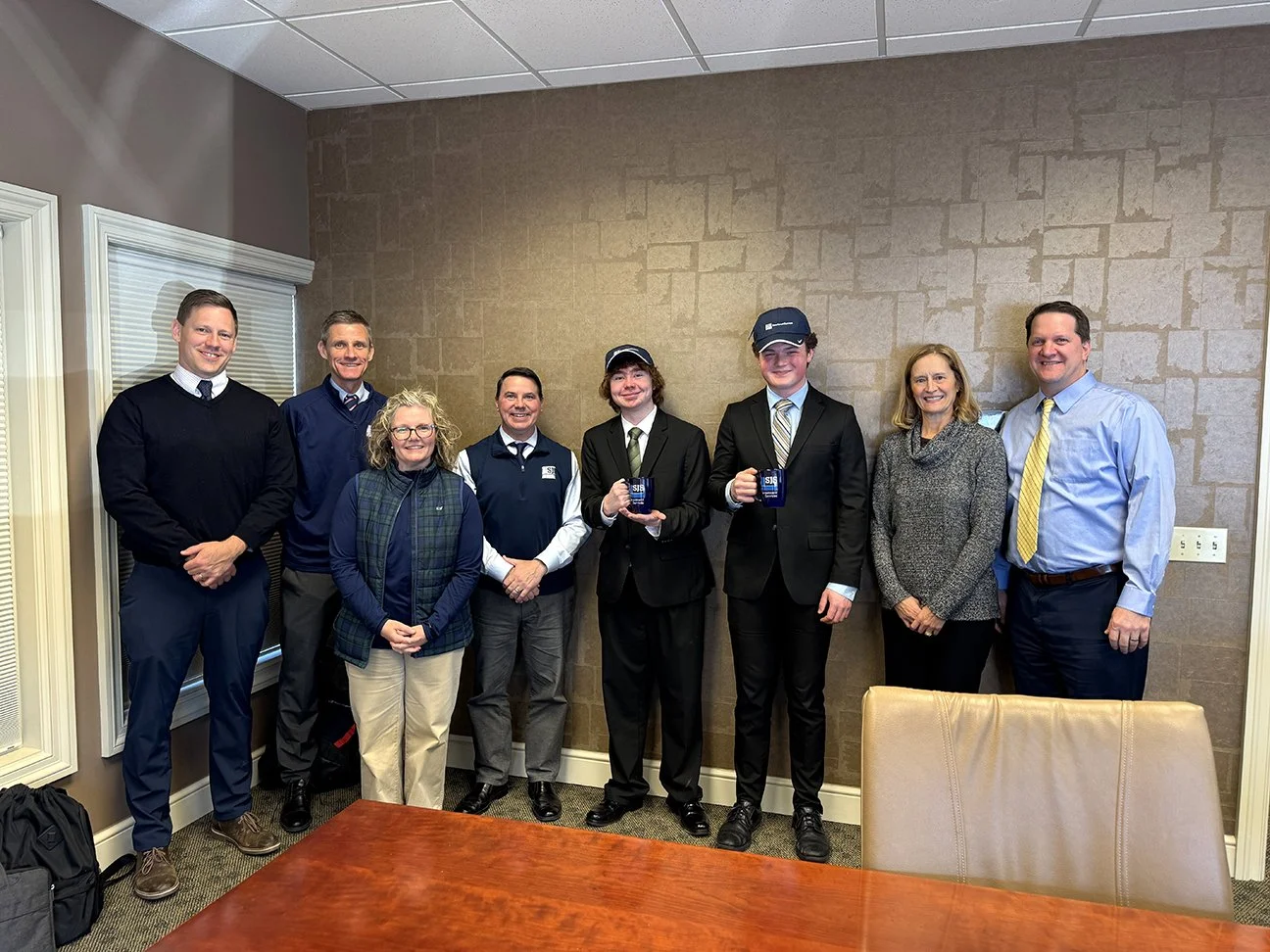
SJS Outlook: Q1 2025
SJS Q1 2025 Outlook includes a market update, team highlights, SJS book club insights and important information on the social security fairness act.
SJS 2024 Annual Report
The SJS Annual Report provides updates on the SJS Team, MarketPlus Investing®, SJS purpose, mission, & values, multi-family office services, and SJS community involvement.
Protecting Your Personal Information and Financial Assets
While the returns on your investments are important, so is the safety of your personal information and assets.

While the returns on your investments are important, so is the safety of your personal information and assets. With technology advancements in recent years, protecting your information is becoming as important as ever. We have been updating our practices and policies to ensure that your information and assets remain secure.
We also want to emphasize some best practices that can help us work together on this:
MULTI-FACTOR AUTHENTICATION
Using an additional login layer, like an authentication app, PIN, email, or text message, greatly reduces the risk of your data being compromised.
SHARING INFORMATION SECURELY
Sending sensitive information via email can expose your data to hackers. To share it more securely, use a trusted document-sharing portal (like MySJS Portal), password-protect the file, encrypt the email, or consider mailing physical documents.
SKEPTICAL OF REQUESTS FOR SENSITIVE INFORMATION
Our rule is that all information requests are considered illegitimate unless proven otherwise. Also, for one-time requests to withdraw money, SJS requires verbal confirmation.
AVOID PUBLIC COMPUTERS AND WI-FI
Public computers and Wi-Fi are common ways hackers access personal information. When security is a concern, using a personal Wi-Fi hotspot from your cell phone is a safer alternative.
STORING YOUR PERSONAL INFORMATION IN SAFE PLACES
Store personal information securely, whether digital or physical, and share it only with trusted people and services. Use secure online password storage, password-protected files, or a safe-deposit box in a hidden location.
CHECK YOUR CREDIT REPORTS AND FREEZE YOUR CREDIT
The three major credit bureaus—Equifax, Experian, and TransUnion—offer free annual credit report checks. To protect your information, consider freezing your credit with each bureau and only unfreezing it when needed.
WHEN IN DOUBT, MEET IN PERSON
Despite the many communication technologies available, in-person interactions are often the most effective and secure way to get work done.
We’re always happy to meet with you to discuss ways to better protect your information. Contact your advisor today!
Important Disclosure Information:
Statements contained in this article that are not statements of historical fact are intended to be and are forward looking statements. Forward looking statements include expressed expectations of future events and the assumptions on which the expressed expectations are based. All forward looking statements are inherently uncertain as they are based on various expectations and assumptions concerning future events and they are subject to numerous known and unknown risks and uncertainties which could cause actual events or results to differ materially from those projected.
Advisory services are provided by SJS Investment Services, a registered investment advisor (RIA) with the SEC. Registration does not imply a certain level of skill or training. SJS Investment Services does not provide legal or tax advice. Please consult your legal or tax professionals for specific advice.
Planning Financially For The New Year
As we begin the new year, we have some ideas for concrete actions to start your new year on the right foot, financially.
By Advisor Bobby Adusumilli, CFA.
As we begin the new year, we have some ideas for concrete actions to start your new year on the right foot, financially.
Review retirement contributions and gifting goals: In 2025, the IRS is boosting retirement contribution limits to new highs, as detailed in the table below. The IRS is also increasing the amount you may gift to an individual recipient to $19,000 in 2025, without affecting lifetime gift tax exemptions.
2025 Select Retirement Plan Contribution Limits
Source: “Retirement Topics - Contributions”. IRS, irs.gov. See Important Disclosure Information
Notify your accountant: It is important to notify your accountant of any contributions or donations that may have a tax consequence, as your tax documents may not explicitly state all of your contributions and donations. For example, retirement plan contributions, charitable donations (particularly qualified charitable distributions (QCDs) from your Traditional IRA if you are over age 70 1/2), and 529 plan contributions can all potentially help you save on taxes. Also, if you are invested in private funds, notify your accountant that you may not receive K-1 tax forms until later in 2025.
Keep SJS apprised of trusted advisor changes: We want to keep up with changes affecting your family, including changes to your attorney, accountant, or banker. Please let us know if you have made changes to the professionals you work with.
Update your estate plan: It is a good practice to regularly review your beneficiary designations to ensure they match your current wishes and align with your estate planning documents. Reviewing your estate planning documents periodically is also recommended, at least every five years or when there is a major change in your life.
Keep your wealth protected: Wealth accumulation is only part of the equation; the other piece is wealth protection. We strive to help keep your personal data safe, including avoiding sending personal information via email (unless encrypted) and reaching out to you to confirm that requests we receive from you are legitimate. Taking additional steps like adding multi-factor authentication and changing passwords periodically can help to keep your information safe.
As always, we are here to help you put your best foot forward. We are glad to meet with you to help keep you on track!
Important Disclosure Information:
There is no guarantee investment strategies will be successful. Past performance is no guarantee of future results. Diversification neither assures a profit nor guarantees against a loss in a declining market.
Statements contained in this article that are not statements of historical fact are intended to be and are forward looking statements. All forward looking statements are inherently uncertain as they are based on various expectations and assumptions concerning future events and they are subject to numerous known and unknown risks and uncertainties which could cause actual events or results to differ materially from those projected.
Advisory services are provided by SJS Investment Services, a registered investment advisor with the SEC. Registration does not imply a certain level of skill or training. SJS Investment Services does not provide legal or tax advice. Please consult your legal professional or tax professional for specific advice.
Suggested Reading
SJS Outlook: Q4 2024
This Outlook includes a letter from Scott J. Savage on gratitude and excitement, what the yield curve means for you, planning financially for the new year, SJS puppy, and looking forward to Q1 2025.
Financial To-Dos Before The End Of The Year
As we approach the end of the year, we want to highlight some important financial items to review before the new year.
By Investment Associate Bobby Adusumilli, CFA.
As we approach the end of the year, we want to highlight some important financial items to review before the new year:
Contributing to workplace retirement plans, health savings accounts, and 529 plans for education: Each of these accounts help you to save and potentially invest in tax-advantaged ways, though all contributions need to be completed prior to December 31st.
Required minimum distributions (RMDs) from pre-tax retirement plans: For those age 72+ who need to take RMDs from retirement accounts such as a Traditional IRA, ensuring that your RMDs are satisfied prior to December 31st can help you avoid a potential financial penalty from the IRS.
Charitable donations as well as gifting to loved ones: Particularly in a positive return investment year, it may be advantageous to donate appreciated securities from a taxable account. Additionally, for those age 70.5+, you are able to make qualified charitable distributions (QCDs) directly from your Traditional IRA worth up to $105,000 prior to December 31st. For those gifting to individuals, you can gift $18,000 per beneficiary without being subject to gift tax.
Private fund tax forms: For those investing directly in private funds, you may have received K-1 tax forms relating to your investments, which may need to be included as part of your taxes due by October 15th.
As always, we would be happy to assist you in reviewing your finances to help ensure you are achieving your financial goals.
Important Disclosure Information:
There is no guarantee investment strategies will be successful. Past performance is no guarantee of future results. Diversification neither assures a profit nor guarantees against a loss in a declining market.
Statements contained in this report that are not statements of historical fact are intended to be and are forward looking statements. Forward looking statements include expressed expectations of future events and the assumptions on which the expressed expectations are based. All forward looking statements are inherently uncertain as they are based on various expectations and assumptions concerning future events and they are subject to numerous known and unknown risks and uncertainties which could cause actual events or results to differ materially from those projected.
Advisory services are provided by SJS Investment Services, a registered investment advisor (RIA) with the SEC. Registration does not imply a certain level of skill or training. SJS Investment Services does not provide legal or tax advice. Please consult your legal or tax professionals for specific advice.
SJS Outlook: Q3 2024
This Outlook includes our discussion of election time, financial to-dos before the end of the year, new SJS Perrysburg office, SJS Team updates, and looking forward to Q4 2024.

Earning More Interest On Your Cash
While people commonly hold their cash within checking and savings accounts, we want to highlight three short-term, interest-bearing investments that can be held within your investment account.
By Investment Associate Bobby Adusumilli, CFA.
One of our roles as advisors is to look for opportunities to allow your money to work better for you. Cash is often one of the most overlooked assets when it comes to improving someone’s investment returns. People may have large amounts of cash for a variety of reasons: emergency fund, saving for a house down payment, planning to buy a new car, etc. We often see people accumulating cash in their checking account without really thinking about it. Particularly today, with short-term U.S. Treasury bonds paying upwards of 5% interest on an annualized basis, we view this as a missed opportunity to earn more interest.
There are many ways to potentially increase the amount of interest you receive on your cash savings while still investing in something that is low risk and readily transferable to your checking account within a few business days. While people commonly hold their cash within checking and savings accounts, we want to highlight three short-term, interest-bearing investments that can be held within your investment brokerage account:
Sources: Average Interest-Bearing Checking Account and Average Savings Account: "Bankers Resource Center: National Rates and Rate Caps". FDIC, 20-May-2024, fdic.gov. Schwab Value Advantage Money Fund (SWVXX): "Schwab Value Advantage Money Fund® - Investor Shares". Charles Schwab, 31-May- 2024, schwabassetmanagement.com. One-Month Treasury Bill: "Daily Treasury Par Yield Curve Rates". U.S. Department of the Treasury, 31-May-2024, treasury.gov. Dimensional Ultrashort Bond ETF: "DUSB: Ultrashort Fixed Income ETF". Dimensional Fund Advisors, 31-May-2024, dimensional.com. Yield will not necessarily equal realized returns. See Important Disclosure Information.
Money market fund: A mutual fund that continually invests in ultrashort-term (around one-month on average), high-quality bonds. Money market funds accrue interest daily (interest is typically paid monthly) and are not expected to fluctuate in price. As a mutual fund, they are subject to an expense ratio. A good proxy to determine how the interest rate of a money market fund may change over time is to take the interest of a one-month Treasury bill and subtract the expense ratio.
U.S. Treasuries: Treasury bills, notes, and bonds (Treasuries) are issued directly by the U.S. government for terms ranging from one month to thirty years, as detailed in the chart below. They are subject to federal income tax, but not state or local income tax. Treasury bonds are often cheaper to buy and hold than money market funds, though you have to decide what you want to do with the money when the Treasury matures. You can sell Treasuries before they mature, though the value does fluctuate if sold before maturity. You can buy Treasuries through most major investment brokerage platforms including Charles Schwab.
Ultrashort bond ETF: An ETF (exchange traded fund) that continually invests in ultrashort-term, investment-grade bonds. Ultrashort bond ETFs typically range in average maturity from three months to one year. Compared to a money market fund, ultrashort bond ETFs usually invest in slightly longer-term bonds and have more exposure to corporate bonds, though any additional risk is typically accompanied by higher expected interest. Many ultrashort bond ETFs have lower expense ratios than various money market funds. It is important to note that ultrashort bond ETFs will fluctuate in price to some degree.
With interest rates rising over the last few years, we have had a lot of conversations about cash with clients. If you would like to discuss ways you can earn more on your cash, please feel free to reach out to us.
Source: U.S. Department of the Treasury, as of June 30, 2024. See Important Disclosure Information.
Important Disclosure Information:
There is no guarantee investment strategies will be successful. Past performance is no guarantee of future results. Diversification neither assures a profit nor guarantees against a loss in a declining market.
Statements contained in this report that are not statements of historical fact are intended to be and are forward looking statements. Forward looking statements include expressed expectations of future events and the assumptions on which the expressed expectations are based. All forward looking statements are inherently uncertain as they are based on various expectations and assumptions concerning future events and they are subject to numerous known and unknown risks and uncertainties which could cause actual events or results to differ materially from those projected.
Advisory services are provided by SJS Investment Services, a registered investment advisor (RIA) with the SEC. Registration does not imply a certain level of skill or training. SJS Investment Services does not provide legal or tax advice. Please consult your legal or tax professionals for specific advice.
SJS Outlook: Q2 2024
This Outlook includes Founder & CEO Scott J. Savage’s gratitude for your 40 years of trust, how you can earn more interest on your cash, welcoming new SJS Team members, and looking forward to Q3 2024.
Protecting Your Personal Information & Financial Assets
We want to emphasize some best practices that can help us work together to ensure your information and assets remain safe.
By Investment / Compliance Associate Bobby Adusumilli, CFA.
While the returns of your investment portfolio are important, so are your personal information and assets. With technology advancements in recent years, protecting your information is becoming as important as ever. We have been updating our practices and policies to ensure that your information and assets remain secure. We also want to emphasize some best practices that can help us work together to ensure your information and assets remain safe:
Multi-Factor Authentication: When logging into various websites and programs, having at least one additional login layer - such as a pin number, email, text message, and / or authentication app - can significantly decrease the chances of your data getting compromised. In light of this, we recently made the decision to require multi-factor authentication for all MySJS Portals. While this adds an extra step for people logging in to their MySJS Portals, we believe this will help protect sensitive client information.
Sharing Information Securely: Simply sending an email with sensitive information is one of the easiest ways for hackers to access your data. Other ways to share your information more securely include using a trusted document-sharing portal (such as your MySJS Portal), password-protecting the relevant file, encrypting the email, and (old-school) mailing the relevant documents.
Skeptical Of Requests For Sensitive Information: Scammers are coming up with increasingly clever ways to ask for your information, such as sending convincing emails as well as phone calls pretending to be someone else (today, scammers can call from a phone number that you think is legitimate as well as use a voice software to sound like someone else). At SJS, our general rule of thumb is that all requests for information are illegitimate until proven otherwise. Additionally, when we receive a one-off email to withdraw money from your account, SJS requires you to call us to provide verbal authorization for the withdrawal request.
Storing Your Personal Information In Safe Places: For both physical and digital information, it is important to store your personal information in safe places, and to only share this information with people you trust. For example, you can use a password-protected file, a secure online password storage service, or a safe-deposit box kept in a hidden location. We recently ordered waterproof and fire-resistant envelopes that people can store their documents in - if you would like one, please let us know.
Avoid Public Computers & Wi-Fi: Public computers and Wi-Fi are relatively easy ways that hackers can access your personal information. Using personal Wi-Fi hotspots from your phone can limit the need to use public computers and Wi-Fi.
When In Doubt, Meet In-Person: Even with all of the different technologies and ways to communicate with each other, many times the best way to get work done both effectively and securely is in-person. Our favorite parts of our days are meeting with our clients face-to-face.
As always, we are here to help, and we are glad to meet with you to discuss how you can better keep your information secure!
Important Disclosure Information:
Statements contained in this article that are not statements of historical fact are intended to be and are forward looking statements. Forward looking statements include expressed expectations of future events and the assumptions on which the expressed expectations are based. All forward looking statements are inherently uncertain as they are based on various expectations and assumptions concerning future events and they are subject to numerous known and unknown risks and uncertainties which could cause actual events or results to differ materially from those projected.
Advisory services are provided by SJS Investment Services, a registered investment advisor (RIA) with the SEC. Registration does not imply a certain level of skill or training. SJS Investment Services does not provide legal or tax advice. Please consult your legal or tax professionals for specific advice.
Suggested Reading
SJS Outlook: Q1 2024
The Outlook includes our evolving MarketPlus® Investing philosophy by standing on the shoulders of giants, and ways to help protect your personal information and financial assets. We also highlight The Ability Center and look forward to Q2 2024.
Planning (Financially) For The New Year
As we begin the new year, we have some ideas for concrete actions to start your new year on the right foot, financially.
By Senior Advisor Jennifer Smiljanich, CFP® & Associate Advisor Austin Grizzell, CFP®.
As we begin the new year, we have some ideas for concrete actions to start your new year on the right foot, financially.
Review Retirement Contributions & Gifting Goals
In 2024, the IRS is boosting retirement contribution limits to new highs, as detailed in the table below. The IRS is also increasing the amount you may gift to an individual recipient to $18,000 in 2024, without affecting lifetime gift tax exemptions.
2024 Select Retirement Plan Contribution Limits
Source: “Retirement Topics - Contributions“. IRS, irs.gov. See Important Disclosure Information
Notify Your Accountant
It is important to notify your accountant of any contributions or donations that may have a tax consequence, as your tax documents that you provide your accountant may not explicitly state all of your contributions and donations. For example, retirement plan contributions, charitable donations (particularly qualified charitable distributions (QCDs) from your Traditional IRA if you are over age 70 1/2), and 529 plan contributions can all potentially help you save on taxes.
Keep SJS Apprised Of Trusted Advisor Changes
We want to keep up with changes affecting your family, including changes to your attorneys, accountants, or bankers. Please let us know if you have made changes to the professionals you work with.
Update Your Estate Plan
It is a good practice to regularly review your beneficiary designations to ensure they match your current wishes and align with your estate planning documents. Reviewing your estate planning documents periodically is also recommended, at least every five years or when there is a major change in your life situation.
Keep Your Wealth Protected
Wealth accumulation is only part of the equation; the other piece is wealth protection. We strive to help keep your personal data safe, including avoiding sending personal information via email and reaching out to you to confirm that requests we receive from you are legitimate. Taking additional steps like changing passwords periodically and adding multi-factor authentication can help to keep your information safe.
As always, we are here to help you put your best foot forward. We are glad to meet with you to help keep you on track!
Important Disclosure Information & Sources:
There is no guarantee investment strategies will be successful. Past performance is no guarantee of future results. Diversification neither assures a profit nor guarantees against a loss in a declining market.
Statements contained in this article that are not statements of historical fact are intended to be and are forward looking statements. All forward looking statements are inherently uncertain as they are based on various expectations and assumptions concerning future events and they are subject to numerous known and unknown risks and uncertainties which could cause actual events or results to differ materially from those projected.
Advisory services are provided by SJS Investment Services, a registered investment advisor with the SEC. Registration does not imply a certain level of skill or training. SJS Investment Services does not provide legal or tax advice. Please consult your legal professional or tax professional for specific advice.
Hyperlinks to third-party information are provided as a convenience.
Suggested Reading
SJS Outlook: Q4 2023
The SJS Q4 2023 Outlook includes our insights on small town values, MarketPlus® Investing, and planning financially for the new year. We also highlight new SJS Team members and look forward to Q1 2024.
International Samaritan: Walking Hand-In-Hand With Families In Garbage Dump Communities
International Samaritan is a 501(c)(3) nonprofit organization that is working to break the chains of poverty and improving lives, particularly within garbage dump communities worldwide.
An interview with Investment / Compliance Associate Bobby Adusumilli. This interview is part of our Stories of Giving & Achievement Series, highlighting community involvement efforts. If you are interested in learning more about International Samaritan, please visit their website.
Bobby, can you tell us about International Samaritan and their mission?
International Samaritan was started by a group of students and faculty from St. John’s Jesuit High School, which is where I went to high school. In the early 1990s, Father Don Vettese, S.J., helped to lead St. John’s students on annual service trips to Guatemala. These students saw the conditions of how people were living near the garbage dump in Guatemala, which was and still is where a lot of people live.
In contrast to landfills, garbage dumps are dangerous, poorly regulated areas, with trash spilling into the surrounding communities. These garbage dump communities are home to refugees, lepers, abuse victims, orphans, and other extraordinarily vulnerable groups. As a result, the average life expectancy in garbage dump communities is around 35 years old, and the majority of children drop out of school by seventh grade, often in order to work in the garbage dumps to provide for their families.[1]
The St. John’s students wanted to do something to help the people in these communities break the cycle of generational poverty, and Father Vettese challenged them to create a plan. Together in 1994, they created International Samaritan, which is a 501(c)(3) nonprofit organization that is working to break the chains of poverty and improving lives, particularly within garbage dump communities, where an estimated (probably significantly underestimated) 15 million people are confirmed to live worldwide. International Samaritan does this in a few primary ways, tailoring services to each community:
Holistic scholarships for students from preschool through college, helping to cover school fees, medical expenses, and other living expenses so that students don’t have to drop out of school.
Support schools so that they can operate efficiently and hire excellent staff.
Safe water and safe spaces for students, their families, and community members.
Build homes for families that don’t have them through volunteer work and contracting local businesses.
Strategic partnerships with local leaders to identify and serve community needs.
Originally focusing on Guatemala, International Samaritan now works within 7 communities / countries: Ethiopia, Guatemala, San Pedro Sula in Honduras, Tegucigalpa in Honduras, Jamaica, Kenya, and Uganda. Today, International Samaritan supports nearly 900 students through its scholarships and partnerships with schools.
2022 - Francisco Coll School in Guatemala
How did you get involved with International Samaritan?
International Samaritan hosts service immersion trips for high schools, universities, organizations, and other interested groups of people to experience the communities and volunteer while there.
In 2011, entering my senior year of high school, St. John’s organized a weeklong service immersion trip to Guatemala with International Samaritan. Along with over a dozen classmates, we spent a few days seeing the garbage dump community in Guatemala and volunteering at the Francisco Coll School, such as doing maintenance work and spending time with the students.
While the trip did have a service element, its biggest goal was educating us about the conditions and difficulties that people living in garbage dump communities face and demonstrating ways we could help. Particularly for us high school students growing up in the United States, it was shocking to see the conditions that these students - similar to us - had to grow up in, and how they continued to come to school every day with joy and ready to study. While seeing the conditions saddened us, it also made us want to help as well as have more gratitude for what we had back home.
2011 - A classmate and I with two young students from the Francisco Coll School
In 2022, I had the opportunity to travel back to Guatemala for a five-day trip with a group of people interested in becoming more involved with International Samaritan. We saw a lot of the same places that I had seen over a decade prior. Compared to what I remembered from 2011, International Samaritan had really improved their schools and expanded to serve ages from toddlers through high school students, with college age students receiving scholarships to attend local universities. For example, International Samaritan bought a building near the garbage dump which they converted to a Family Life Center to provide a safe space with good resources for students to come to before and after school to complete their schoolwork as well as relax. Additionally, I could tell the garbage dump community in Guatemala had improved, though there is still a lot more work to be done.
What probably most impressed me during this trip was seeing the care and enthusiasm of the program leaders, teachers, and other staff members. A lot of these caretakers live in the community, and they seem to really want to help these children succeed. We arrived at the end of the school year, and some of the teachers told us that they are sad for the upcoming break because they enjoy being with the students each day. To me, having educators who really care about the students gives the children a better chance of breaking the cycle of poverty.
2022 - Teachers, staff members, and group members at the Francisco Coll School
How can people get involved with and support International Samaritan?
Financial limitation is the number one reason why International Samaritan is not able to support more students. Unfortunately, International Samaritan has to turn away students each year. Since 2019, 100% of donations to International Samaritan go towards services in the developing nations, as all other overhead costs are covered by their endowment fund. If you are interested in financially supporting International Samaritan, you can visit intsam.org/donation-redirect.
If you are interested in attending a service immersion trip or participating in their Learn, Serve, Grow program, book clubs, or other projects, you can visit intsam.org/lsg-program. While I have learned a lot about International Samaritan through conversations with their team members as well as via their written materials and videos, actually seeing the Guatemala community and their work has made me feel strongly about how important their services are.
Finally, every October, International Samaritan organizes a global 5K, which you can participate in by visiting intsamglobal5k.com. You can run with your own small team wherever you are, or you can join a larger team. Additionally, some cities are organizing events for people to meet up and run together - for example, I am helping to organize a 5K run in the Toledo, Ohio area in early November, with more details to follow. This year, International Samaritan’s goal is to raise $150,000 in order to provide 50 students with scholarships.
I am grateful to know the International Samaritan team, and hope more people are able to learn about the amazing services that they are providing around the world!
2022 - International Samaritan 5K run with students in Guatemala
2011 - My classmates and I at the Francisco Coll School in Guatemala with Juan Carlos, who drove us around during the trip
2011 - Painting at the Francisco Coll School
2022 - Students at the Family Life Center in Guatemala
2022 - Watching a grade school graduation ceremony practice in Guatemala
Important Disclosure Information & Sources:
[1] “International Samaritan“. International Samaritan, intsam.org.
[2] “IntSam Global 5K”. International Samaritan, runsignup.com.
Hyperlinks to third-party information are provided as a convenience.
Suggested Reading
Leadership Toledo: Inspiring Community Involvement
Leadership Toledo is an organization that connects individuals with the community, engaging and involving them with initiatives that make the Toledo region a great place to live, work, and enjoy.
An interview with Investment / Compliance Associate Bobby Adusumilli, who recently completed the 2022-2023 Signature Program with Leadership Toledo. This interview is part of our Stories of Giving & Achievement Series, highlighting community involvement efforts. If you are interested in learning more about Leadership Toledo, please visit their website.
Bobby, can you tell us about Leadership Toledo and their mission?
Leadership Toledo is an organization that connects individuals with the community, engaging and involving them with initiatives that make the Toledo region a great place to live, work, and enjoy. Their mission is driven by four goals:[1]
Lead - Become a more confident leader
Connect - Become more connected to your community
Grow - Grow stronger in self-awareness
Serve - Identify service that is meaningful to you
Leadership Toledo offers various programs for both students and adults focused on getting more involved in the community. Their Youth Leadership Toledo for high school sophomores as well as their Signature Program for adults involve day-long sessions throughout the year focusing on different community involvement and leadership topics around the Toledo-area. The Youth in Philanthropy Encouraging Excellence (YIPEE) for high school Juniors and Seniors as well as the Spark program for adults aim to inspire philanthropic action. Leadership Toledo also hosts a Youth Conference and a Community Leadership Series.[1]
How did you get involved with the Signature Program? What did you do throughout the year?
A lot of people in the Toledo-area have been involved with Leadership Toledo in some way. My sister as well as a couple of my friends were in Youth Leadership Toledo when they were in high school. Additionally, my colleagues Andrew Schaetzke and Rachel Keesey were part of the Signature Program in the past. Because they enjoyed the program so much and met many people through the program, they encouraged me to apply for the 2022-2023 class.
With nearly 50 people in the program, we met as a large group once a month from August to June, with each day focusing on a particular topic:
August: Meet & greet
September: Opening retreat
October: Project selection
November: SIMSOC - Simulated society
December: Servant leadership
January: Health & human services
February: Criminal justice
March: Education
April: History & regional development
May: Cultural arts
June: Closing retreat
Additionally, each person was part of a small group (4-6 people) that worked on a project with a local non-profit organization. In my case, five of us worked with the Cherry Street Mission Ministries to develop employment training and work opportunities for guests of the organization.
2022-2023 Leadership Toledo Signature Program Cohort at the Opening Retreat at Oak Openings Preserve Metropark. Source: Leadership Toledo.
Did you have a favorite program day?
One of the great things about the Signature Program is that each month has a different focus, so I learned about a wide variety of topics. Even though I grew up in the Toledo-area, I was surprised at how little I knew about the city’s history and all the interesting things going on today.
While there were a lot of great days, I probably most enjoyed the Education Day. That morning, eight of us toured the Toledo Pre-Medical and Health Science Academy, which is a Toledo Public Schools (TPS) high school designed in partnership with ProMedica to help prepare students for careers in a medical profession while still fulfilling their general education requirements. The school is new, but it was very evident that the students have already learned a lot about medical-related topics. Two underclassmen led us through the tour, and we were very impressed by their communication skills and knowledge. This school seems like a good education path to keep students engaged, learning, and moving along to careers that they are looking forward to.
We spent that afternoon at Rogers High School, where we heard a panel of superintendents speak about their daily lives, successes, and challenges of their jobs. Each superintendent serves a different community, so hearing the variety of challenges and the solutions was fascinating to me. We also learned more about Connecting Kids to Meals, which offers after school and summer programs to provide hot, nutritious meals at no cost to kids in low-income and underserved areas throughout the entire year. This day further confirmed to me that there are really great organizations in Toledo serving children and education.
2022-2023 Leadership Toledo Signature Program Cohort at the Criminal Justice Day. Source: Leadership Toledo.
What was your project? How did it go, and what was the outcome?
Cherry Street Mission Ministries (CSMM) is a downtown Toledo-based organization committed to delivering solutions that will reverse the cycle of poverty for people in our communities through providing meals, temporary housing, working development training, and employment opportunities.[2] In order to further enhance their workforce development training and employment opportunities, CSMM is looking to create social enterprise intervention (SEI) businesses for their guests. Their first SEI business - a food truck - is expected to go live this year. Cherry Street Mission Ministries asked our five-person Leadership Toledo team to help come up with the idea and business plan for their second SEI business.
Our team met every few weeks to work on this project. We first discussed potential ideas for the specific business. Once we decided on the business idea, we put together a 14-page business plan covering the products, services, training curriculum, equipment, target market, marketing, organizational structure, potential revenue, expenses, key metrics, and milestones. We presented our business plan to the CSMM team, which they seem very enthusiastic about and feel that this is an SEI business that they could sustain. I don’t want to spoil their plans, but stay tuned to Cherry Street Mission Ministries for their next SEI business within the next year or so!
Team for the Cherry Street Mission project. Source: Cherry Street Mission Ministries.
How can the community get involved with Leadership Toledo?
Leadership Toledo has a variety of events for people around Toledo to attend. Their Community Leadership Series spotlights exceptional leaders and organizations within the greater Toledo region. Additionally, each Fall, Leadership Toledo has an Annual Breakfast where you can meet the team, students, adults, and alumni of the programs to learn more about the organization. I think the team at Leadership Toledo - Anna, Arika, Danielle, Elizabeth, and Nicole - is really spectacular, and it’s amazing to me how well they run the Signature Program; you can reach out to them via the website if you would like to learn more about Leadership Toledo.
I am really grateful to have been part of the 2022-2023 Signature Program. My hope is that one person from the SJS Team is able to participate in the Signature Program each year as a way to further connect us with and support the Toledo community.
2022-2023 Leadership Toledo Signature Program Cohort at the Closing Retreat. Source: Leadership Toledo.
Important Disclosure Information & Sources:
[1] “Leadership Toledo“. Leadership Toledo, leadershiptoledo.org.
[2] “Our Mission“. Cherry Street Mission Ministries, cherrystreetmission.org.
Hyperlinks to third-party information are provided as a convenience.
Suggested Reading
SJS Outlook: Q1 2023
The SJS Q1 2023 Outlook includes our insights on planning for your legacy, tomorrow’s headlines today, how the SECURE 2.0 Act may impact your finances, and looking forward to Q2 2023.
How The SECURE 2.0 Act May Impact Your Finances
In efforts to further improve retirement plan saving and investing, the SECURE 2.0 Act was signed into law in December 2022. We want to highlight how this act may impact your finances.
By Investment Associate Bobby Adusumilli, CFA.
In 2019, the SECURE Act was signed into law with the goal of helping people to save and invest for retirement.[1] In efforts to further improve retirement plan saving and investing, the SECURE 2.0 Act was signed into law in December 2022.[2][3] We want to highlight how this act may impact your finances.
Option For Roth Matching & Non-Elective Employer Contributions To Retirement Plans
Beginning in 2023, employer retirement plans (such as 401(k)s and 403(b)s) will be able to offer the option for employees to receive matching and non-elective employer contributions as Roth contributions, which are immediately vested. The Roth employer contributions would be added to the employee’s taxable income for that year.
It is important to recognize that this is optional for your employer, and this feature may not be available yet on your employer's retirement platform.
Increasing The Beginning Age For Required Minimum Distributions (RMDs)
Currently, owners of retirement accounts including Traditional 401(k), 403(b), 457(b), and IRA accounts are required to begin taking RMDs from these accounts starting at age 72. Based on birth year for people who have not already begun taking RMDs, the SECURE 2.0 Act changes the beginning age for RMDs to the following:
Required Roth Catch-Up Contributions For High Wage Earners For Employer Retirement Plans
Effective in 2024, for employees age 50+ who made at least $145,000 in wages (will be adjusted for inflation going forward) in the previous year from an employer, any catch-up contribution to that employer’s retirement plan must be a Roth contribution. If an employer retirement plan doesn’t offer a Roth catch-up contribution option, then catch-up contributions are not allowed for anyone for these employer retirement plans. Roth catch-up contributions do not apply for self-employed individuals, nor do they apply to IRAs such as SIMPLE IRAs.
Higher Catch-Up Limits For Employer Retirement Plans For Participants Age 60-63
Currently for employer retirement plans, participants age 50+ may make catch-up contributions of $7,500 to a 401(k) or 403(b), or $3,500 for SIMPLE IRAs. Starting in 2025, individuals age 60-63 will have the ability to make larger catch-up contributions. For a 401(k) and 403(b), the annual catch-up contribution limit for people age 60-63 will increase to the greater of $10,000 or 150% of the regular catch-up amount for 2024. For a SIMPLE IRA, the annual catch-up contribution limit for people age 60-63 will increase to the greater of $5,000 or 150% of the regular catch-up amount for 2025. These catch-up contribution limits will be indexed for inflation beginning in 2026.
Ability To Offer Roth Option For SIMPLE IRA & SEP IRA Plans Beginning In 2023
Limited Ability To Transfer A 529 Balance To A Roth IRA
Starting in 2024, a 529 plan beneficiary whose account has existed for at least 15 years may be able to use their balance to make Roth IRA contributions cumulatively up to $35,000 throughout their lifetime, subject to conditions.
Annually, the total amount you contribute to a Roth IRA - both via money earned as well as through a 529 account - cannot exceed the Roth IRA contribution limits.
You must have earned at least corresponding income within the year to contribute 529 account money to your Roth IRA.
Any contributions and associated earnings made to the 529 account within the previous five years are ineligible to be transferred to a Roth IRA.
This aspect of the SECURE 2.0 Act is complicated, and we expect further rule clarifications in the future.
Employer Matches For Student Loan Payments
Effective in 2024, employers will be able to to offer employer matches for eligible federal student loan payments made by participants. The student loan payments will be treated as salary deferrals for vesting and matching purposes.
It should be noted that this is an option for employers, but not an obligation.
For IRAs, The Catch-Up Limit As Well As Qualified Charitable Distributions (QCDs) From Traditional IRAs Will Be Indexed To Inflation Starting In 2024
As always, if you would like to discuss how the SECURE 2.0 Act may impact you and your family, please reach out to us.
Important Disclosure Information & Sources:
[1] “H.R.1994 - Setting Every Community Up for Retirement Enhancement Act of 2019". United States Congress, 2019, congress.gov.
[2] “SECURE 2.0 Act of 2022". United States Senate Committee on Finance, 19-Dec-2022, finance.senate.gov.
[3] “SECURE Act 2.0: Later RMDs, 529-to-Roth Rollovers, And Other Tax Planning Opportunities“. Jeffrey Levine, 28-Dec-2022, kitces.com..
There is no guarantee investment strategies will be successful. Past performance is no guarantee of future results. Diversification neither assures a profit nor guarantees against a loss in a declining market.
Statements contained in this report that are not statements of historical fact are intended to be and are forward looking statements. Forward looking statements include expressed expectations of future events and the assumptions on which the expressed expectations are based. All forward looking statements are inherently uncertain as they are based on various expectations and assumptions concerning future events and they are subject to numerous known and unknown risks and uncertainties which could cause actual events or results to differ materially from those projected.
Advisory services are provided by SJS Investment Services, a registered investment advisor (RIA) with the SEC. Registration does not imply a certain level of skill or training. SJS Investment Services does not provide legal or tax advice. Please consult your legal or tax professionals for specific advice.
Hyperlinks to third-party information are provided as a convenience.
5 Investing Lessons Learned & Re-learned In 2022
The end of the year provides a great time for us to reflect on recent experience to divine lessons to help us going forward.
By Chief Investment Officer Tom Kelly, CFA & Investment Associate Bobby Adusumilli, CFA.
The end of the year provides a great time for us to reflect on recent experience to divine lessons to help us going forward. We want to highlight five lessons that we have learned and re-learned throughout 2022.
Volatility Can Happen Quickly
From a year-to-date performance perspective through November, 2022 has been the worst year for global stocks since the Great Recession from 2007-2009.[1] After more than a decade of positive performance, we knew that global stocks (as measured by the MSCI All Country World Index (ACWI)) having a down year was entirely possible.[1] What has been particularly unusual about 2022 is that U.S. bonds (as measured by the Bloomberg U.S. Aggregate Bond Index) have experienced their worst calendar year performance in the history of the index going back to 1976.[2]
Stock market volatility is to be expected - it is one of the trade-offs in pursuing higher expected returns, as this graph demonstrates:[1]
Source: Morningstar, as of November 30, 2022. Returns are based on total return of the MSCI All Country World Index, which is a free float-adjusted market capitalization weighted index designed to measure the equity market performance of developed and emerging markets. Intra-year drops refers to the largest market drops from a peak to a trough during the year. For illustrative purposes only. See Important Disclosure Information.[1]
In comparison, bond markets typically have much lower volatility than stocks. However, due to higher-than-expected inflation in 2022, the U.S. Federal Reserve has raised interest rates dramatically throughout 2022, which has led to an upward shift in interest rates across maturities:[2][3]
Source: Department of U.S. Treasury, as of November 30, 2022. See Important Disclosure Information.
As a consequence of the rapid increase in U.S. interest rates, existing U.S. investment grade bonds have had to decline in price in order to compensate prospective investors to buy existing bonds versus new bonds with higher interest rates. This is partially why the U.S. investment grade bond market has suffered this year:[2]
Source: Morningstar, as of November 30, 2022. Returns are based on total return of the Bloomberg US Aggregate Bond Index, which is a broad base, market capitalization-weighted bond market index representing intermediate term investment grade bonds traded in the United States. Intra-year drops refers to the largest market drops from a peak to a trough during the year. For illustrative purposes only. See Important Disclosure Information.[2]
Unfortunately, it is very difficult to know when volatility will occur and what changes to make to investment portfolios ahead of time. While sometimes client portfolios experience short-to-medium-term pain, we believe that strategically designing portfolios for the long-term is most likely to benefit the majority of our clients.
For Investment-Grade Bonds, Duration Is Critical
While current yield is a good predictor of return for investment-grade bonds over their maturities (which tend to be higher-quality bonds with low expected risk of default), duration is the most important factor that influences investment-grade bond prices over the short-term.[4] Duration measures a bond portfolio’s price sensitivity to interest rate changes. Because interest rates have risen dramatically throughout 2022, higher-duration bonds have experienced significantly worse performance than shorter-duration bonds in 2022:
Sources: Morningstar, S&P as of November 30, 2022. Duration measures a bond’s or fixed income portfolio’s price sensitivity to interest rate changes. The S&P indices are broad, comprehensive, market-value weighted indices that seeks to measure the performance of their respective markets. See Important Disclosure Information.
Given recent performance, you may be wondering: if the U.S. Treasury yield curve is nearly flat, meaning investors are getting paid nearly the same interest regardless of maturity, why would you buy longer-term bonds? There are two important factors to consider:
The future is uncertain. It is very difficult to predict how interest rates will change relative to what the market is already pricing in. With longer-duration investment grade bonds currently yielding higher than the market’s priced-in expected inflation rates, we think it makes sense for long-term investors to have some exposure to longer-duration bonds.[5][6] Additionally, shorter-duration bonds have reinvestment risk, meaning that if interest rates have fallen by the time the bond matures, then new bonds may have to be purchased at lower interest rates. Longer-maturity investment grade bonds can allow you to “lock-in” an interest rate for longer.
If / when the U.S. Federal Reserve reduces interest rates, longer-duration bonds will likely benefit more in price compared to shorter-duration bonds.
As investment advisors, we continuously monitor duration and credit quality across the bond investments that we recommend. While this year has been rough, we believe the outlook is significantly brighter for bond investors.
Alternatives Are Becoming More & More Important
Alternative investments include asset classes that behave differently than publicly-traded stocks and bonds. Some of these asset classes include private equity, private debt, real estate, infrastructure, natural resources, insurance / reinsurance, and other more complex trading strategies.
High-quality alternative investments have historically been primarily offered to ultra-high net worth institutions and families. Many of the world’s top investors have had significant allocations to alternatives for decades.[7] With advances in investment technology, more and more investors now have access to alternative investments. As a result, the demand for alternative investments is expected to increase in the coming years.
Alternative investments have important tradeoffs to consider. They typically cost more in fees, are more complex, and are less transparent compared to publicly-traded stocks and bonds. Additionally, alternative investments often have lock-up periods, tax inefficiencies, and usually involve more account management. As a result, it is critical to do thorough due diligence before choosing an alternative investment.
In late 2021, SJS added the Stone Ridge Diversified Alternatives Fund (SRDAX) to MarketPlus Investing models.[8][9] While the timing was fortunate given the recent struggles of publicly-traded stocks and bonds, we believe that alternative investments can provide meaningful diversification benefits to client portfolios over the long-term.[8] We are focusing most of our investment research and due diligence efforts on alternatives, with the hope of finding more beneficial investments for our clients.
There Is Always Something Smart To Do
Even when stocks and bonds are struggling, there are smart things that investors can do to potentially help their investment portfolios over time:
Rebalancing means selling investments that are higher than your target allocations, and buying investments that are under-allocated, with the goal of maintaining your target level of risk.
Tax loss harvesting for taxable accounts allows for realized net capital losses to be used to offset current / future capital gains, sell investments that you no longer want to hold, and offset up to $3,000 of your federal taxable income for the current year and future years.
Adding to investments that have attractive expected risk/return characteristics. For example, we believe that allocating to what we think are high-quality alternative investments may be able to help client portfolios over time, though there are no guarantees. Additionally, we previously wrote about Series I Savings Bonds, which are bonds offered by the U.S. government that pay you interest based on the CPI-U inflation index.
Revisiting asset location, which involves placing the most tax-inefficient investments in tax-advantaged accounts. For example, most alternative investments tend to be tax-inefficient, paying high amounts of dividends, interest, and capital gains. Therefore, we have prioritized placing these alternative investments within tax-advantaged client accounts when possible.
Long-Term Investors Have An Advantage
One theme that shows up over and over again in research and our experience with clients is that investors with long time horizons (10+ years) have an advantage over those with short time horizons (<5 years) when it comes to withstanding volatility in order to capture market performance over time.[10][11] Beyond just their time horizon, we have found that investors who are able to keep recent events within perspective of long-term history are better able to stay committed to their investment plan even in the midst of difficulty. For example, despite experiencing 15 recessions, societal changes, and periods of political difficulties, the U.S. stock market (as measured by the S&P 500) has still grown over 10,000-times its initial value from January 1926 through November 2022, as depicted in this graph:
-Sources: NBER, Morningstar, as of November 30, 2022. Recession start and end dates are based on the US Business Cycle Expansions and Contractions data from the NBER. Gray shaded areas represent periods of recession. The S&P 500 Index is a free float-adjusted market-capitalization-weighted index of 500 of the largest publicly traded companies in the United States. The S&P 500 total return index assumes reinvestment of all distributions. See Important Disclosure Information.
While there are no guarantees that the stock market going forward will experience positive performance like the past, we believe in the global economy and innovation. As a result, we believe that stocks and bonds can continue to provide positive returns over the next 10+ years on average, though volatility will cause year-to-year performance differences. While nothing is certain, we are optimistic about the future.
Important Disclosure Information & Sources:
[1] Source: Morningstar, Dimensional Returns Web, as of November 30, 2022. The MSCI ACWI Index is a free float-adjusted market capitalization weighted index designed to measure the equity market performance of developed and emerging markets.
[2] Source: Morningstar, Dimensional Returns Web, as of November 30, 2022. The Bloomberg US Aggregate Bond Index is a broad base, market capitalization-weighted bond market index representing intermediate term investment grade bonds traded in the United States.
[3] “Consumer Price Index for All Urban Consumers: All Items in U.S. City Average“. Federal Reserve Bank of St. Louis, 30-Nov-2022, fred.stlouis.org.
[4] “SJS 2021 Capital Markets Expectations: Making Sense Of The Future“. SJS Investment Services, 04-Feb-2021, sjsinvest.com.
[5] “5-Year Breakeven Inflation Rate“. Federal Reserve Bank of St. Louis, 30-Nov-2022, fred.stlouis.org.
[6] “10-Year Breakeven Inflation Rate“. Federal Reserve Bank of St. Louis, 30-Nov-2022, fred.stlouis.org.
[7] Pioneering Portfolio Management: An Unconventional Approach to Institutional Investment. David Swensen, 2009, Free Press.
[8] “Stone Ridge Diversified Alternatives Fund“. Stone Ridge Asset Management, stoneridgefunds.com.
[9] MarketPlus Investing® models consist of institutional quality registered investment companies. Investment values will fluctuate, and shares, when redeemed, may be worth more or less than original cost. There are limitations inherent in model allocations. In particular, model performance may not reflect the impact that economic and market factors may have had on the advisor's decision making if the advisor were actually managing client money. Not to be construed as investment advice.
[10] “Quantitative Analysis of Investor Behavior“. DALBAR, dalbar.com.
[11] “Are Stocks Riskier Than Bonds?“ Bobby Adusumilli, 07-May-2021, sjsinvest.com.
There is no guarantee investment strategies will be successful. Past performance is no guarantee of future results. Diversification neither assures a profit nor guarantees against a loss in a declining market.
Statements contained in this article that are not statements of historical fact are intended to be and are forward looking statements. All forward looking statements are inherently uncertain as they are based on various expectations and assumptions concerning future events and they are subject to numerous known and unknown risks and uncertainties which could cause actual events or results to differ materially from those projected.
Indices are not available for direct investment. Index performance does not reflect the expenses associated with management of an actual portfolio. Index performance is measured in US dollars. The index performance figures assume the reinvestment of all income, including dividends and capital gains.
Advisory services are provided by SJS Investment Services, a registered investment advisor (RIA) with the SEC. Registration does not imply a certain level of skill or training. SJS Investment Services does not provide legal or tax advice. Please consult your legal or tax professionals for specific advice.
Hyperlinks to third-party information are provided as a convenience.
Four High School Seniors Intern With SJS Investment Services
We asked each student to write a summary of what they learned during the internship, which we share here. We thank Kleiston, CJ, Beckham, and Zach for spending their internship with us, and we wish them well going forward!

One of our favorite traditions at SJS Investment Services is when students intern with us. It is an opportunity for us to teach the next generation of investors some of what we have learned, as well as learn from them.
From August to December 2022, four Seniors from St. John’s Jesuit High School - Kleiston Bonnell, CJ Hornbeak, Beckham Schmitz, and Zachary Zitkovic - interned with the SJS Team in Sylvania, Ohio. Throughout their internship, they did activities including:
Learn about a wide variety of topics on personal finance, from taxes to insurance to the financial costs with having a family
Study the importance of investing, as well as different ways of investing
Introduction to retirement and other investment accounts (ex. IRA, 401(k), 529, HSA, etc.)
Research different investors and specific investments
Read The Investment Answer by Daniel C. Goldie and Gordon S. Murray as well as The Psychology of Money by Morgan Housel, which they get to keep
Meet with most members of the SJS Team as well as some local business leaders
Create a LinkedIn profile (Kleiston, CJ, Beckham, Zach) and resume
Present an investment-related idea for the SJS Team to consider
We asked each student to write a summary of what they learned during the internship, which we share below. We thank Kleiston, CJ, Beckham, and Zach for spending their internship with us, and we wish them well going forward!
Kleiston Bonnell
I very much enjoyed my time at SJS. The staff was welcoming and very conversational. Bobby mentored us throughout the semester. We started with the basics such as what is a stock and a bond and how each works. We also learned early on some of the key characteristics of people who have become and stayed wealthy. We were provided with two books at the start, The Psychology of Money and The Investment Answer.
As our time continued, we met with many of the SJS team members to talk and sit in on calls with them. We would continue to sit with Bobby and learn about more of the jargon of the financial field such as REITS (real estate investment trusts) and ETFs (exchange traded funds). We learned about a way to get a head start on our future with a Roth IRA. We learned about different investment accounts such as 401(k)s, which are retirement plans offered by your job. We also learned about the 529 plan, which can be used to pay for education expenses.
Halfway through the internship, we met with a SJJ alumnus named Paul Kwapich, who runs River Asset Management. We were able to talk with him about his experience getting started in the real estate field. Coming to the end of our internship, I am very thankful for Kevin and Scott for giving us the opportunity to join them at SJS. And I would also like to thank Bobby for taking the time to mentor us and give us a head start on investing and helping us set ourselves up for success.
CJ Hornbeak
During my internship at SJS Investment Services, I have learned many things about the stock market, as well as many ways to save and potentially gain money. Because investments can lose money over short or even long periods, I need some stable money to keep and not invest (emergency account). I learned the difference between a stock and bond. A stock is a piece of ownership in a company you can buy yourself, and a bond is like a loan to a company or government. Also, owning a share of a REIT is like owning part of real estate, and with that comes the importance of paying off the buildings, taxes, and bonds.
I learned about mutual funds and ETFs, which are types of pooled investment securities. I also learned about different types of investment accounts, such as taxable accounts. I learned about Roth IRAs, in which you must contribute after-tax money. If you follow the rules, your contributions and earnings can grow tax-free, and you can withdraw them tax-free and penalty-free starting at age 59.5.
We went to Paul Kwapich’s real estate company, which owns, operates, and finances income-generating real estate. Bobby also gave us a book called The Psychology of Money, which talks about how dealing with money can be hard for many people. Doing well with money isn’t guaranteed - it’s a lot about how you behave. We also learned how a lot of wealthier people end up losing their wealth by buying nicer things and spending too much money instead of saving money and spending less.
I learned about FICA taxes, which provide necessary funding for the government to pay Social Security and Medicare benefits. FICA taxes are payroll taxes that occur before retirement plan contributions. Medicare provides healthcare primarily for people age 65 and older. Social Security provides income for people as they get older. We also learned about other taxes, as well as about tax deductions. Lastly, I learned about venture capital investing, which provides capital to startup companies and small businesses that may have long-term growth potential.
Beckham Schmitz
During my time at SJS Investment Services, I have been able to broaden my knowledge of the business world. Interning with SJS has presented me with a lot of opportunities and experiences. I had no idea what I was getting myself into when I first joined the internship program at St. John’s. However, I am very fortunate that I decided to intern with SJS and am grateful for the knowledge it has left me.
During my time at SJS, I have undergone many talks and activities with Bobby Adusumilli. He gave us a rundown of the ins and outs of business. He taught us about managing money and strategies to potentially help set ourselves up for our futures. Also, he taught us a lot of business vocabulary so that we can better comprehend investment markets. Additionally, I am thankful for the different SJS team members we had the opportunity to speak with. Being able to see the different jobs and ask specific questions regarding their positions was very informative. I think learning how to start and operate a business will prepare us for our futures.
I am very thankful to the SJS team for allowing me to intern with them. This internship has left me with a lot of new knowledge and skills. I think this time spent at SJS will better set me up for my future and leave me with connections. I appreciate everyone at SJS for giving us their time and broadening our knowledge in their fields.
Zachary Zitkovic
SJS has helped me learn some of the necessary knowledge needed in order to make smart financial decisions. I really enjoyed and valued our lessons in learning how to manage money. This is a crucial skill that can be vital at such a young age to accumulate wealth over time. You must learn what “enough” is for you. When you learn how to budget but enjoy your money in a humble fashion, it can lead to smarter financial decisions and greater profits in the long run. Whether it means living below your means, value of paying taxes and bills on time, or just learning the value of investing in a broad-market index mutual fund instead of trying to beat the market, I truly can say I’m much more knowledgeable now than I was before this internship. These skills learned will live with me for the rest of my life and I am blessed to have been given the opportunity to be introduced to them at such a young age.
I think it’s incredibly important for many people to know that past performance on the market can’t guarantee what the future may look like. I learned in the book The Psychology of Money (given to us by the Advisors) that almost nothing is ever as good or as bad as you think. It helps to be level-headed in the investment world and not rush decisions because of a high or a low. The best money lesson I've learned over the past few months is that your money mindset is more important than the number in your bank account. If you fear money or think you're terrible with money, that may become true. It was also great learning about the different retirement plans like the IRA and 401(k). You may have the option to do Roth plans where you tax the money you put in right away, or Traditional where it’s taxed when it comes out. Roth is popular among younger investors but both are good plans depending on the company you may work for.
These 75 hours spent at SJS have been some of the most important and crucial time in all my time at St. John’s. It was great seeing how there’s so many different ways to achieving financial success. I’ve realized this based on all the different SJS team members, CEOs, and popular figures we researched, and learned how there’s no one straight path to achieving wealth. It was amazing learning about all the different stories and paths to see how people got to where they are today. The ability to learn from the employees at SJS has been nothing short of a blessing. Bobby has done an incredible job giving us the basics of many financial topics. We were even given the opportunity to tour and learn at Paul Kwapich’s real estate business River Asset Management. There, we were able to learn about the basics of real estate, much like how Bobby taught us in finance. The connections I’ve made with all the team members at SJS and their connections will be relationships that I will cherish for the rest of my life.
Important Disclosure Information:
There is no guarantee investment strategies will be successful. Past performance is no guarantee of future results. Diversification neither assures a profit nor guarantees against a loss in a declining market.
Advisory services are provided by SJS Investment Services, a registered investment advisor (RIA) with the SEC. Registration does not imply a certain level of skill or training. SJS Investment Services does not provide legal or tax advice. Please consult your legal or tax professionals for specific advice.
Statements contained in this article that are not statements of historical fact are intended to be and are forward looking statements. All forward looking statements are inherently uncertain as they are based on various expectations and assumptions concerning future events and they are subject to numerous known and unknown risks and uncertainties which could cause actual events or results to differ materially from those projected.
Hyperlinks to third-party information are provided as a convenience.
Suggested Reading
What Should You Do About A Recession?
We explore what is a recession, how the US stock market has performed before and after a recession, and how an investor can prepare for recessions.

By Investment Associate Bobby Adusumilli, CFA.
One common discussion topic with our clients recently is whether the US is in a recession. While it is commonly believed that a recession is a period of two or more consecutive quarters of negative economic (GDP) growth, that is not exactly how recessions are officially defined within the US. As of August 2022, the National Bureau of Economic Research (NBER) has not declared a recession in the US during any part of 2022.[1]
In an effort to better understand recessions, we explore how a recession is defined, what have been the recessions throughout US history, which indicators go in to determining a recession, how the US stock market has performed before and after a recession, and how an investor can prepare for recessions.
What Is A Recession?
The NBER's traditional definition of a recession is a significant decline in economic activity that is spread across the economy and that lasts more than a few months. The NBER believes that while each of the three criteria - depth, diffusion, and duration - needs to be met individually to some degree, extreme conditions revealed by one indicator may partially offset weaker indications from another.[2]
It is important to note that the start date for a recession is often declared in retrospect, meaning it is possible to be in a recession for a few months before it is officially declared.
Since 1928, there have been 15 recessions in the US lasting on average 12.5 months, according to the NBER.[1]
Source: “US Business Cycle Expansions and Contractions“. NBER, nber.org.
What Indicators Go In To Determining A Recession?
Data for all indicators can be found and downloaded from the Federal Reserve Bank of St. Louis FRED website. Indicators include:[2]
How Has The US Stock Market Performed Before A Recession?
Over the last 15 recessions, the S&P 500 has had an average annualized return of 15.80% during the two years before the start of a recession.[3] None of these two-year periods had a negative return. This is not a huge surprise, as the period before the start of a recession usually coincides with a peak in the business cycle.[1]
Sources: Dimensional Returns Web, NBER, Morningstar. Recession start dates are based on the US Business Cycle Expansions and Contractions data from the National Bureau of Economic Research. The S&P 500 total return index assumes reinvestment of all distributions. See Important Disclosure Information.
How Has The US Stock Market Performed After The Start Of A Recession?
Over the last 15 recessions, the S&P 500 has had an average annualized return of 5.97% during the two years following the start of recession.[3] While the average return is positive, the S&P 500 had a negative return in 5 of the 15 two-year periods. In some cases, the S&P 500 fell significantly (such as at the start of the Great Depression), fell but then rebounded quickly (such as during the start of the COVID-19 pandemic), or just didn’t really experience any outsized volatility (such as after World War II).[1]
Sources: Dimensional Returns Web, NBER, Morningstar. Recession start dates are based on the US Business Cycle Expansions and Contractions data from the National Bureau of Economic Research. The S&P 500 total return index assumes reinvestment of all distributions. See Important Disclosure Information.
Taking a longer-term view, the S&P 500 has eventually recovered and grown after all recessions over the past century, though in some recessions it has taken many years for this to happen.[3] The US stock market has been able to withstand the short-term volatility caused by recessions, growing significantly over time.
Sources: Dimensional Returns Web, NBER, Morningstar. Gray shaded areas represent periods of recession. Recession start and end dates are based on the US Business Cycle Expansions and Contractions data from the National Bureau of Economic Research. The S&P 500 total return index assumes reinvestment of all distributions. See Important Disclosure Information.
How Can You Prepare For A Recession?
Build Up Your Emergency Fund
An emergency fund can give you the ability and confidence to stick with your investment plan through a recession. The amount that you should save in your emergency fund partially depends on what would help you sleep comfortably at night if your investment portfolio begins to decline in value. Some people feel comfortable with an emergency fund with 6 months' worth of living expenses, while others prefer 1-2 years' worth of living expenses.
The idea behind an emergency fund as a way to make it through a recession is not new. Detailing his experiences living through the Great Depression, Benjamin Roth wrote in The Great Depression: A Diary, “This depression has indelibly impressed on my mind one thing - and that is the value of having on hand sufficient capital to cover emergencies. In the investment field it means the difference between success or failure to have enough capital to buy bargains when they are available or to hold on to investments thru thick and thin and not be forced to sell at a loss.“[4]
Diversify Across Stocks, Bonds, & Alternatives
Periods of negative US stock market performance are inevitable. By diversifying across global stocks, high-quality bonds, and alternative investments with low correlations to US stocks, you can help to limit the impact of a period of negative US stock market performance on your portfolio.
Review Your Asset Allocation Ahead Of Time
Your asset allocation refers to the amount of stocks, bonds, and alternatives that you hold in your investment portfolio. While it may be difficult to imagine how you may react to declines in your investment portfolio, we believe it is critical to choose a level of riskiness that you will be able to stick with during good investment times and bad.
Important Disclosure Information & Sources:
[1] “US Business Cycle Expansions and Contractions“. NBER, nber.org.
[2] “Business Cycle Dating Procedure: Frequently Asked Questions“. NBER, nber.org.
[3] The S&P 500 Index is a free float-adjusted market-capitalization-weighted index of 500 of the largest publicly traded companies in the United States.
[4] The Great Depression: A Diary. Benjamin Roth, 2010, Publicaffairs.
Indices are not available for direct investment. Index performance does not reflect the expenses associated with management of an actual portfolio. Index performance is measured in US dollars. The index performance figures assume the reinvestment of all income, including dividends and capital gains. The performance of the indices was obtained from published sources believed to be reliable but which are not warranted as to accuracy or completeness.
There is no guarantee investment strategies will be successful. Past performance is no guarantee of future results. Diversification neither assures a profit nor guarantees against a loss in a declining market.
Statements contained in this article that are not statements of historical fact are intended to be and are forward looking statements. All forward looking statements are inherently uncertain as they are based on various expectations and assumptions concerning future events and they are subject to numerous known and unknown risks and uncertainties which could cause actual events or results to differ materially from those projected.
Advisory services are provided by SJS Investment Services, a registered investment advisor (RIA) with the SEC. Registration does not imply a certain level of skill or training. SJS Investment Services does not provide legal or tax advice. Please consult your legal or tax professionals for specific advice.
Hyperlinks to third-party information are provided as a convenience and we disclaim any responsibility for information, services or products found on websites or other information linked hereto.