
By Robert Schaefer, CFP®, CTFA, MBA
A revocable living trust is one of the most commonly discussed estate planning tools, but it is also one of the most commonly misunderstood. Some people assume a trust is only for wealthy families. Others assume it protects assets from creditors or eliminates estate taxes. In reality, a revocable living trust is a flexible planning tool with specific benefits - and important limitations.
Understanding what a revocable living trust does, what it does not do, and when timing matters can help you decide whether it belongs in your estate plan.
What is a revocable living trust and how does it work?
A revocable living trust is a legal arrangement created during your lifetime to hold and manage assets for your benefit. You are typically the person who creates the trust, funds it with assets, and serves as the initial trustee. That means you can generally continue to buy, sell, manage, and use the assets in the trust much as you did before.
Because the trust is revocable, you can usually change its terms, add or remove assets, change beneficiaries, or revoke it entirely while you are alive and have capacity. You can also leave it unfunded during your lifetime and designate it to receive assets at your death. If you become unable to manage your affairs, the successor trustee you named can step in and manage the trust assets for your benefit. After your death, the successor trustee distributes the assets according to the trust’s instructions. Oftentimes, your successor trustee may be a spouse, a trusted individual or family member, or a corporate trustee depending on your financial situation and family dynamics.
In this way, a revocable living trust can act as a “will substitute” for assets titled in the trust. It provides a structure for management of the assets during and after your life. It also gives the trustee different powers over trust assets.
What is the difference between a will and a revocable trust?
A will and a revocable living trust can work together, but they serve different purposes.
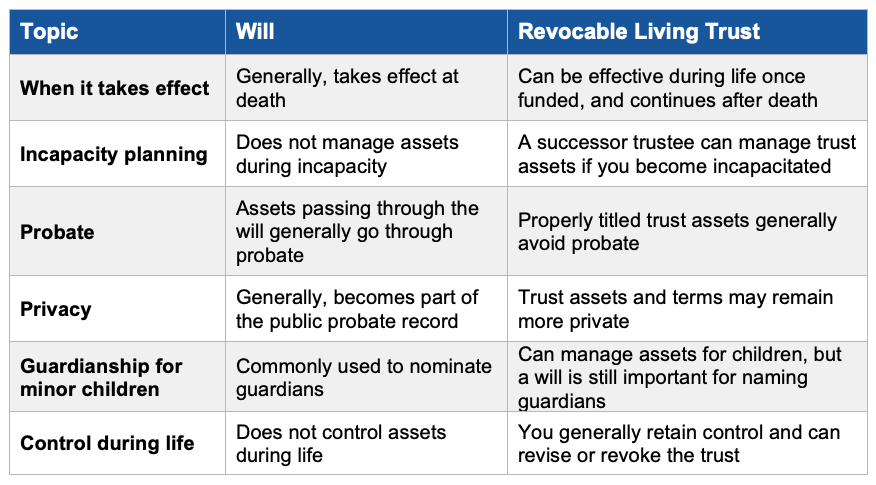
A will is still an important foundational document, even when a trust is used. It can address assets outside the trust, nominate guardians for minor children, and include a pour-over provision directing any remaining probate assets into the trust.
Does a revocable trust protect assets from creditors?
Generally, no. A revocable living trust does not typically protect your assets from your own creditors during your lifetime.
Because you retain control over the trust and can change or revoke it, the law generally treats the assets as still belonging to you. That means creditors may be able to reach assets held in a revocable trust to satisfy legitimate claims or debts.
A revocable trust also generally does not remove assets from your taxable estate or reduce estate taxes. Because you retain control, the assets are generally still considered part of your estate for estate tax purposes.
If asset protection or estate tax reduction is a primary goal, that may point toward a different type of trust, such as an irrevocable trust. Those structures generally involve giving up more control and should be considered in the context of your broader goals and tax situation.
What does it mean to “fund” a trust—and why does it matter?
Creating a trust document is only the first step. Typically, if you establish the trust document and have taxable accounts – i.e. joint investment account, checking or savings accounts – it may make sense to fund the trust to have it work as intended.
Funding a trust means transferring ownership of assets into the trust. Depending on the asset, that may involve:
Retitling real estate into the name of the trust.
Changing the registration on or retitling bank or investment accounts.
Assigning ownership of certain personal property or business interests.
Reviewing beneficiary designations on life insurance policies and retirement accounts.
This step matters because a trust can only manage or avoid probate for assets that are actually titled in it. Assets that remain in your individual name may still need to go through probate, even if you have a trust.
When should I consider setting up a revocable living trust?
A revocable living trust may make sense when you want more structure, privacy, and continuity than a will alone can provide.
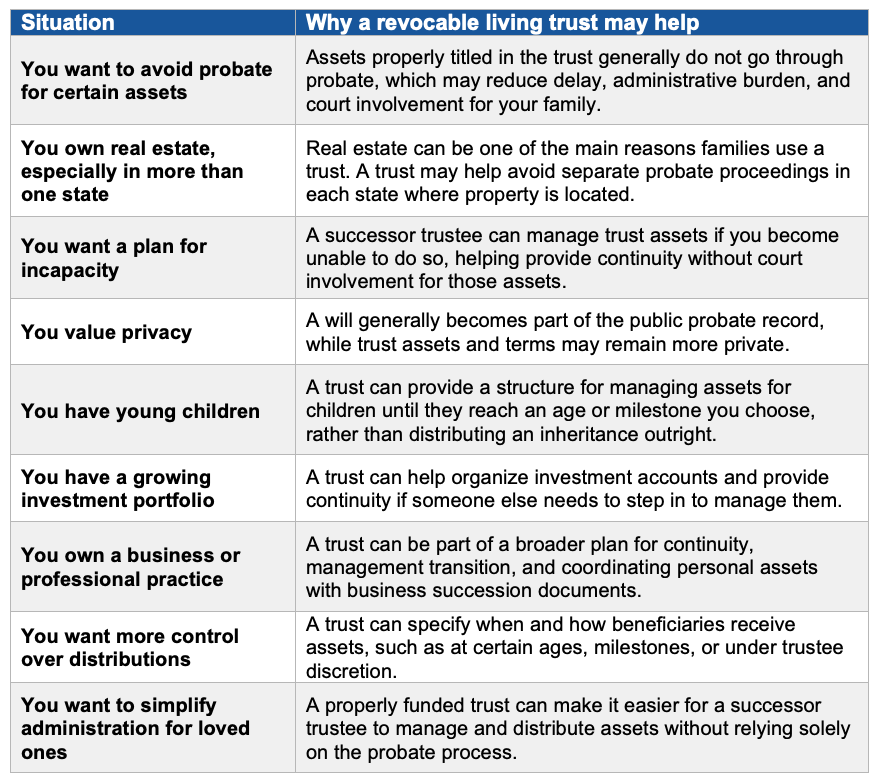
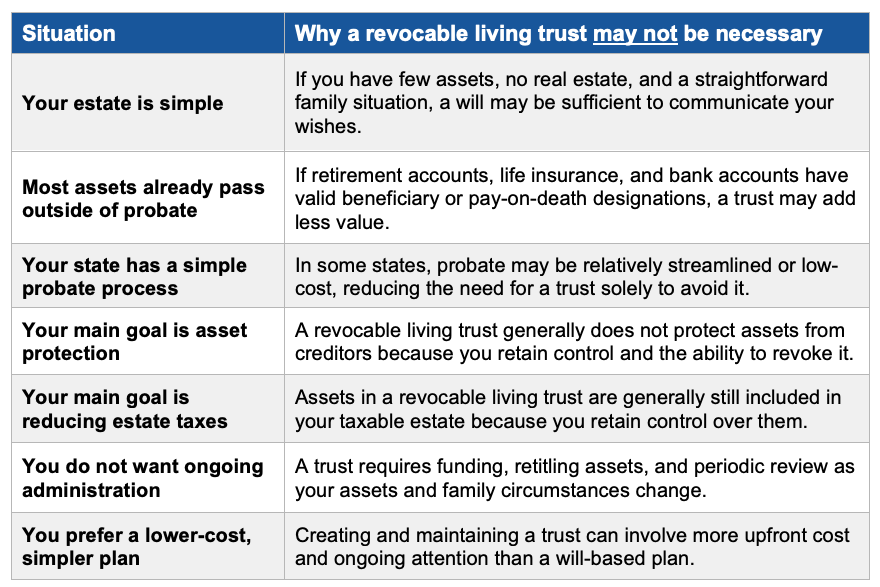
A revocable living trust is not necessary for everyone. In some situations, a will-based plan may be simpler, less expensive, and perfectly appropriate.
How does a trust affect the way my assets are invested and managed?
A trust does not automatically change your investment strategy, but it can change who has authority to manage assets and under what instructions.
During your lifetime, you can typically continue to manage trust investments as trustee. If you become incapacitated, your successor trustee can step in to manage investments, pay bills, and make financial decisions according to the trust document.
A trust can also provide structure around investment assets by identifying:
Who manages the assets.
How income and distributions are handled.
At what age beneficiaries receive part or all of the assets.
What happens if the person who created the trust becomes unable to manage their own affairs.
This can be especially useful for families with real estate, investment accounts, or business interests. A revocable trust may help consolidate ownership and simplify administration, while coordination with LLCs or other entities may be appropriate for certain investment properties.
For business owners, estate planning should align personal documents with business documents. Trusts, buy-sell agreements, operating agreements, and life insurance can all play a role in supporting continuity, ownership transition, and family liquidity.
Why timing matters
Timing matters because a trust only works as intended when it is created, funded, and kept up to date.
It may be especially important to revisit trust planning when:
You buy or sell real estate.
You experience a significant increase in assets or income.
You get married, divorced, or remarried.
You have or adopt a child.
You start, sell, or transition a business.
You move to another state.
Your health or family circumstances change.
A trust created but never funded may not provide the benefits you expect. Likewise, a trust that is not updated after a major life event may no longer reflect your wishes or current asset structure.
Bringing Your Financial Plan Together
A revocable living trust can be a powerful tool for families who want more control, privacy, and continuity in their estate plan. It is especially worth considering when real estate, investments, children, or incapacity planning are part of the picture.
Ultimately, estate planning is about more than deciding how your assets will be distributed. It is about making sure your financial plan reflects your wishes, supports the people who matter most, and provides greater confidence for the future.
At SJS, we believe thoughtful financial planning means looking at the bigger picture and understanding how your investments, estate plan, tax considerations, and family goals work together. By taking a coordinated approach to wealth management, we strive to help clients navigate important decisions with clarity and confidence, so they can focus on what matters most.
Important Disclosure Information:
There is no guarantee investment strategies will be successful. Past performance is no guarantee of future results. Diversification neither assures a profit nor guarantees against a loss in a declining market.
Advisory services are provided by SJS Investment Services, a registered investment advisor (RIA) with the SEC. Registration does not imply a certain level of skill or training. SJS Investment Services does not provide legal or tax advice. Please consult your legal or tax professionals for specific advice.
Statements contained in this article that are not statements of historical fact are intended to be and are forward looking statements. Forward looking statements include expressed expectations of future events and the assumptions on which the expressed expectations are based. All forward looking statements are inherently uncertain as they are based on various expectations and assumptions concerning future events and they are subject to numerous known and unknown risks and uncertainties which could cause actual events or results to differ materially from those projected.